Test a half-point lower interest assumption
Annual interest rate (%): 8.5% → 8%
Indicative eligible loan₹46,09,234₹47,82,172
LOANS · FREE TOOL
Estimate an affordable loan from income, EMIs, rate, and tenure. Adjust the assumptions and see how the result changes.
Interactive tool
Change the inputs to compare scenarios. Your values stay in this browser.
Lender eligibility depends on underwriting, credit history, property, income policy and other obligations.
QUICK TAKEAWAY
This is a result from the assumptions currently entered. Compare a few alternatives below before drawing conclusions.
BASED ON YOUR INPUTS
With these inputs, indicative eligible loan is ₹46,09,234.
For context, illustrative emi capacity is ₹40,000.
Test a half-point lower interest assumption changes indicative eligible loan from ₹46,09,234 to ₹47,82,172 in this model.
Model note: Lender eligibility depends on underwriting, credit history, property, income policy and other obligations.
TRY A DIFFERENT ASSUMPTION
Each card recalculates from the inputs above.
Annual interest rate (%): 8.5% → 8%
Loan tenure (years): 20 → 25
A MINI CHALLENGE
Test a value here first. Your calculator changes only if you apply it.
Keep experimenting to test ₹1 crore.
Calculations run locally. Browser activity remembers calculator visits and quiz scores only—not financial inputs or results. Share links include values only when you choose to share them.
PaisaCalc guide · India

This home loan eligibility calculator gives an indicative principal amount that could fit the repayment capacity entered. Enter monthly net income in ₹, existing monthly EMIs in ₹, an illustrative income share for all EMIs (FOIR) as a percentage, annual interest rate, and tenure in years. The result is a possible new home-loan EMI and the principal that EMI could support.
It is a planning model, not a bank sanction, in-principle approval, or promise of eligibility. A lender may define income differently, use another obligation ratio, check bureau history and employment, assess the property, and apply its own policy. Processing charges, down payment, stamp duty, registration, insurance and maintenance are outside this principal estimate.
Property prices and household budgets often move on different timelines. A quick estimate helps a salaried or self-employed buyer set a property-search range before paying a token amount or arranging a down payment. It makes existing personal, vehicle, education or credit-card EMIs visible instead of treating the proposed home loan in isolation.
The number is most useful when treated as a ceiling for a conversation, not as a target to maximise. Compare the indicative EMI with essential costs, insurance, investing and an emergency reserve. A lender can still offer less because a mathematical capacity does not replace underwriting or property due diligence.
First, the model multiplies monthly net income by the selected FOIR-style share. If income is ₹1,00,000 and the entered share is 50%, the total EMI capacity is ₹50,000. It then subtracts existing EMIs; with ₹10,000 already committed, the illustrative new home-loan EMI is ₹40,000. If existing EMIs exceed this capacity, usable new EMI is zero rather than a negative loan amount.
Next, the model converts that possible EMI into a principal using the annual rate divided by 12 and the total number of monthly payments (years × 12). The calculation assumes a regular fully amortising repayment, a constant entered rate for the illustration, and payments at monthly intervals. Floating-rate loans can change EMI or tenure when the lender resets the rate.
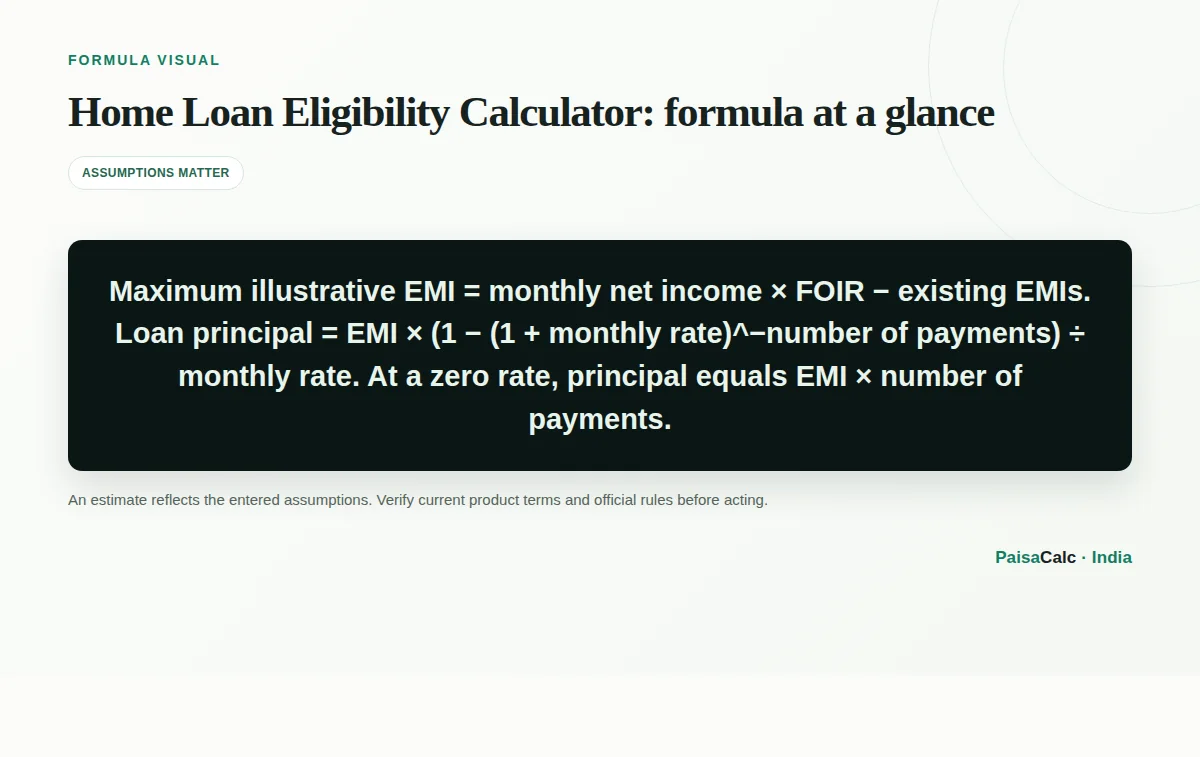
Maximum illustrative EMI = monthly net income × (FOIR ÷ 100) − existing monthly EMIs. Loan principal = EMI × [1 − (1 + r)^−n] ÷ r, where r is the monthly rate (annual rate ÷ 12 ÷ 100) and n is the number of monthly payments. Use rupees, percentage points and years consistently when comparing outputs.
At a zero interest rate, the annuity division is not used: principal = EMI × n. For a positive rate, the formula discounts each future monthly payment to today. It excludes fees, tax relief, prepayments, missed payments, step-up instalments, rate changes and lender-specific rounding. FOIR here is an editable assumption, not a universal Indian regulatory threshold.
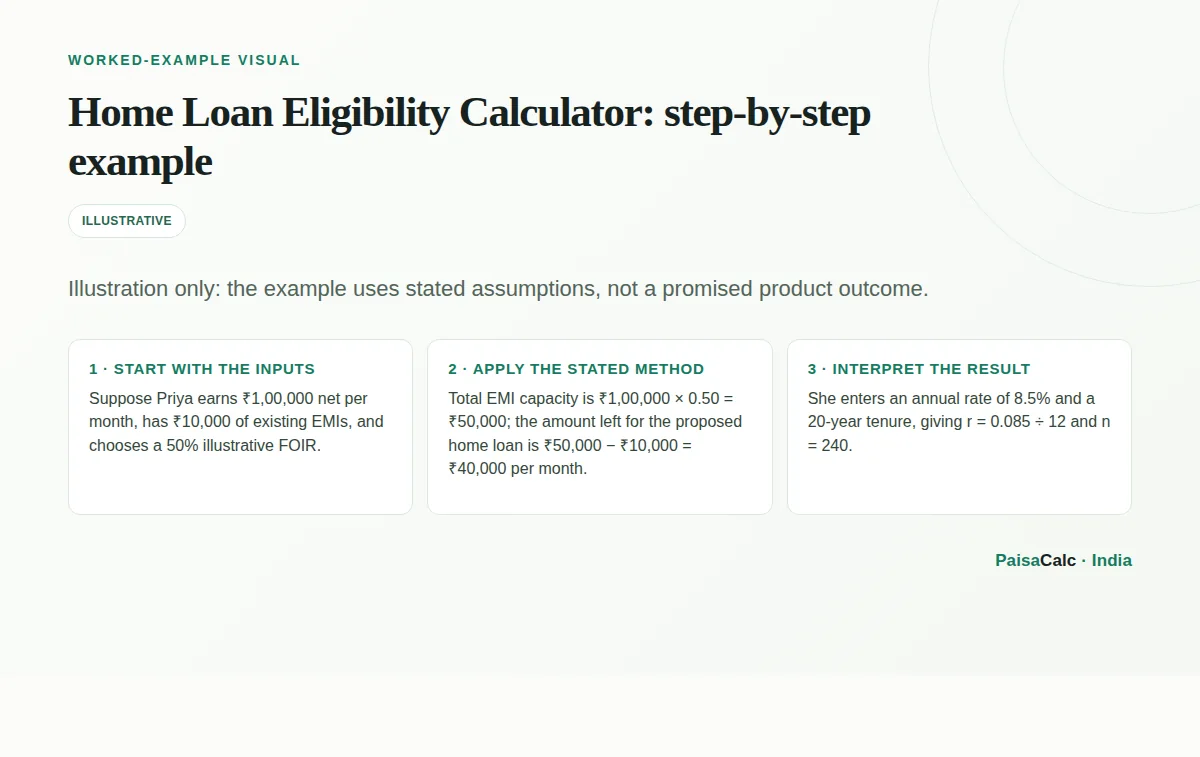
Suppose Priya earns ₹1,00,000 net per month, has ₹10,000 of existing EMIs, and chooses a 50% illustrative FOIR. Total EMI capacity is ₹1,00,000 × 0.50 = ₹50,000; the amount left for the proposed home loan is ₹50,000 − ₹10,000 = ₹40,000 per month. She enters an annual rate of 8.5% and a 20-year tenure, giving r = 0.085 ÷ 12 and n = 240.
The calculator applies the annuity formula to the ₹40,000 payment and returns an estimated principal under those assumptions (approximately ₹46.1 lakh, subject to rounding). Priya should not treat ₹42.3 lakh as approved: she needs funds for down payment and transaction costs, and a lender may reduce the amount after its checks. Testing a lower FOIR or higher rate gives a cautious range.
A first-time buyer in Bengaluru, Pune or Kochi can compare a compact flat with a larger property without confusing asking price with affordable debt. A borrower moving from rented accommodation can add likely rent overlap and maintenance to the household budget before relying on the calculated EMI. It can support a co-applicant discussion, but combined income and obligations are assessed under the lender’s rules.
Existing debt is another practical test. A ₹25,000 car-loan EMI may materially reduce capacity even if salary is unchanged. Paying down a high-cost balance can improve the budget, but should not drain the emergency reserve. For a self-employed applicant, use a defensible monthly net-income figure after regular business commitments and ask the lender which documents and income period it accepts.
The calculator is fast, transparent and adjustable. Change one input at a time to see how income, debt, EMI share, rate or tenure affects the theoretical principal. This shows which financial decision has the largest effect on affordability.
It also creates a common starting point for lender conversations. Take the assumptions to a formal enquiry and request the lender’s full repayment schedule and cost disclosure. A longer tenure can increase the principal supported by a fixed EMI, but usually extends interest payments; the benefit is therefore cash-flow flexibility, not free borrowing.
Do not enter gross annual CTC for monthly net income, or omit a spouse’s or co-borrower’s EMI from the household budget. Do not copy a promotional rate without checking its type, reset terms and conditions. A zero existing-EMI input is appropriate only when there are genuinely no relevant monthly commitments.
Another mistake is treating the full calculated principal as the property budget. Keep a separate allowance for down payment, stamp duty, registration, legal or technical checks, processing costs, insurance, brokerage, interiors and ongoing maintenance. Avoid choosing a 30- or 40-year tenure solely to maximise eligibility: age at maturity, retirement income and interest may make it unsuitable.
Build the housing budget from take-home cash flow, not only the calculator result. Reserve an emergency fund, account for insurance, and include a buffer for rate increases or income interruption. Keep the proposed EMI comfortable after savings goals; a lender’s maximum is not the same as a prudent personal limit.
Ask each lender for a written schedule that separates principal, interest, fees and any insurance or bundled service. Compare like-for-like rate type, reset terms, tenure and part-prepayment rules rather than comparing only the first EMI. Before signing, verify title and approvals through qualified professionals and understand non-refundable payments. This tool estimates borrowing capacity; it cannot replace legal, tax or regulated financial advice.
Use scenario bands: lower income, higher obligations, a higher rate and shorter tenure form a conservative case; a lower assumed EMI share can form a comfort case. The difference between scenarios is a useful stress test for a floating-rate loan. A small rate change can matter over 240 or 360 payments.
Separate repayment capacity, lender/property limits and cash needed upfront. The calculator addresses only the first, and even that through an editable assumption. A property may be valued below its negotiated price, while a strong-salary applicant may lack a sufficient down payment. Recalculate after clearing an EMI or changing the planned tenure, then seek an in-principle assessment and treat its conditions and validity period as decisive.
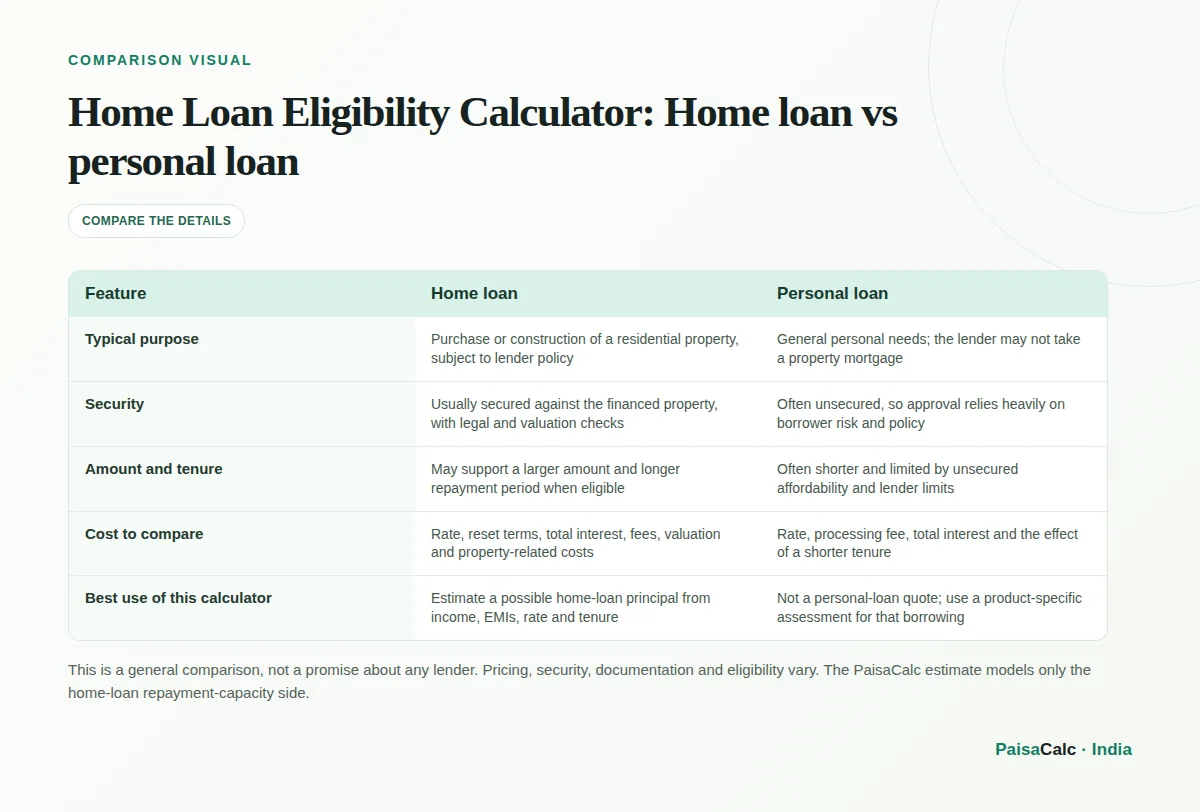
| Feature | Home loan | Personal loan |
|---|---|---|
| Typical purpose | Purchase or construction of a residential property, subject to lender policy | General personal needs; the lender may not take a property mortgage |
| Security | Usually secured against the financed property, with legal and valuation checks | Often unsecured, so approval relies heavily on borrower risk and policy |
| Amount and tenure | May support a larger amount and longer repayment period when eligible | Often shorter and limited by unsecured affordability and lender limits |
| Cost to compare | Rate, reset terms, total interest, fees, valuation and property-related costs | Rate, processing fee, total interest and the effect of a shorter tenure |
| Best use of this calculator | Estimate a possible home-loan principal from income, EMIs, rate and tenure | Not a personal-loan quote; use a product-specific assessment for that borrowing |
This is a general comparison, not a promise about any lender. Pricing, security, documentation and eligibility vary. The PaisaCalc estimate models only the home-loan repayment-capacity side.
No. It estimates a mathematical amount from your inputs. Approval can differ after the lender checks income documents, credit history, age, existing obligations, the property and its own policy.
FOIR is an obligation-to-income assumption used to reserve part of monthly income for EMIs. The acceptable share varies by lender, borrower profile and loan product; this calculator lets you model a share rather than stating a universal rule.
Existing EMIs already consume monthly repayment capacity. The model subtracts the entered amount from income multiplied by the selected FOIR share before estimating a new home-loan EMI.
Enter monthly net income in rupees, using a consistent, supportable figure. Do not substitute annual CTC or gross salary; confirm the lender’s accepted income definition, especially for variable pay or self-employment.
A longer tenure generally lowers the EMI needed for a given principal and can raise the principal supported by a fixed EMI. It also usually increases total interest and may conflict with age-at-maturity or retirement plans.
No. The result estimates principal capacity only. Budget separately for the down payment, stamp duty, registration, processing and legal costs, insurance, interiors and maintenance.
The model treats the usable new EMI as zero, so it does not produce a negative loan. Review the obligations, income figure and FOIR assumption; do not borrow merely to force a positive result.
No. It is a repayment-capacity calculation and does not assume a tax regime, deduction, property use or eligibility. Get current tax guidance for your circumstances rather than reducing the EMI on an assumed benefit.
A lender can apply its own FOIR, income exclusions, credit assessment, valuation, loan-to-value and age rules. Fees and other obligations can also change the final offer.
Run a conservative scenario, check EMI against essential spending and savings, and compare the full cost schedule. Then request a formal in-principle assessment; do not pay a non-refundable property deposit based only on this estimate.
Use primary and provider references to verify current rules, rates, and product terms.
Supports the recommendation to request a written disclosure of key loan terms and costs rather than relying on a headline EMI.
Supports the generic explanation that lenders assess repayment capacity and may use their own income/obligation assumptions; the calculator does not present a universal FOIR rule.
Supports the warning to scrutinise property valuation and documentation and not treat a calculation as a substitute for property due diligence.
TAKE A 30-SECOND BREAK
Three questions to help the key ideas stick.