Raise monthly saving by 25%
Monthly contribution (₹): ₹10,000 → ₹12,500
Emergency-fund target₹3,00,000₹3,00,000
PLANNING · FREE TOOL
Set a liquid savings target based on monthly essential expenses. Adjust the assumptions and see how the result changes.
Interactive tool
Change the inputs to compare scenarios. Your values stay in this browser.
QUICK TAKEAWAY
This is a result from the assumptions currently entered. Compare a few alternatives below before drawing conclusions.
BASED ON YOUR INPUTS
With these inputs, emergency-fund target is ₹3,00,000.
Remaining gap shows a modeled surplus of ₹2,50,000.
Raise monthly saving by 25% changes emergency-fund target from ₹3,00,000 to ₹3,00,000 in this model.
TRY A DIFFERENT ASSUMPTION
Each card recalculates from the inputs above.
Monthly contribution (₹): ₹10,000 → ₹12,500
Coverage months: 6 → 9
A MINI CHALLENGE
Test a value here first. Your calculator changes only if you apply it.
Keep experimenting to test 12 months or fewer.
Calculations run locally. Browser activity remembers calculator visits and quiz scores only—not financial inputs or results. Share links include values only when you choose to share them.
PaisaCalc guide · India

The Emergency Fund Calculator estimates how much accessible money you may want when income stops or an unexpected bill arrives. Enter essential monthly expenses, coverage months, current emergency savings and the amount you can add each month. The tool is a planning estimate, not a recommendation for a bank account, deposit, mutual fund or risk level.
Its outputs separate the target, reserve, remaining gap, months currently funded and approximate time to close that gap. Use essential costs rather than take-home pay: rent or home-loan EMI, food, utilities, transport, insurance, medicines, school needs and other unavoidable commitments may belong in the estimate. Keep optional spending outside the core number unless it is genuinely necessary.
A cash reserve can give an Indian household breathing room after a job loss, delayed freelance payment, hospital expense, urgent repair or family responsibility. Without accessible savings, a disruption may force a credit-card balance, personal loan, premature investment sale or missed EMI. The right target is personal: dual-income employees may test differently from a single-income family, business owner or irregular worker.
No universal rule makes three, six or twelve months correct for everyone. Dependants, health cover, notice period, location, debt, family support and likely job-search time matter. This calculator makes assumptions visible so you can compare scenarios instead of treating one number as a promise of security.
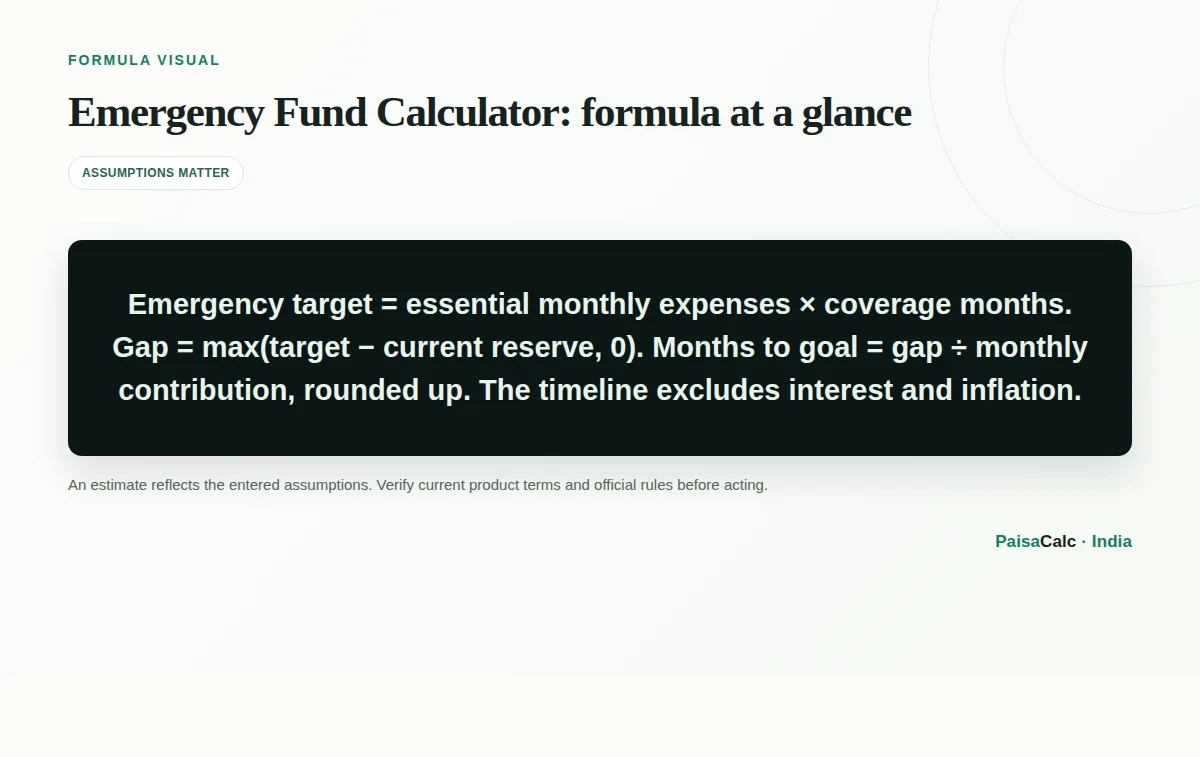
First, the calculator multiplies essential monthly expenses by coverage months, then subtracts current emergency savings. If the result is negative, the gap is zero because the reserve meets or exceeds the target. Funded months is a comparison of current savings with one month of essentials; it does not predict a crisis or income recovery.
For a positive gap, the timeline divides it by the planned monthly contribution and rounds up. A ₹2,50,000 gap with a ₹10,000 contribution is about 25 months. If contribution is zero, no completion date can be estimated. The calculation assumes regular contributions, no withdrawals, interest or interruption; actual interest, inflation and changing expenses can differ.
Emergency target = essential monthly expenses × coverage months. Gap = max(emergency target − current reserve, 0). Months to goal = ceiling(gap ÷ monthly contribution) when the gap is positive and contribution is greater than zero. Money inputs are Indian rupees; coverage is 1 to 36 months in the brief.
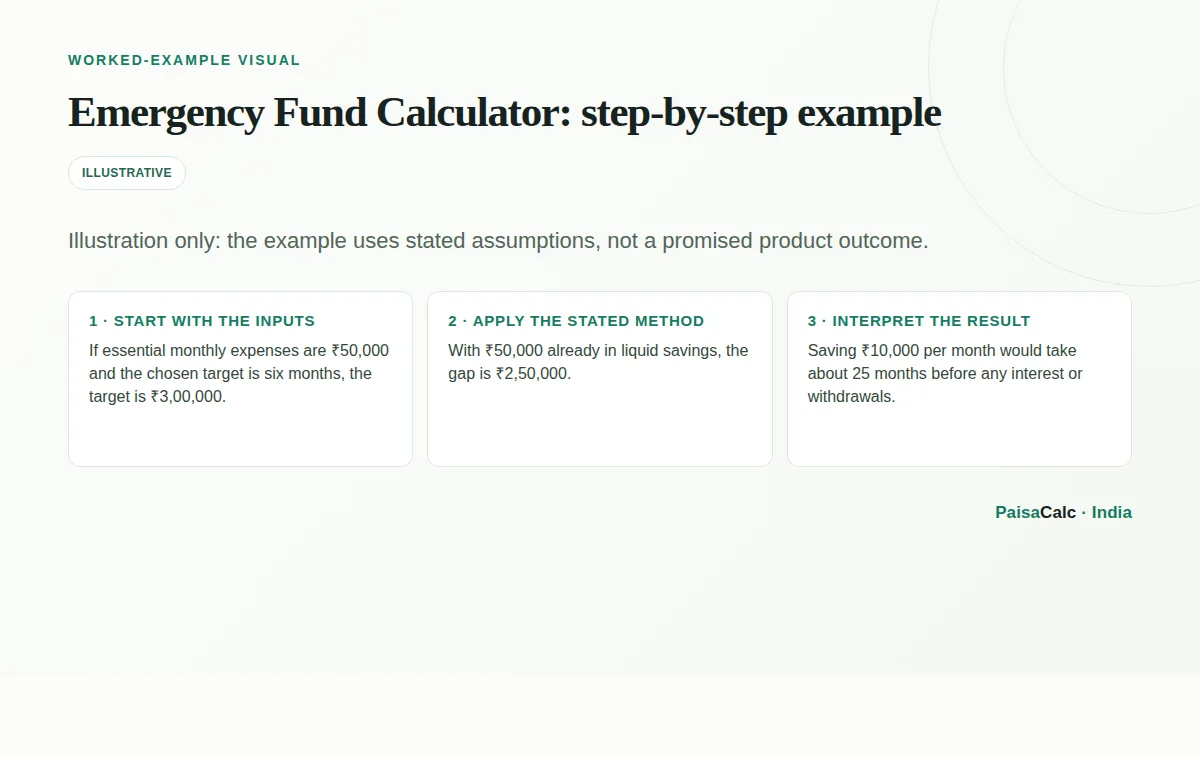
With essential expenses of ₹50,000, six months, current savings of ₹50,000 and monthly saving of ₹10,000, the target is ₹3,00,000, gap ₹2,50,000 and timeline 25 months. The formula excludes interest and inflation, so it is easy to audit. If prices or expenses rise, update the inputs rather than assuming the old target still buys the same coverage.
Imagine Neha lives in Pune, has essential monthly costs of ₹50,000 and tests six months of cover. Her essentials include rent, groceries, utilities, an EMI, health premiums and commuting, but not restaurant spending or a holiday. She enters ₹50,000 and 6, producing a target of ₹3,00,000.
Neha has ₹50,000 in separate savings, so the gap is ₹2,50,000. At ₹10,000 per month, she needs 25 contributions under the no-interest assumption. She can rerun three months, twelve months or another contribution, and check that the balance is genuinely accessible before counting it.
A salaried employee can compare six months with the notice period and likely job-search time. A consultant, shop owner, gig worker or commission-based salesperson may test nine or twelve months because income is less predictable. A household supporting parents, children or a dependent may include recurring care costs and consider a separate medical buffer.
The tool helps after a move, marriage, new loan, resignation, health event or shift to one income. A couple can run a household scenario and then a single-income stress scenario. Someone rebuilding after using savings can enter the remaining balance and choose an affordable contribution rather than an aspirational one.
The main benefit is a target tied to household essentials rather than an arbitrary rupee amount. A clear gap can become a monthly transfer, while comparing months shows why trimming an expense or adding a contribution changes the timeline. The model is transparent enough for a beginner to check.
It supports conversations about essential costs, account access and review dates. Keeping the reserve distinct from long-term investments can reduce the temptation to sell a volatile asset during a fall. These are planning benefits, not performance claims: the tool cannot ensure cash for every shock.
A common error is using gross salary or lifestyle spending instead of the minimum monthly cost needed to operate. The opposite is excluding unavoidable EMIs, insurance, medicines, school transport or dependant support. Review bank statements and separate recurring necessities from discretionary spending before entering one figure.
Do not count shares, equity funds or property as cash at a guaranteed value. Volatility, sale time and access matter urgently. A high-interest product is not automatically suitable; check liquidity, safety, access, deposit-insurance position, tax on interest and withdrawal conditions. Update the target after inflation, a new dependant, job change or major loan.
Start with a contribution that can continue through an ordinary month, then automate it after income arrives if possible. Build in stages: one month, three months, then a larger target if justified. If you have expensive revolving debt, weigh repayment against retaining accessible cash; emptying the reserve can expose you to the next bill.
Hold the reserve separately from spending money and label it clearly. Check access on weekends, transfer limits and nominee or joint-account arrangements. Indian bank-deposit protection has conditions and limits, so read current DICGC information rather than assuming every balance is insured. Review after a salary change, new dependent, move, health event or income change.
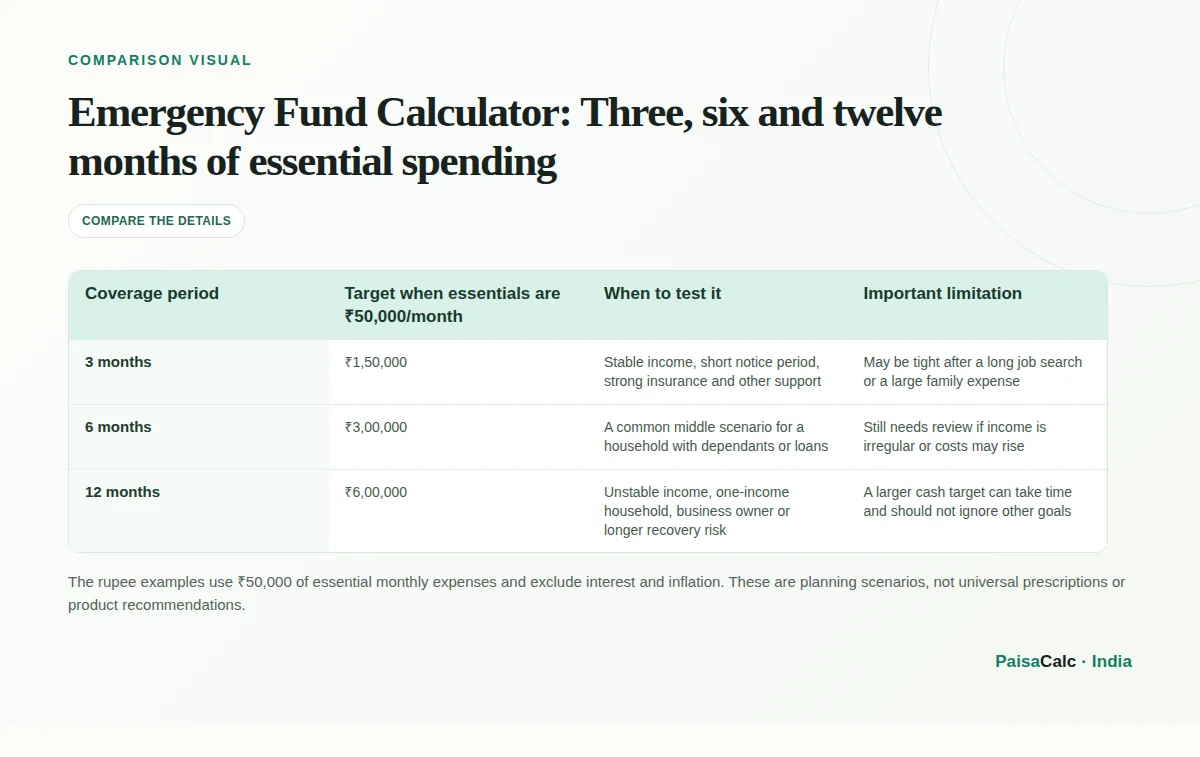
Run a sensitivity table rather than one forecast. With ₹50,000 of essentials, three months is ₹1,50,000, six is ₹3,00,000 and twelve is ₹6,00,000 before inflation or interest. Compare those scenarios with job stability, insurance waiting periods and recovery time. If saving takes too long, test a temporary expense cut, annual bonus or staged target without treating irregular income as guaranteed.
The calculator is nominal and static: it does not inflate expenses, model interest, deduct tax, simulate withdrawals or choose a cash product. Maintain low- and high-case expenses, identify medical or repair risks, and check insurance coverage. When savings exceed the target, the gap is zero; the surplus is not automatically suitable for investing, debt repayment or spending.
| Coverage period | Target when essentials are ₹50,000/month | When to test it | Important limitation |
|---|---|---|---|
| 3 months | ₹1,50,000 | Stable income, short notice period, strong insurance and other support | May be tight after a long job search or a large family expense |
| 6 months | ₹3,00,000 | A common middle scenario for a household with dependants or loans | Still needs review if income is irregular or costs may rise |
| 12 months | ₹6,00,000 | Unstable income, one-income household, business owner or longer recovery risk | A larger cash target can take time and should not ignore other goals |
The rupee examples use ₹50,000 of essential monthly expenses and exclude interest and inflation. These are planning scenarios, not universal prescriptions or product recommendations.
It depends on income stability, dependants, essential costs, insurance, notice period and family support. Test three, six and twelve months, then choose a target that fits your household rather than relying on one universal rule.
Include unavoidable costs such as rent or home-loan EMI, food, utilities, transport, medicines, insurance premiums, school needs and essential debt payments. Exclude optional lifestyle spending unless it is necessary for the household to function.
Usually include unavoidable EMIs and other commitments that must continue during an income disruption. Check the loan agreement and your own household priorities; the calculator does not decide which debt should be refinanced or repaid.
No. The target is expenses multiplied by months, and the timeline assumes no interest, inflation, withdrawals or missed contributions. Update expenses and savings as circumstances change.
The core reserve generally prioritises access and stability over uncertain returns. Shares and other volatile assets can fall when cash is needed, so do not count them at a guaranteed value in this estimate.
The calculator shows a zero gap because the stated reserve meets the selected target. Review whether the money is genuinely accessible and whether your chosen months still fit your income, dependants and future expense changes.
The target and gap can still be calculated, but there is no finite savings timeline for a positive gap. Enter a contribution you can realistically maintain or use the gap to set a staged plan.
Choose an accessible, stable arrangement that matches your need for quick withdrawals and your own risk tolerance. Check access, charges, tax treatment, nominee details and current deposit-insurance information before choosing a product; this calculator does not recommend one.
Review it after a job change, new dependent, marriage, move, major loan, health event or material change in essential costs. A periodic budget review can also reveal that the old target no longer reflects current prices.
No. Cash savings and insurance address different risks. A reserve can help with deductibles, exclusions, delays or costs not covered by a policy, while policy terms and coverage limits should be checked separately.
Use primary and provider references to verify current rules, rates, and product terms.
The page supports the general planning guidance to allocate money for an emergency fund covering unexpected expenses or financial setbacks, while treating this calculator as an estimate rather than a promise.
The guidance to check current deposit-insurance limits and conditions before counting bank deposits as fully protected. The guide states that eligible deposits are insured for principal and interest up to the applicable maximum amount.
The caution that deposit insurance has a maximum limit and applies subject to the applicable rules, so users should not assume that every emergency-fund rupee in every account is insured without checking the official terms.
TAKE A 30-SECOND BREAK
Three questions to help the key ideas stick.