Raise monthly retirement saving by 20%
Monthly retirement saving (₹): ₹15,000 → ₹18,000
Target retirement corpus₹6,87,95,485₹6,87,95,485
RETIREMENT · FREE TOOL
Estimate a retirement corpus from future expenses and savings. Adjust the assumptions and see how the result changes.
Interactive tool
Change the inputs to compare scenarios. Your values stay in this browser.
Simplified drawdown model; taxes, pensions, health shocks and irregular expenses are not included.
QUICK TAKEAWAY
This is a result from the assumptions currently entered. Compare a few alternatives below before drawing conclusions.
BASED ON YOUR INPUTS
With these inputs, target retirement corpus is ₹6,87,95,485.
Estimated surplus / gap shows a modeled shortfall of ₹4,72,74,449.
Raise monthly retirement saving by 20% changes target retirement corpus from ₹6,87,95,485 to ₹6,87,95,485 in this model.
Model note: Simplified drawdown model; taxes, pensions, health shocks and irregular expenses are not included.
TRY A DIFFERENT ASSUMPTION
Each card recalculates from the inputs above.
Monthly retirement saving (₹): ₹15,000 → ₹18,000
Current age: ₹35 → ₹30
A MINI CHALLENGE
Test a value here first. Your calculator changes only if you apply it.
Keep experimenting to test a zero or positive savings gap.
Calculations run locally. Browser activity remembers calculator visits and quiz scores only—not financial inputs or results. Share links include values only when you choose to share them.
PaisaCalc guide · India

The Retirement Calculator is a first-pass estimate of what a household may need when paid work stops. It uses age, retirement age, current monthly expenses, expense inflation, assumed returns, a plan-through age, existing retirement savings, and monthly saving. It shows estimated spending at retirement, a target corpus, projected savings, and a surplus or shortfall.
The result is an estimate, not a promise or personal investment recommendation. It does not read EPF or NPS statements, forecast an individual pension, apply product withdrawal rules, or know your taxes. Enter rupees consistently and count each EPF, NPS, fund, or bank balance only once.
A ₹60,000 lifestyle today will not cost ₹60,000 after 25 years if prices rise. Food, rent, transport, medicines, and home help can all change while salary income stops on a particular date. Inflating present spending makes that transition visible instead of relying on a vague round-number corpus.
Indian households may combine EPF, NPS, investments, pension, rent, business income, or family support. These sources differ in certainty and timing. A gap is a prompt to save more, retire later, reduce flexible spending, add reliable income, or seek a professional review.
First, the model finds the saving period as retirement age minus current age and inflates current monthly expenses across it. It then estimates the corpus needed for level monthly withdrawals from retirement age through the selected plan-through age using the post-retirement return. The withdrawal horizon is a planning assumption, not a lifespan prediction.
Current savings compound at the pre-retirement return, while monthly retirement saving is projected as regular contributions over the same period. The result compares projected savings with the target. Returns are smooth assumptions; actual returns, fees, taxes, pauses, and inflation can differ.
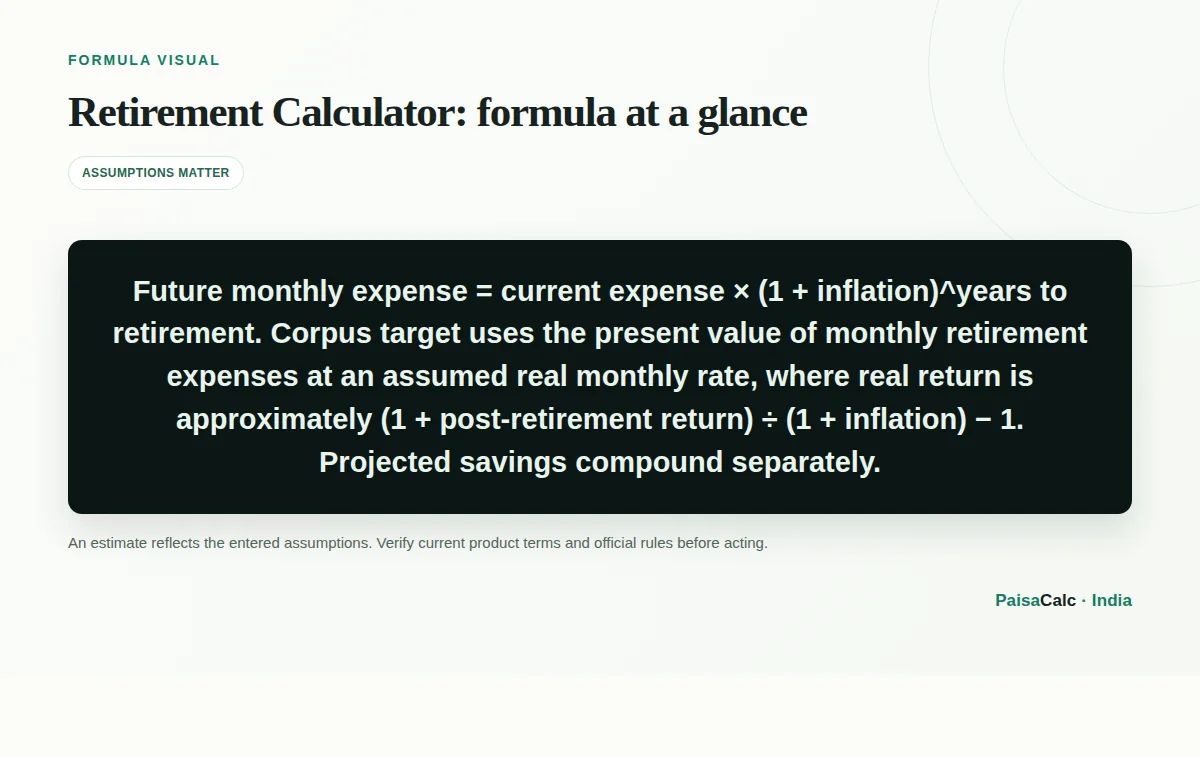
Let n be years to retirement, m current monthly expense, and i annual inflation as a decimal. Future monthly expense is m × (1 + i)^n. Thus 6% inflation multiplies the amount by 1.06 each year rather than adding six percentage points once. A long horizon can substantially raise the nominal amount needed for the same lifestyle.
The target uses a level monthly withdrawal stream over the months from retirement age to plan-through age. It uses approximate real annual return (1 + post-retirement return) ÷ (1 + inflation) − 1, converts it consistently to a monthly rate, and applies present value. Projected savings combine future value of current savings and monthly contributions at the pre-retirement return. Near-zero returns are handled as cash-flow sums.
This is not a tax or fee model. It assumes regular contributions, stable assumptions, and no unlisted pension income. Compare reliable net pension or rent separately with essential spending rather than treating it as investment growth.
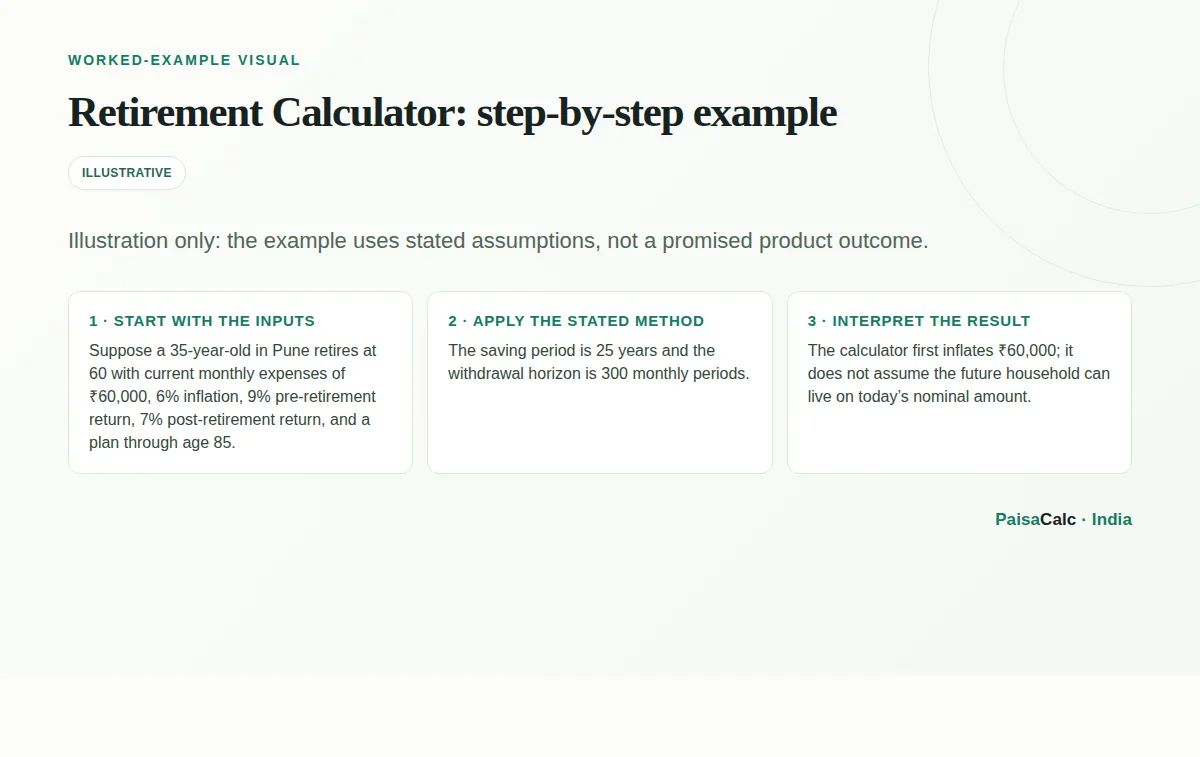
Suppose a 35-year-old in Pune retires at 60 with current monthly expenses of ₹60,000, 6% inflation, 9% pre-retirement return, 7% post-retirement return, and a plan through age 85. The saving period is 25 years and the withdrawal horizon is 300 monthly periods. The calculator first inflates ₹60,000; it does not assume the future household can live on today’s nominal amount.
If current retirement savings are ₹5,00,000 and monthly saving is ₹15,000, the model compounds both at the 9% assumption while the target uses future spending and the post-retirement assumption. The difference is an indicative gap, not an SIP quote. Test ₹20,000 saving, retirement at 62, and a lower return as separate scenarios.
The example excludes an unentered pension, taxes, fees, healthcare shocks, and a spouse’s longer horizon. Add those considerations in a broader plan and keep an emergency reserve outside the retirement corpus.
A salaried employee can use the estimate before an annual increment to decide how much should go toward retirement. Include an EPF balance once and add a contribution only when it is represented in the saving input. Check the EPF passbook or statement instead of guessing.
A self-employed person can enter a conservative monthly average and run a lower-contribution case. An NPS user can include the relevant balance and contributions, then check product rules separately. Couples should run a joint budget and survivor case: a plan through age 85 may be too short for one partner, and medical costs may not follow ordinary inflation.
The main benefit is visibility: one view links time, inflation, spending, current savings, and monthly saving. It turns “am I saving enough?” into adjustable assumptions and shows how a higher contribution, later retirement, or lower spending affects the result over many years.
Run a base, lower-return, and higher-inflation case. Keep a written record for annual review when income, health cover, family responsibilities, or location changes. A corpus is not automatically sustainable income, and pension or rent may reduce withdrawals while carrying its own reliability risk.
Do not use today’s expense unchanged, choose a high return to erase the gap, or read an assumption as guaranteed. Returns vary by year, and withdrawals during a weak market can hurt sustainability even when a long-run average looks attractive.
Avoid double-counting an EPF balance already in current savings, and do not count a home unless you have a realistic plan to release its value. A plan-through age is not a maximum lifespan: healthcare, care costs, taxes, fees, and a spouse’s needs may require a buffer.
Start with a clean household budget. Mark spending essential, flexible, one-off, or likely to disappear after work. Keep emergency-fund and health-insurance planning separate. Review nominee details, account access, and debt repayment so the corpus is not the only part of the plan.
Vary inflation, both return assumptions, retirement age, and lifespan one at a time. If there is a shortfall, consider gradual contribution increases, a later retirement, lower discretionary spending, or dependable income. Verify EPF, NPS, annuity, and rental information from current statements; product rules and tax treatment can change.
The largest drivers are usually saving horizon, inflation, retirement spending, and the difference between pre- and post-retirement returns. A one-percentage-point change compounded for 25 years can materially alter projected savings, but it does not make the outcome certain. Sensitivity cases are more useful than one precise corpus figure.
Sequence risk means two portfolios with the same average return can produce different outcomes if one falls early in withdrawals. For a stronger review, split essential and discretionary spending, model a longer survivor horizon, subtract only reliable net income, and add fees, taxes, health costs, and one-time goals outside this basic estimate.
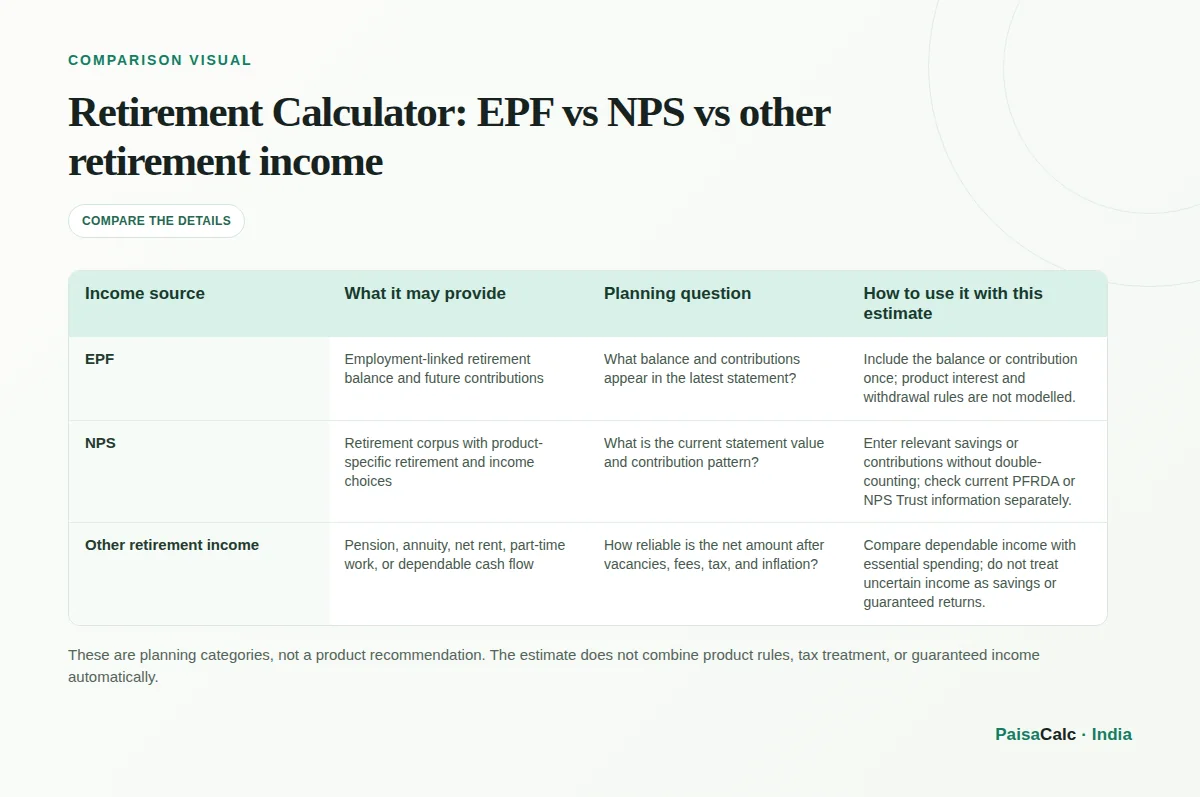
| Income source | What it may provide | Planning question | How to use it with this estimate |
|---|---|---|---|
| EPF | Employment-linked retirement balance and future contributions | What balance and contributions appear in the latest statement? | Include the balance or contribution once; product interest and withdrawal rules are not modelled. |
| NPS | Retirement corpus with product-specific retirement and income choices | What is the current statement value and contribution pattern? | Enter relevant savings or contributions without double-counting; check current PFRDA or NPS Trust information separately. |
| Other retirement income | Pension, annuity, net rent, part-time work, or dependable cash flow | How reliable is the net amount after vacancies, fees, tax, and inflation? | Compare dependable income with essential spending; do not treat uncertain income as savings or guaranteed returns. |
These are planning categories, not a product recommendation. The estimate does not combine product rules, tax treatment, or guaranteed income automatically.
There is no universal amount. It depends on future expenses, inflation, retirement length, returns, taxes, and reliable income. Use several scenarios rather than a universal rupee rule.
It can reflect balances and contributions you enter, but it does not import statements or model product-specific rules. Enter each balance once and verify it from the relevant statement.
Prices can rise for many years, so the same lifestyle may need a much higher nominal monthly amount later. Medical and care costs may need a separate assumption.
No. Returns are scenario assumptions. Market returns, fees, taxes, asset allocation, and the order of returns can change how long savings last.
Test higher contributions, later retirement, lower discretionary spending, and adverse-return cases. Use the result to review a full household plan, not as a recommendation.
Compare reliable net pension or rent separately with essential spending. Do not turn uncertain rent, vacancies, fees, or informal support into guaranteed savings.
It is the age through which monthly withdrawals are scheduled, not a lifespan prediction. Consider both partners, longevity, and care needs.
Only if you have a realistic plan to release its value. A home you occupy is not liquid corpus; model a future sale or downsizing separately.
Inflation and compounding run for many years. A modest change in spending, contribution, return, or retirement age can affect both future expenses and saving time.
Review annually and after a job change, marriage, dependent-care need, major loan, health event, or retirement-age change. Replace guesses with current statements.
Use primary and provider references to verify current rules, rates, and product terms.
Members should check actual EPF balances in the official member passbook; calculator projections do not replace account-specific EPFO records or scheme rules.
NPS is a distinct retirement-planning component and its product-specific retirement or income choices should be checked against current official information.
Investment outcomes are not guaranteed and investors should consider risk and suitability rather than treating an assumed return as certain.
TAKE A 30-SECOND BREAK
Three questions to help the key ideas stick.