Test a car loan 10% smaller
Loan principal (₹): ₹8,00,000 → ₹7,20,000
Estimated monthly EMI₹16,607₹14,946
LOANS · FREE TOOL
Estimate a monthly vehicle-loan EMI and total interest. Adjust the assumptions and see how the result changes.
Interactive tool
Change the inputs to compare scenarios. Your values stay in this browser.
QUICK TAKEAWAY
This is a result from the assumptions currently entered. Compare a few alternatives below before drawing conclusions.
BASED ON YOUR INPUTS
With these inputs, estimated monthly emi is ₹16,607.
For context, total repayment is ₹9,96,401.
Test a car loan 10% smaller changes estimated monthly emi from ₹16,607 to ₹14,946 in this model.
TRY A DIFFERENT ASSUMPTION
Each card recalculates from the inputs above.
Loan principal (₹): ₹8,00,000 → ₹7,20,000
Tenure (years): 5 → 4
A MINI CHALLENGE
Test a value here first. Your calculator changes only if you apply it.
Keep experimenting to test 10% less modeled interest than the current result.
Calculations run locally. Browser activity remembers calculator visits and quiz scores only—not financial inputs or results. Share links include values only when you choose to share them.
PaisaCalc guide · India

A car loan calculator estimates the fixed monthly equated monthly instalment (EMI) for a standard reducing-balance vehicle loan. Enter the principal in rupees, annual interest rate, and tenure in years. It returns estimated EMI, total scheduled repayment, total interest, and a balance trend. It is a planning estimate, not a sanction or lender quote. Use the amount actually borrowed, not the showroom price. If a car costs ₹10,00,000 and you pay ₹2,00,000 upfront, start with ₹8,00,000, subject to how the lender treats insurance, registration, accessories, and financed charges. The model excludes down payment, fees, insurance, taxes, balloon payments, and lender-specific rounding.
An EMI can look affordable while hiding a costly tenure. Comparing EMI with total repayment and interest shows that a longer term generally lowers the monthly amount but keeps principal outstanding for more months. Indian ownership costs also include fuel or charging, servicing, tyres, insurance, parking, tolls, and depreciation. Use the estimate to set a payment ceiling that leaves room for essential bills and an emergency reserve. A dealer’s rate is an input to verify, not a guarantee for every borrower or vehicle.
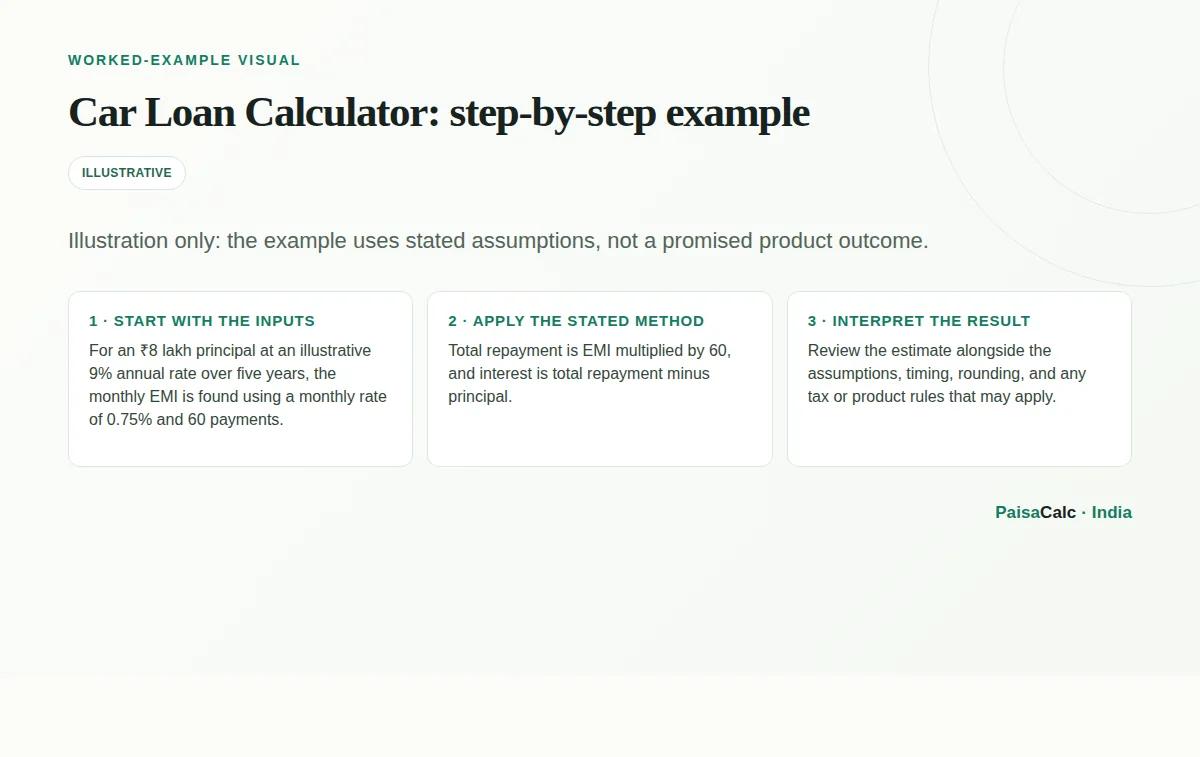
The calculator converts the annual percentage rate into a monthly decimal rate by dividing by 12 and 100, then converts years into monthly payments. At 9% for five years, the monthly rate is 0.75% and there are 60 payments. Each instalment combines interest on the opening balance with principal reduction; the interest share usually declines as the balance falls. Total scheduled repayment is EMI multiplied by the number of payments, and estimated interest is repayment minus principal. At zero interest, EMI is principal divided by payments. Actual figures can differ because of rounding, first-due dates, fees, or floating-rate changes.
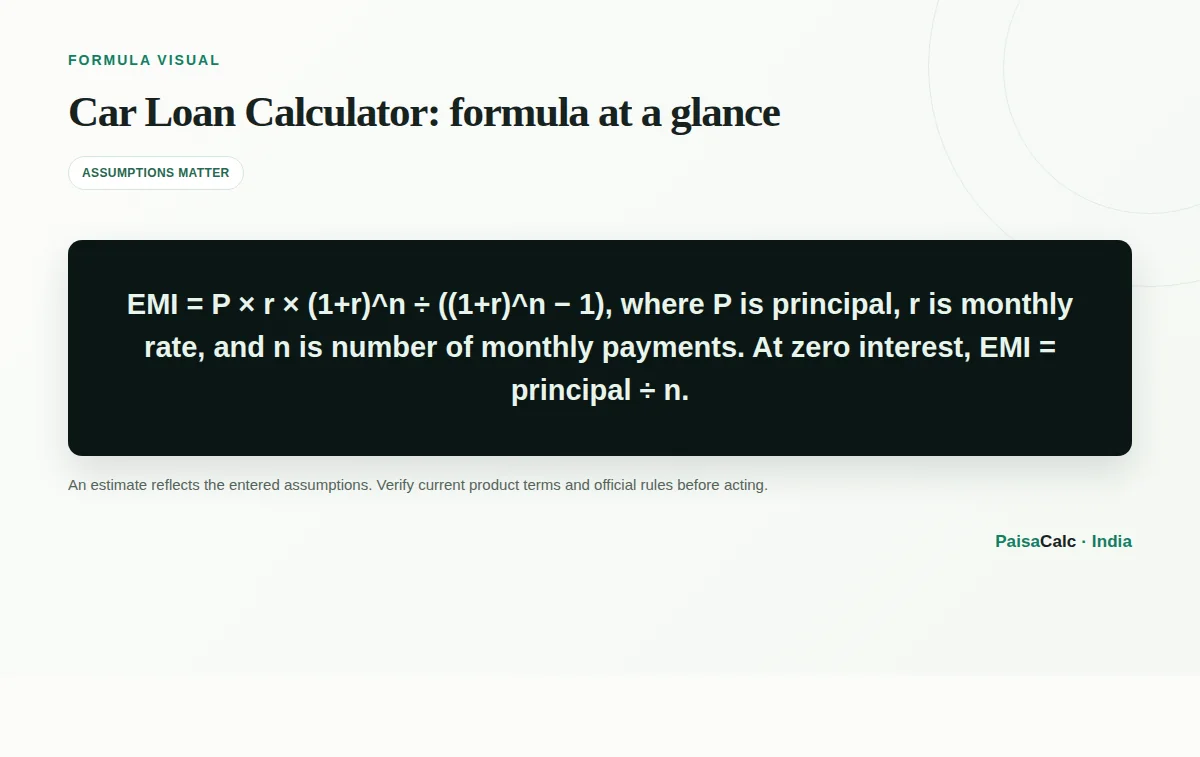
For a positive monthly rate: EMI = P × r × (1 + r)^n ÷ ((1 + r)^n − 1). P is principal in rupees, r is the monthly rate as a decimal, and n is the number of monthly payments. Thus 9% annually becomes r = 0.09 ÷ 12 = 0.0075; five years becomes n = 60. This is a reducing-balance formula, not a flat-rate quotation. The display uses EMI × n for repayment and EMI × n − P for interest, rounded for readability. Processing fees, insurance, GST on a fee, late charges, and other costs are not included unless financed in P.
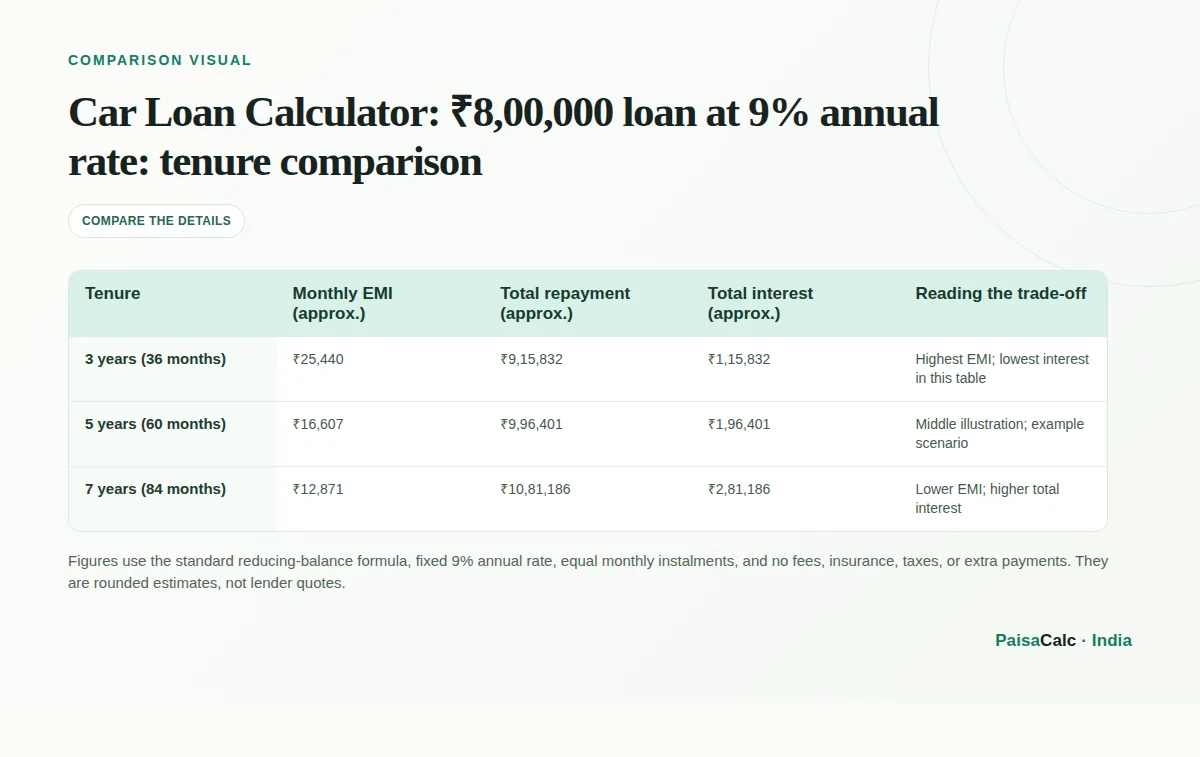
Suppose a ₹10,00,000 car has a planned ₹2,00,000 down payment, leaving estimated principal of ₹8,00,000. Enter ₹8,00,000, 9%, and five years. The monthly rate is 0.75% and the schedule has 60 payments. The result is an EMI of about ₹16,607, repayment of about ₹9,96,401, and interest of about ₹1,96,401. At the same principal and rate for seven years, EMI is about ₹12,871, but repayment is about ₹10,81,186 and interest ₹2,81,186. The lower EMI therefore adds roughly ₹84,785 interest. Verify exact rupees in the lender’s schedule.
A first-time buyer can test a new hatchback, sedan, or SUV after the planned down payment without confusing on-road price with financed amount. A family replacing a vehicle can model new borrowing separately from an old-loan closure or resale shortfall. A used-car buyer can use the formula, then test a different rate or shorter term because used-vehicle conditions may differ. Use like-for-like scenarios when comparing a bank, non-bank lender, or dealer offer. If the offer has a balloon payment, irregular instalments, floating rate, or bundled insurance, do not present this standard EMI as the contract schedule; request the complete repayment statement.
The calculator gives a consistent comparison: each scenario uses the same principal, rate convention, and monthly schedule. You can see how a bigger down payment lowers EMI and interest, or how a shorter tenure raises EMI while reducing interest-bearing months. The balance trend also explains why early instalments may reduce principal slowly. Run a few plausible rates and tenures, such as 8%, 9%, and 10% or four, five, and seven years. Use the results with your budget and existing EMIs, without assuming any rate is available to everyone. The output cannot assess credit approval, vehicle valuation, or eligibility.
Do not enter the full on-road price after making a down payment, and do not assume accessories or insurance are financed. Ask whether the quoted rate is fixed or floating, how it can reset, and whether it is annualised or another convention. Do not compare a flat-rate advertisement directly with a reducing-balance result. Never choose only the smallest EMI. Compare repayment, interest, processing and documentation charges, late-payment consequences, and prepayment terms. Check whether fees are deducted from disbursal and whether the vehicle is new or used. Rounding, payment dates, credit profile, and vehicle age can change the final schedule.
Build a complete vehicle budget: EMI plus fuel or charging, maintenance, insurance, parking, tolls, and annual costs. Compare it with stable take-home income after existing obligations and retain a cash buffer for repairs or income disruption. If affordability depends on an uncertain bonus, test a lower principal or delay the purchase. Before signing, request the sanction terms, repayment schedule, and applicable Key Facts Statement. Compare the annualised cost and disclosed charges, then verify rate type, first due date, security, late-payment rules, and prepayment conditions. RBI guidance supports transparent disclosure; the exact document requirements depend on the regulated entity and product.
Test rate and tenure sensitivity. For ₹8,00,000 at 9%, moving from five to seven years cuts EMI by about ₹3,735 monthly but adds about ₹84,785 interest. That may help a temporary cash-flow constraint, but is costly if used only to stretch the vehicle budget. Planned prepayment can change the result; this calculator does not model it, so ask how the lender applies it and whether conditions or charges exist. Consider total mobility cost, including depreciation, rather than loan cost alone. Distinguish the nominal rate input from the broader annual percentage cost in disclosures. This model assumes fixed rate, equal payments, no fees, and no extra payments: use it to frame questions, then rely on the signed schedule.
| Tenure | Monthly EMI (approx.) | Total repayment (approx.) | Total interest (approx.) | Reading the trade-off |
|---|---|---|---|---|
| 3 years (36 months) | ₹25,440 | ₹9,15,832 | ₹1,15,832 | Highest EMI; lowest interest in this table |
| 5 years (60 months) | ₹16,607 | ₹9,96,401 | ₹1,96,401 | Middle illustration; example scenario |
| 7 years (84 months) | ₹12,871 | ₹10,81,186 | ₹2,81,186 | Lower EMI; higher total interest |
Figures use the standard reducing-balance formula, fixed 9% annual rate, equal monthly instalments, and no fees, insurance, taxes, or extra payments. They are rounded estimates, not lender quotes.
A reducing-balance EMI uses principal, monthly rate, and number of payments. Equal payments are assumed; lender rounding, dates, and fees can change the instalment.
No. Enter principal after the down payment. Registration, insurance, accessories, and other costs are separate unless explicitly financed.
Yes, for a standard fixed-rate estimate. Used-car rates, tenure limits, fees, vehicle age rules, and approval terms may differ.
A longer tenure spreads repayment across more months. The EMI may fall, but principal remains outstanding longer and total interest generally rises.
It divides principal by the number of payments. A genuine zero-cost loan is uncommon, so check whether fees offset an apparent zero rate.
No. It covers principal, scheduled EMI, repayment, and interest only. Add separately quoted charges to your budget and inspect the documents.
No. Approval, final rate, financed amount, dates, rounding, and conditions depend on the lender, borrower, vehicle, and contract.
The estimate assumes regular instalments only. Ask about part-prepayment, foreclosure, notice, minimum amounts, and applicable charges.
Compare both: EMI tests monthly affordability, while repayment and interest show borrowing cost. Also compare fees, rate type, and prepayment terms.
Confirm principal, annualised rate and type, tenure, EMI, due date, charges, security, late-payment rules, and prepayment conditions in the documents.
Use primary and provider references to verify current rules, rates, and product terms.
The planning advice to obtain and review a Key Facts Statement and the distinction between an estimate and lender disclosures, including APR, charges and repayment information.
The claim that banks should disclose fees and charges, loan cost information, interest type, EMI and related terms to support informed comparison.
TAKE A 30-SECOND BREAK
Three questions to help the key ideas stick.