Raise the monthly deposit by 20%
Monthly deposit (₹): ₹5,000 → ₹6,000
Estimated maturity value₹1,99,651₹2,39,581
SAVING · FREE TOOL
Estimate the maturity value of recurring monthly deposits. Adjust the assumptions and see how the result changes.
Interactive tool
Change the inputs to compare scenarios. Your values stay in this browser.
Approximation assumes equal month-end deposits and monthly compounding; institution rules can differ.
QUICK TAKEAWAY
This is a result from the assumptions currently entered. Compare a few alternatives below before drawing conclusions.
BASED ON YOUR INPUTS
With these inputs, estimated maturity value is ₹1,99,651.
The projected amount is ₹19,651 above modeled contributions or deposits; this is not a guaranteed return.
Raise the monthly deposit by 20% changes estimated maturity value from ₹1,99,651 to ₹2,39,581 in this model.
Model note: Approximation assumes equal month-end deposits and monthly compounding; institution rules can differ.
TRY A DIFFERENT ASSUMPTION
Each card recalculates from the inputs above.
Monthly deposit (₹): ₹5,000 → ₹6,000
Tenure (months): 36 → 48
A MINI CHALLENGE
Test a value here first. Your calculator changes only if you apply it.
Keep experimenting to test ₹10 lakh.
Calculations run locally. Browser activity remembers calculator visits and quiz scores only—not financial inputs or results. Share links include values only when you choose to share them.
PaisaCalc guide · India

The RD Calculator India is a planning tool for a recurring deposit: you place a chosen amount into an account each month for a fixed number of months. It estimates total installments, modeled interest, and maturity value in Indian rupees.
Enter a monthly deposit, annual nominal rate, and tenure in months. A ₹5,000 installment for 36 months means 36 deposits and ₹1,80,000 of contributions before interest; the result is not a bank certificate or product offer.
This model assumes equal month-end contributions and monthly compounding at one-twelfth of the annual rate. Actual bank or post-office terms can use quarterly compounding, different dates, rounding, or other rules.
An RD turns a future lump sum into a monthly commitment, helping a salaried employee, student, or household plan for school fees, an insurance premium, or a planned purchase.
The result separates contributions from estimated interest. That shows whether a higher final amount comes mainly from saving more or from the rate, which is useful when testing a monthly budget.
An official quote may differ because of compounding, deposit dates, missed-installment rules, early closure, or tax treatment. Use this estimate as a comparison starting point and ask the institution for its schedule.
The tool takes monthly installment P, converts the annual nominal rate into monthly decimal rate i by dividing by 1,200, and uses the number of deposits n. Each contribution is assumed to arrive at month-end.
For a positive rate, it applies an ordinary-annuity formula to equal deposits, then compares maturity with P × n. That difference is estimated interest; P × n is the amount you contribute.
At 0% the result is exactly P × n. Input limits are ₹1–₹1,00,00,000 monthly, 0%–30% annual rate, and 1–600 months; these limits are not recommendations.
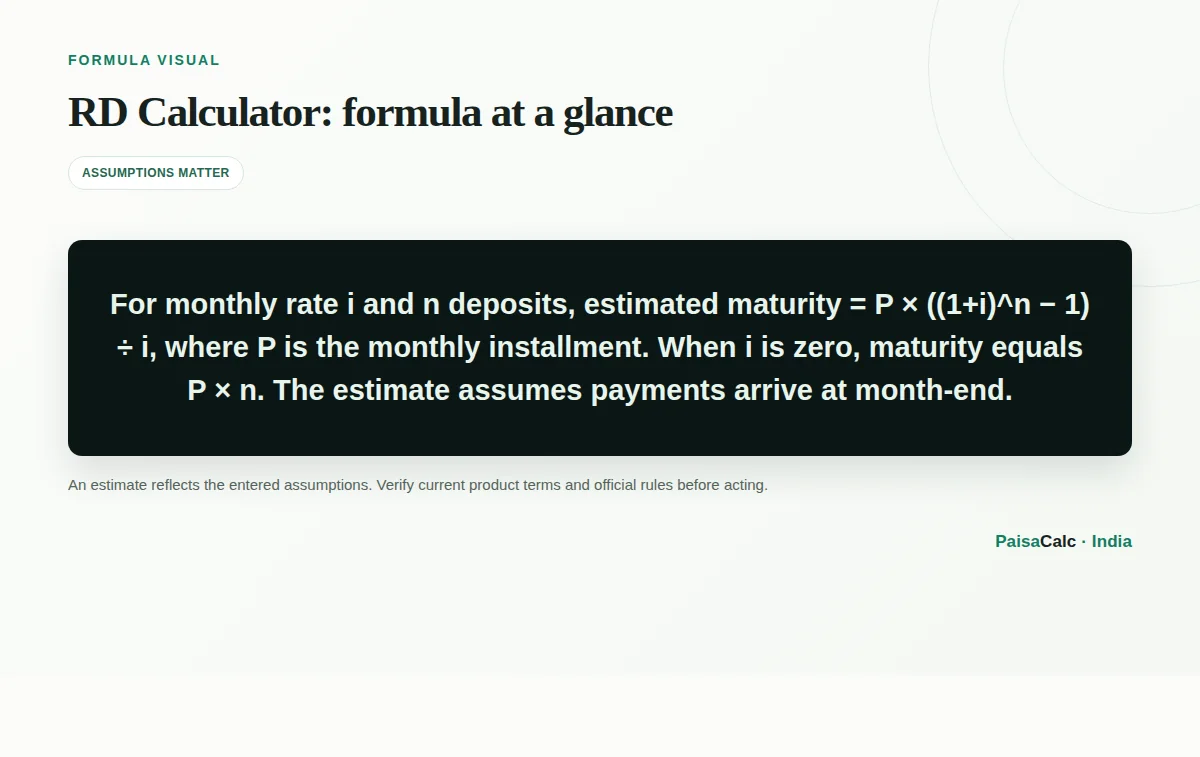
For a positive rate, estimated maturity = P × ((1 + i)^n − 1) ÷ i, where P is monthly deposit, i is monthly rate, and n is number of deposits. At 7% nominal annual interest, i = 0.07 ÷ 12.
The power term represents repeated monthly growth, while the annuity expression adds the growth-weighted value of staggered installments. It is not the same as investing the whole contribution total on day one.
When i = 0, maturity = P × n. The model excludes tax, penalties, bonuses, and bank-specific adjustments, so compare rates quoted under the same convention.
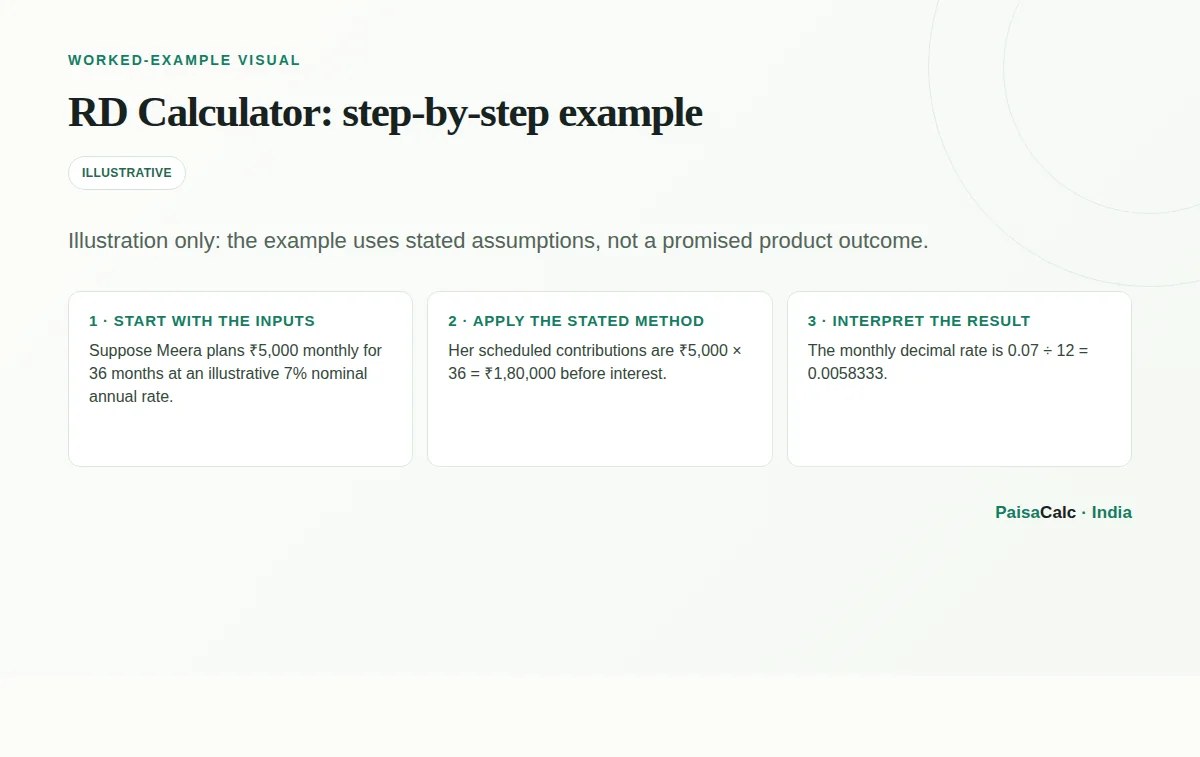
Suppose Meera plans ₹5,000 monthly for 36 months at an illustrative 7% nominal annual rate. Her scheduled contributions are ₹5,000 × 36 = ₹1,80,000 before interest.
The monthly decimal rate is 0.07 ÷ 12 = 0.0058333. Substituting P = 5,000 and n = 36 gives an estimated maturity of about ₹1,99,700 and estimated interest of about ₹19,700, subject to rounding.
Meera should compare this with the institution’s official quote. Quarterly compounding or different installment dates can change the figure, and testing ₹4,000 versus ₹6,000 shows the effect of the monthly commitment.
A first-job earner in Pune could estimate a laptop or relocation reserve while aligning the installment with salary dates. The output helps compare 12-, 24-, and 36-month horizons.
A family in Lucknow might plan school expenses by comparing maturity with the date money is needed. To reverse-engineer an installment, start with the target and test a sustainable amount rather than assuming a surplus every month.
A self-employed person with uneven receipts can use the model as a baseline, then check whether the product allows missed installments, charges a default fee, and fixes the rate for the full tenure. The calculator assumes every payment is on time.
The main benefit is habit-based saving: a fixed monthly instruction turns an intention into a visible, time-bound reserve. The output shows how much of maturity comes from deposits themselves.
Scenario testing is quick. Hold tenure constant and change the deposit, or hold the deposit constant and test a longer tenure, while checking each choice against take-home pay and household expenses.
The formula is auditable. A zero-rate check returns total contributions, while a positive rate produces modeled interest; that transparency helps when an official quote uses a different convention.
Do not enter annual savings in the monthly field. If you can set aside ₹60,000 per year, ₹5,000 is its simple monthly equivalent, but an account may require payments on prescribed dates.
Do not assume every RD compounds monthly or that annual rates are directly comparable. Indian banks and small-savings schemes publish their own rate, compounding, deposit-day, and default rules.
Do not add tax benefits, TDS, penalties, or early-closure proceeds to this pre-tax estimate. Also check nominee, KYC, minimum installment, and missed-payment provisions with the provider.
Start with the goal date and amount, then choose an installment that remains comfortable after rent, food, debt, and irregular bills. A maintainable RD is more useful than an ambitious one that leads to defaults.
Keep an emergency buffer outside the RD. Early closure or missed payments may have conditions, so compare the modeled maturity after allowing a safety margin instead of relying on the highest advertised rate.
Record the provider’s rate, tenure, installment date, maturity date, crediting convention, and charges. Re-run the calculator with matching assumptions and separate the pre-tax result from your after-tax plan.
Deposit timing matters. Under this month-end model, the first installment earns longest and the last earns almost no interest; a beginning-of-month schedule would generally produce a slightly higher result.
Sensitivity testing separates levers: a higher monthly deposit changes maturity broadly in proportion, while rate and tenure affect the growth of installments over their remaining months. A larger maturity does not alone prove a better return.
Keep units consistent: rupees per month, months for n, and annual percentage converted to monthly decimal. Compare pre-tax with pre-tax and include a buffer for rounding, taxes, and product-rule differences.
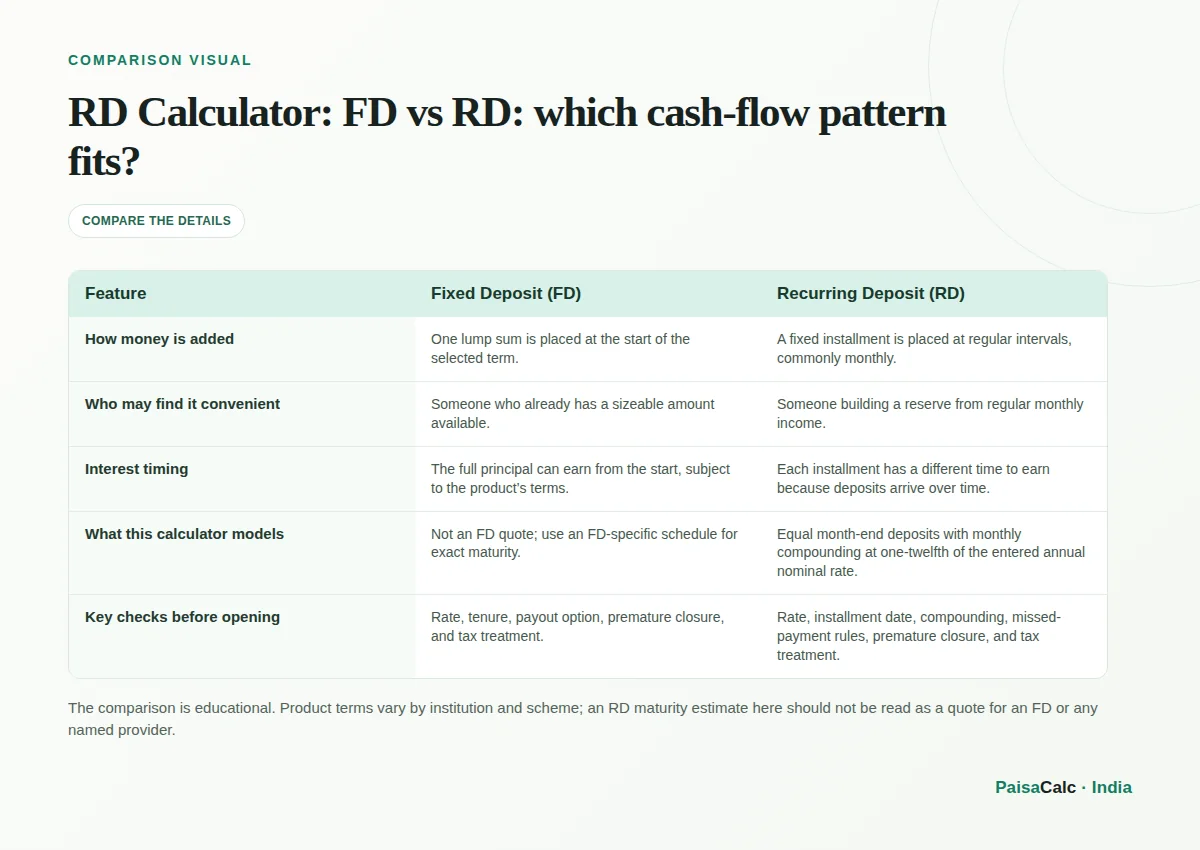
| Feature | Fixed Deposit (FD) | Recurring Deposit (RD) |
|---|---|---|
| How money is added | One lump sum is placed at the start of the selected term. | A fixed installment is placed at regular intervals, commonly monthly. |
| Who may find it convenient | Someone who already has a sizeable amount available. | Someone building a reserve from regular monthly income. |
| Interest timing | The full principal can earn from the start, subject to the product’s terms. | Each installment has a different time to earn because deposits arrive over time. |
| What this calculator models | Not an FD quote; use an FD-specific schedule for exact maturity. | Equal month-end deposits with monthly compounding at one-twelfth of the entered annual nominal rate. |
| Key checks before opening | Rate, tenure, payout option, premature closure, and tax treatment. | Rate, installment date, compounding, missed-payment rules, premature closure, and tax treatment. |
The comparison is educational. Product terms vary by institution and scheme; an RD maturity estimate here should not be read as a quote for an FD or any named provider.
It is a planning estimate based on month-end deposits and monthly compounding. A bank’s official calculation can vary with quarterly compounding, installment dates, rounding, and product terms.
Not always. Indian recurring-deposit products use institution-specific conventions, often including quarterly compounding. Check the product disclosure and compare its assumptions with this model.
No. The result is pre-tax. Taxability, TDS, exemptions, and reporting depend on current law and your circumstances, so use the official tax information or a qualified adviser for the tax view.
The institution may charge a penalty, apply default rules, or allow a limited grace period. This calculator assumes every installment is paid on schedule and does not model missed payments.
Use it only as a rough comparison. Post-office scheme rates and prescribed calculation rules can differ from this simplified monthly model; confirm the current official scheme terms before relying on the result.
It is the fixed rupee amount scheduled for each month, not the total annual contribution and not the maturity amount. The model multiplies it by the number of deposits to calculate total contributions.
The estimate becomes the total of the scheduled deposits: monthly deposit multiplied by the number of months. No interest is added, and the formula avoids dividing by zero.
No. It models a generic monthly schedule. Exact maturity depends on the provider’s rate, compounding, payment dates, rounding, and account rules, so obtain the institution’s written quote.
Yes, but compare the cash-flow pattern as well as the rate. An FD generally invests a lump sum at once, whereas an RD invests installments over time. The comparison table shows the practical distinction without treating either as automatically better.
Yes, as a first planning pass. Test a sustainable installment, add a margin for differences and taxes, keep emergency money liquid, and verify the product schedule before committing.
Use primary and provider references to verify current rules, rates, and product terms.
Bank deposit rates and operating terms are institution- and product-specific; the calculator is an estimate rather than a bank quote.
Post-office savings products have their own published rates and rules, which may differ from the simplified monthly model.
A notified post-office RD scheme has prescribed terms, so a generic calculator should be used only for rough comparison.
The displayed maturity is pre-tax; taxability and TDS/reporting are separate questions governed by current rules and the depositor’s circumstances.
TAKE A 30-SECOND BREAK
Three questions to help the key ideas stick.