Test one percentage point more inflation
Annual inflation (%): 6% → 7%
Estimated future cost₹1,79,085₹1,96,715
PLANNING · FREE TOOL
See how rising prices change purchasing power over time. Adjust the assumptions and see how the result changes.
Interactive tool
Change the inputs to compare scenarios. Your values stay in this browser.
QUICK TAKEAWAY
This is a result from the assumptions currently entered. Compare a few alternatives below before drawing conclusions.
BASED ON YOUR INPUTS
With these inputs, estimated future cost is ₹1,79,085.
For context, increase in rupees is ₹79,085.
Test one percentage point more inflation changes estimated future cost from ₹1,79,085 to ₹1,96,715 in this model.
TRY A DIFFERENT ASSUMPTION
Each card recalculates from the inputs above.
Annual inflation (%): 6% → 7%
Years: 10 → 15
Calculations run locally. Browser activity remembers calculator visits and quiz scores only—not financial inputs or results. Share links include values only when you choose to share them.
PaisaCalc guide · India

PaisaCalc’s Inflation Calculator India turns an amount you know today into an estimated future rupee amount. Enter a present amount, an annual inflation assumption from 0% to 30%, and a period from 0.1 to 100 years. The result is the amount that would have similar purchasing power if prices rose at that single rate every year.
It is a planning scenario, not an official forecast. A ₹1,00,000 school fee, medical budget, wedding expense, or monthly household requirement may not rise at the same pace as the broad consumer price index (CPI). The calculator helps you express a goal in future nominal rupees and, where useful, translate a future amount back into today’s purchasing power.
A fixed rupee balance can look unchanged while buying less over time. If a family keeps ₹5,00,000 aside for a goal ten years away, the future price of that goal may be higher even though the number of rupees saved is the same. Adding an inflation assumption makes the gap visible before you choose a savings target.
Inflation also makes return comparisons more meaningful. A deposit or investment can increase in nominal terms, yet the real increase in purchasing power may be small after inflation, taxes, fees, and risk. In India, food, rent, transport, education, and healthcare can move differently, so revisit the rate as your spending pattern changes.
The calculator compounds the entered annual rate once per year for the selected number of years. For example, 6% means multiplying by 1.06 each year, rather than adding 6% of the original amount only once. Years can include a decimal, so a 2.5-year planning period is represented by 2.5 in the simplified model.
The main output is the estimated future cost. A reverse view divides a future amount by the same factor to show an approximate value in today’s rupees. It does not fetch live CPI data, predict a particular brand’s price, include tax, or model monthly changes. The rate and duration are your assumptions.
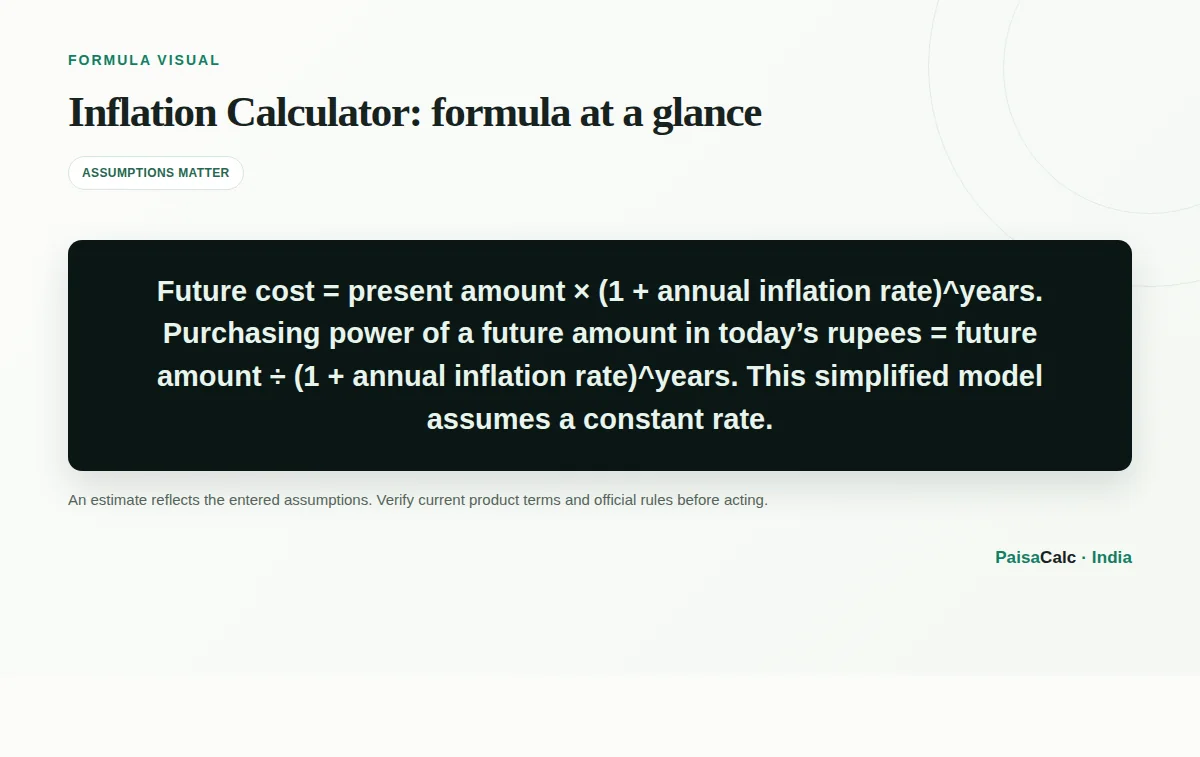
For a present amount P, annual inflation rate r written as a decimal, and years t: Future cost = P × (1 + r)^t. Thus ₹1,00,000 at 6% for 10 years becomes ₹1,00,000 × 1.06^10, or about ₹1,79,085. The difference, about ₹79,085, is the estimated increase in the nominal target under this assumption; it is not a guaranteed charge.
To express a future amount F in today’s rupees, use Today’s purchasing power = F ÷ (1 + r)^t. The same price factor therefore works in opposite directions. At 0% inflation, the factor is 1 and the amount does not change. This basic planner accepts non-negative inflation inputs and assumes a constant annual rate with annual compounding.
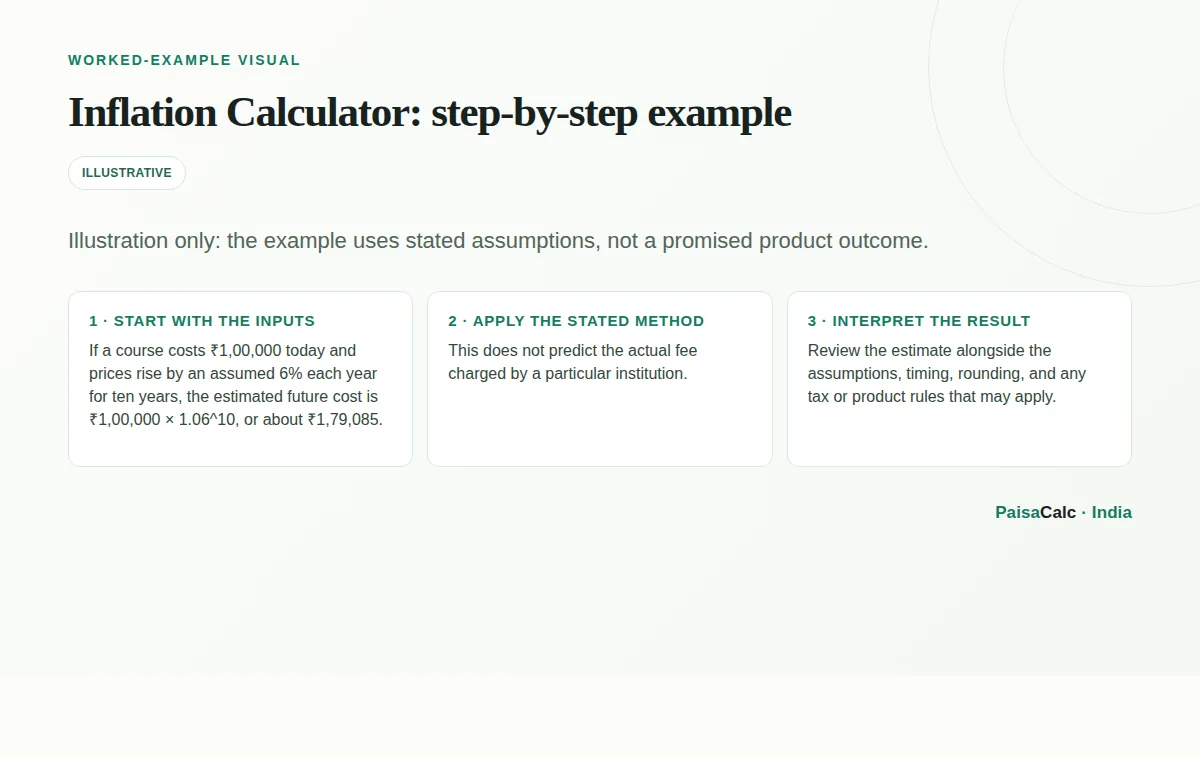
Suppose a professional in Pune estimates that a course costing ₹1,00,000 today may be needed in 10 years. They enter Amount today = ₹1,00,000, Annual inflation = 6%, and Years = 10. First, convert 6% to 0.06; next, calculate the ten-year price factor, 1.06^10, which is approximately 1.79085.
Finally, multiply ₹1,00,000 by 1.79085. The estimated future target is about ₹1,79,085. If the person instead had ₹1,79,085 in ten years, dividing it by 1.79085 gives approximately ₹1,00,000 in today’s purchasing power. The actual course fee could differ because institution pricing, demand, and location need not follow general inflation.
For education, parents can inflate today’s tuition, hostel, books, or exam-preparation budget separately rather than applying one rate to every item. For retirement, a household can test a current monthly essential budget against a future year, then pair it with a corpus plan. For a renovation or vehicle replacement, use the result as a preliminary target before checking vendor quotes.
The tool also helps with cash reserves. If an emergency fund remains in a low-return account, compare its future nominal balance with the future cost of essentials. A tenant may model rent as a scenario but should check actual lease terms and local listings. For a known fee, invoice, contract, or government charge, use the published figure instead of a broad inflation estimate.
The calculator is quick, transparent, and easy to stress-test. You can run 4%, 6%, and 8% scenarios or compare five and ten years without pretending that one number is certain. Showing a future nominal target helps prevent the common mistake of saving only the amount that a goal costs today.
It also creates a common language for financial discussions. A family can separate today’s purchasing power from the future rupee amount, while an investor can compare an estimated after-tax return with an inflation assumption on the same time horizon. The result is an estimate rather than a product recommendation, and it does not account for investment risk or guarantee that a goal will be met.
Do not treat headline CPI as the exact rate for your household. India’s official CPI is an aggregate measure; your city, rent, diet, medical needs, and education choices can create a different personal basket. Do not enter 6% merely because it is familiar—test a range and review it periodically.
Avoid adding the same percentage ten times to the original amount when compounding; the formula applies the rate to the growing amount. Also avoid comparing a nominal investment return with a real cost. Put both in future rupees or both in today’s rupees, remembering that tax, fees, withdrawals, and irregular cash flows can change the outcome.
Start with a current, itemised budget: separate food, rent, utilities, school fees, insurance, healthcare, travel, and discretionary spending. Use the calculator on important categories when their likely inflation differs, then combine the estimates into a practical goal. For a long-term plan, record the assumed rate and date so you can compare it with updated official statistics and your actual bills.
When choosing a savings target, build a range rather than relying on one forecast. Check whether the expected after-tax return is above inflation after considering liquidity and risk; a higher projected return is not free of loss risk. Increase contributions as income changes, keep an emergency reserve separate, and replace a calculator estimate with a provider’s current quote when the goal becomes near term.
Small rate differences become material over long horizons because the factor is exponential. At 6% for 20 years, the price factor is about 3.21; at 8%, about 4.66. A sensitivity table is more useful than a precise-looking single output. An implied real return is approximately (1 + nominal return) ÷ (1 + inflation rate) − 1, before tax and fees.
A broad CPI number is not a promise about education, healthcare, housing, or any asset. Maintain low, central, and high scenarios; match each to the goal’s horizon; and revisit the amount and rate after major life changes. The reverse calculation shows what a future corpus represents in today’s purchasing power, without implying uniform future spending.
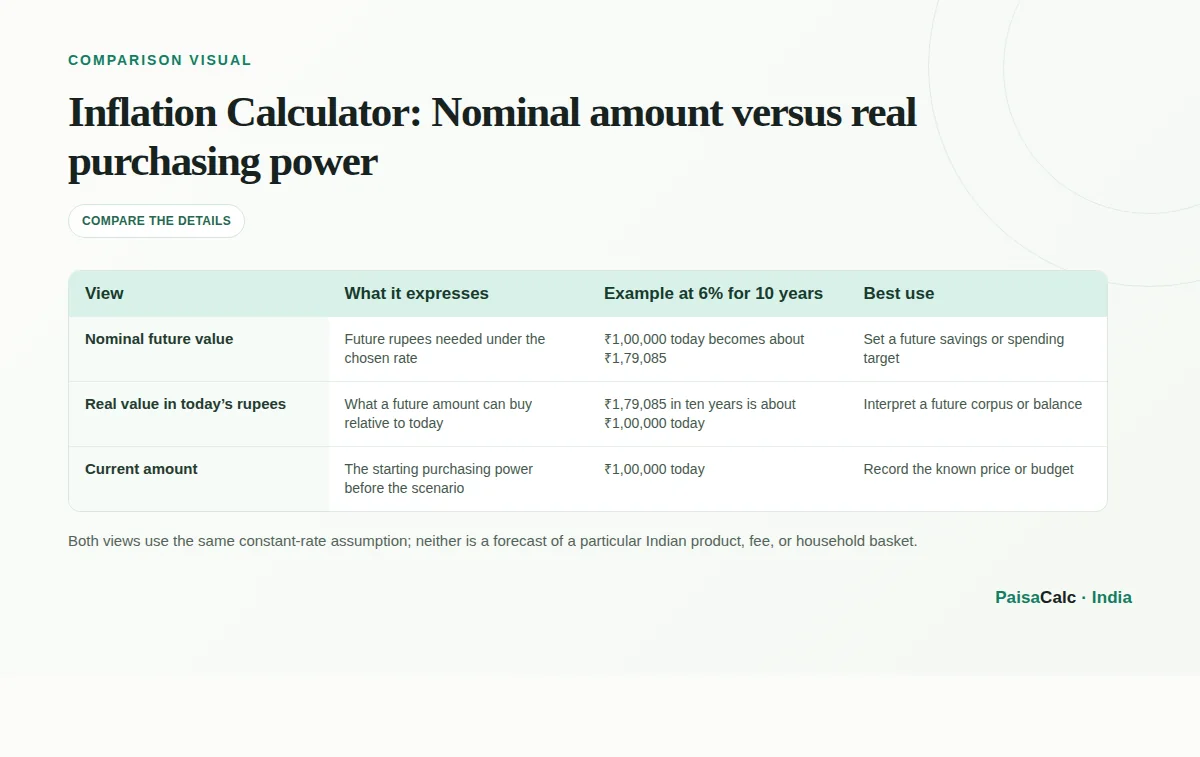
| View | What it expresses | Example at 6% for 10 years | Best use |
|---|---|---|---|
| Nominal future value | Future rupees needed under the chosen rate | ₹1,00,000 today becomes about ₹1,79,085 | Set a future savings or spending target |
| Real value in today’s rupees | What a future amount can buy relative to today | ₹1,79,085 in ten years is about ₹1,00,000 today | Interpret a future corpus or balance |
| Current amount | The starting purchasing power before the scenario | ₹1,00,000 today | Record the known price or budget |
Both views use the same constant-rate assumption; neither is a forecast of a particular Indian product, fee, or household basket.
Choose a planning assumption for the goal and time horizon. Official CPI history is useful context, but your education, healthcare, housing, and food costs may behave differently. Test a reasonable range instead of treating one rate as certain.
No. It uses the annual rate you enter and does not fetch official CPI data or forecast future inflation. Use the official CPI series for historical context, then choose a clearly labelled planning scenario.
If prices rise faster than the after-tax return on savings, the balance may buy fewer goods and services even when its nominal rupee value increases. Compare both figures over the same period.
No. This basic planner accepts non-negative inputs from 0% to 30%. Deflation is a different scenario and is outside the intended use of this calculator.
No. A single rate simplifies a broad trend. Food, rent, fuel, education, healthcare, and technology can rise faster, slower, or even fall during particular periods.
Yes, as a first estimate. Inflate today’s essential or discretionary budget for the expected retirement date, then review the result against your household’s likely spending mix and a broader retirement plan.
It is the number of future rupees estimated to have the same purchasing power as today’s amount under your constant-rate assumption. It is not a quoted price or a guarantee from a seller.
The calculator compounds the rate each year. At 6%, the second year applies 6% to the first year’s increased amount, not only to the original principal, so the cumulative factor is 1.06 raised to the number of years.
Yes. The input allows periods such as 2.5 years. It remains a simplified annual-compounding model, so it should not be read as a precise month-by-month price forecast.
Use an actual published fee, quote, lease term, or contract amount when one is available. Use inflation scenarios for early planning, when the future price is not yet known, and update the estimate as information improves.
Use primary and provider references to verify current rules, rates, and product terms.
CPI is an official aggregate measure used for Indian price and inflation context; the calculator does not directly fetch its current rate.
The CPI measures changes over time in the general level of retail prices for selected goods and services; personal spending can differ from the aggregate basket.
India’s inflation framework uses CPI-based context; the calculator intentionally leaves the annual assumption to the user rather than presenting a policy target as a personal forecast.
TAKE A 30-SECOND BREAK
Three questions to help the key ideas stick.