Test investments 10% higher
Investments and deposits (₹): ₹8,00,000 → ₹8,80,000
Estimated net worth₹28,00,000₹28,80,000
PLANNING · FREE TOOL
Total assets and subtract liabilities for a balance-sheet snapshot. Adjust the assumptions and see how the result changes.
Interactive tool
Change the inputs to compare scenarios. Your values stay in this browser.
QUICK TAKEAWAY
This is a result from the assumptions currently entered. Compare a few alternatives below before drawing conclusions.
BASED ON YOUR INPUTS
With these inputs, estimated net worth is ₹28,00,000.
For context, total assets is ₹62,00,000.
Test investments 10% higher changes estimated net worth from ₹28,00,000 to ₹28,80,000 in this model.
TRY A DIFFERENT ASSUMPTION
Each card recalculates from the inputs above.
Investments and deposits (₹): ₹8,00,000 → ₹8,80,000
Other loans and credit balances (₹): ₹1,00,000 → ₹90,000
Calculations run locally. Browser activity remembers calculator visits and quiz scores only—not financial inputs or results. Share links include values only when you choose to share them.
PaisaCalc guide · India

A net worth calculator gives a point-in-time balance-sheet estimate: it adds what you own and subtracts what you owe. Enter cash and bank balances, investments and deposits, property and other assets, then enter outstanding home loans, vehicle loans, and other loans or credit balances. The result is shown in Indian rupees as total assets, total liabilities, and estimated net worth. This is not a salary, monthly savings, or spendable-cash calculator. A home, land, gold, EPF balance, NPS holding, mutual fund, or fixed deposit can raise net worth while remaining difficult or costly to access quickly. Use the ownership share that belongs to the person or household being measured.
A monthly budget explains cash flow; net worth shows the wider financial position. Comparing snapshots can reveal whether loan balances are falling, investments are accumulating, or property is doing most of the work. That view is useful for an Indian household balancing a home loan, family support, retirement savings, and irregular income. A single positive number does not prove financial security. A household may have substantial property equity but little emergency liquidity, or a modest net worth with a strong savings habit and manageable debt. Reviewing the total assets, total liabilities, and liquid portion together helps turn a vague feeling about progress into a documented starting point for planning.
First, enter realistic current values for cash and bank balances, investments and deposits, property and other assets. For investments, use a statement value or a clearly defined valuation date. For property, use a reasonable current estimate rather than automatically repeating the purchase price. Include only material other assets that fit your household scope; avoid padding the total with everyday possessions. Next, enter outstanding principal or current balances for the home loan, vehicle loans, and other loans or credit balances. Do not enter the original sanctioned amount if repayments have reduced the balance. The calculator totals the four asset fields, totals the three liability fields, and subtracts the second total from the first. It does not independently value assets or forecast returns.
The calculation uses three transparent steps: Total assets = cash + investments + property + other assets. Total liabilities = home loan + vehicle loans + other debt. Net worth = total assets − total liabilities. Every input is a rupee amount, and zero is valid when a category does not apply. The formula treats the entries as estimates at the same valuation date. It does not apply an assumed appreciation rate, tax rate, loan interest rate, inflation rate, brokerage, stamp duty, or sale expense. For a conservative view, record a separate lower-value scenario.

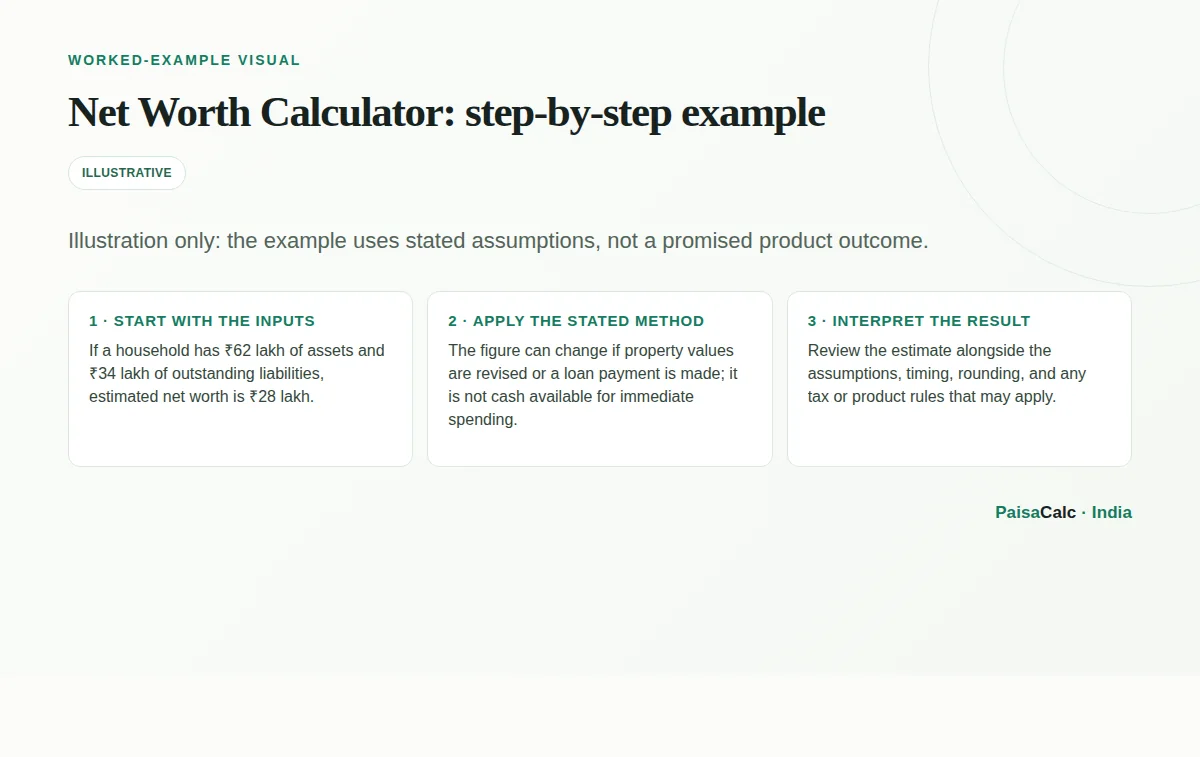
Suppose an Indian household records ₹2,00,000 in cash and bank balances, ₹8,00,000 in investments and deposits, ₹50,00,000 for property, and ₹2,00,000 in other assets. Total assets are therefore ₹62,00,000. The household also has ₹30,00,000 outstanding on a home loan, ₹3,00,000 of vehicle loans, and ₹1,00,000 in other loans or credit balances. Total liabilities are ₹34,00,000. Estimated net worth is ₹62,00,000 − ₹34,00,000 = ₹28,00,000. A loan payment or revised property estimate changes the next snapshot. The ₹28 lakh is not ₹28 lakh available for immediate spending: much of it is tied to property and other assets, and selling or borrowing against them involves separate decisions and costs.
A first-time homebuyer can separate home equity from total property value by recording the property on the asset side and the outstanding home loan on the liability side. A couple can agree whether the snapshot covers both people, then count only the relevant share of a jointly owned flat, land parcel, deposit, or investment. This reduces accidental double-counting when each person keeps separate records. A self-employed professional or family business owner can use a consistent date to compare personal assets and debts before a major purchase, but should keep business books separate unless the business interest is intentionally included. An investor can track deposits, mutual funds, gold, EPF, NPS, and other holdings without pretending they all have the same liquidity. A household approaching retirement can compare net worth with liquid assets and expected expenses.
The calculator creates a short, repeatable inventory instead of leaving assets and debts scattered across bank apps, loan statements, and memory. Its categories are broad enough for common Indian household holdings, including deposits, market investments, residential property, vehicles, and credit balances. It can also be reviewed with a spouse or adviser. Trend is often more useful than a single result. Saving the valuation date and method makes it easier to see whether net worth is rising because debt is being repaid, assets are being added, or an estimate moved. Pair the result with an emergency-fund target, insurance review, cash-flow budget, and debt-cost review. A negative number can be a useful signal to understand rather than a label of failure.
Do not count a financed vehicle at its full purchase price while forgetting its remaining loan. Do not add the same mutual fund, deposit, property, or EPF balance twice because it appears in more than one family member's list. For a joint asset, use the ownership share relevant to your chosen scope. Similarly, use the current outstanding loan balance, not the original loan amount or the sum of every future EMI. Avoid mixing valuation dates, such as a recent investment statement with an old property estimate, without noting the difference. A purchase price may not represent current value or sale proceeds. Exclude personal items with little resale value or place them in other assets only when their value is material and defensible. Keep optimistic estimates separate from a conservative scenario.
Choose a review rhythm that you can repeat, such as annually or after a home purchase, major inheritance, job change, marriage, or large loan repayment. On each date, download or note statement balances, record the property valuation method, and preserve the same ownership scope. A simple table with date, assets, liabilities, liquid assets, and notes is enough to show direction without creating false precision. Use net worth as one planning input, not as a target detached from cash flow. Protect near-term bills with liquid reserves, then examine debt, insurance gaps, and long-term savings. Before calling property or retirement holdings available, ask how quickly they can be accessed and what restrictions or costs apply. Where ownership, estate, business, or tax treatment is complicated, confirm details with a qualified professional rather than guessing.
Separate total net worth from liquid net worth in your notes. Total net worth follows the calculator formula, while a liquidity view can focus on cash, accessible deposits, and investments you could reasonably use for near-term needs. This distinction prevents a property-rich but cash-constrained household from assuming it can meet an emergency without selling or borrowing. Do not subtract an unlisted hypothetical cost from the calculator result; show it as a separate scenario instead. Look at the composition and trend: debt-to-assets can indicate how leveraged the household is, while the change in liabilities can show repayment progress. A falling home-loan balance may be positive even when a market or property estimate moves unpredictably. For a joint household, maintain both a household view and clearly labelled individual views when useful. Use these descriptive ratios with income stability, essential expenses, insurance, and goals.
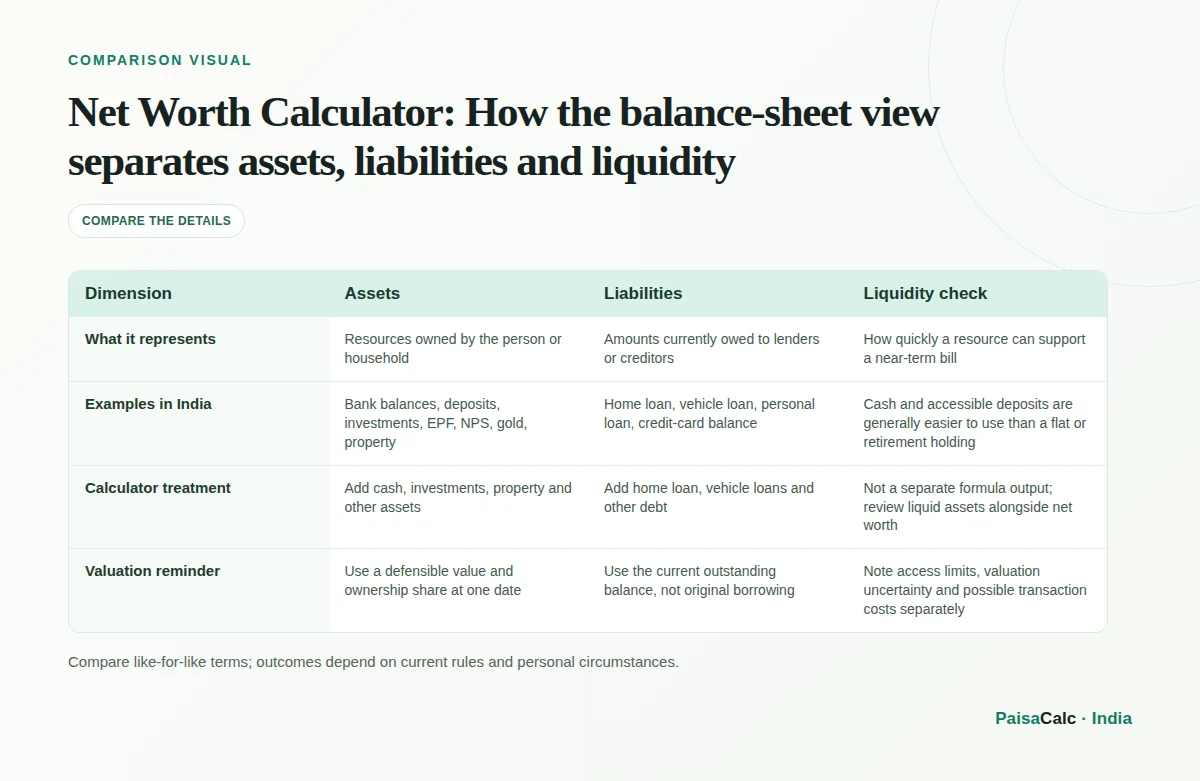
| Dimension | Assets | Liabilities | Liquidity check |
|---|---|---|---|
| What it represents | Resources owned by the person or household | Amounts currently owed to lenders or creditors | How quickly a resource can support a near-term bill |
| Examples in India | Bank balances, deposits, investments, EPF, NPS, gold, property | Home loan, vehicle loan, personal loan, credit-card balance | Cash and accessible deposits are generally easier to use than a flat or retirement holding |
| Calculator treatment | Add cash, investments, property and other assets | Add home loan, vehicle loans and other debt | Not a separate formula output; review liquid assets alongside net worth |
| Valuation reminder | Use a defensible value and ownership share at one date | Use the current outstanding balance, not original borrowing | Note access limits, valuation uncertainty and possible transaction costs separately |
Net worth is total assets minus total liabilities. Common entries include balances, investments, deposits, property, loans, and other debt. Keep the scope consistent.
No. Count only the ownership share relevant to the person or household being measured, and do not count the same share again in another person's snapshot.
No. Net worth includes illiquid assets such as property and subtracts debts. Cash and readily accessible savings are only one part of the balance sheet.
Use a reasonable current estimate at a stated valuation date. Keep any selling-cost scenario separate from the input.
No. Enter the current outstanding balance or principal shown by your lender, because repayments may have reduced the amount owed.
Yes. Liabilities can exceed assets, especially early in a career or after substantial borrowing. Review the trend, cash flow, and repayment plan rather than treating one result as a verdict.
An annual review or a review after a major life change is practical for many households. Use comparable valuation dates and methods so changes are meaningful.
They may be included as assets when they belong to the chosen person or household scope. Use a defensible statement or valuation and remember that access and liquidity differ.
No. The result may include property, retirement holdings, or other assets that are not immediately available. Review liquid assets and near-term obligations separately.
No. It applies only the listed asset and liability totals. If taxes, transaction costs, or a conservative sale value matter, record a separate scenario rather than assuming a rate.
Use primary and provider references to verify current rules, rates, and product terms.
The distinction between organising a household financial position, planning around liquidity, and reviewing financial decisions rather than treating one number as a guarantee.
The advice to understand investment products, risks, ownership and liquidity before assigning values or making financial decisions.
The India-focused examples of EPF holdings as an asset whose statement value and access conditions should be considered separately.
TAKE A 30-SECOND BREAK
Three questions to help the key ideas stick.