Raise the monthly payment by 25%
Monthly payment (₹): ₹5,000 → ₹6,250
Estimated payoff time13 months10 months
LOANS · FREE TOOL
Estimate repayment time and interest for a revolving balance. Adjust the assumptions and see how the result changes.
Interactive tool
Change the inputs to compare scenarios. Your values stay in this browser.
Simplified monthly-rate estimate; issuers may use daily balances, fees, taxes and payment allocation rules.
QUICK TAKEAWAY
This is a result from the assumptions currently entered. Compare a few alternatives below before drawing conclusions.
BASED ON YOUR INPUTS
With these inputs, estimated payoff time is 13 months.
For context, estimated interest is ₹10,338.
The result responds to outstanding balance (₹); change one assumption at a time to see its effect.
Model note: Simplified monthly-rate estimate; issuers may use daily balances, fees, taxes and payment allocation rules.
TRY A DIFFERENT ASSUMPTION
Each card recalculates from the inputs above.
Monthly payment (₹): ₹5,000 → ₹6,250
Annual interest rate / APR (%): 36% → 34%
A MINI CHALLENGE
Test a value here first. Your calculator changes only if you apply it.
Keep experimenting to test 12 months or fewer.
Calculations run locally. Browser activity remembers calculator visits and quiz scores only—not financial inputs or results. Share links include values only when you choose to share them.
PaisaCalc guide · India

This Credit Card Payoff Calculator estimates how many months a revolving balance may take to clear, along with modelled interest and total payments. Enter the outstanding balance in ₹, annual interest rate or APR, and the fixed amount you plan to pay each month. The result is an estimate, not a card issuer payoff quote.
The model is designed for an Indian cardholder who is carrying a balance and wants a simple planning view. It assumes no new purchases, missed payments, late fees, annual fees, taxes or rate changes. Your statement may use daily balances, transaction dates and issuer-specific payment allocation, so check the card’s MITC and current statement before acting.
A payment can look affordable while only a small part reduces principal. In the illustration of ₹50,000 at 36% APR, the first simplified month adds about ₹1,500 of interest. A ₹5,000 payment then leaves roughly ₹3,500 to reduce the balance before other amounts. Seeing both time and interest makes that trade-off visible.
Paying only a minimum-like amount can stretch repayment for months or years, particularly when the balance remains high. The Reserve Bank of India requires card issuers to warn customers about this consequence and disclose the finance-charge method. Use this page to test a payment that fits your cash flow, then confirm the actual due amount with the issuer.
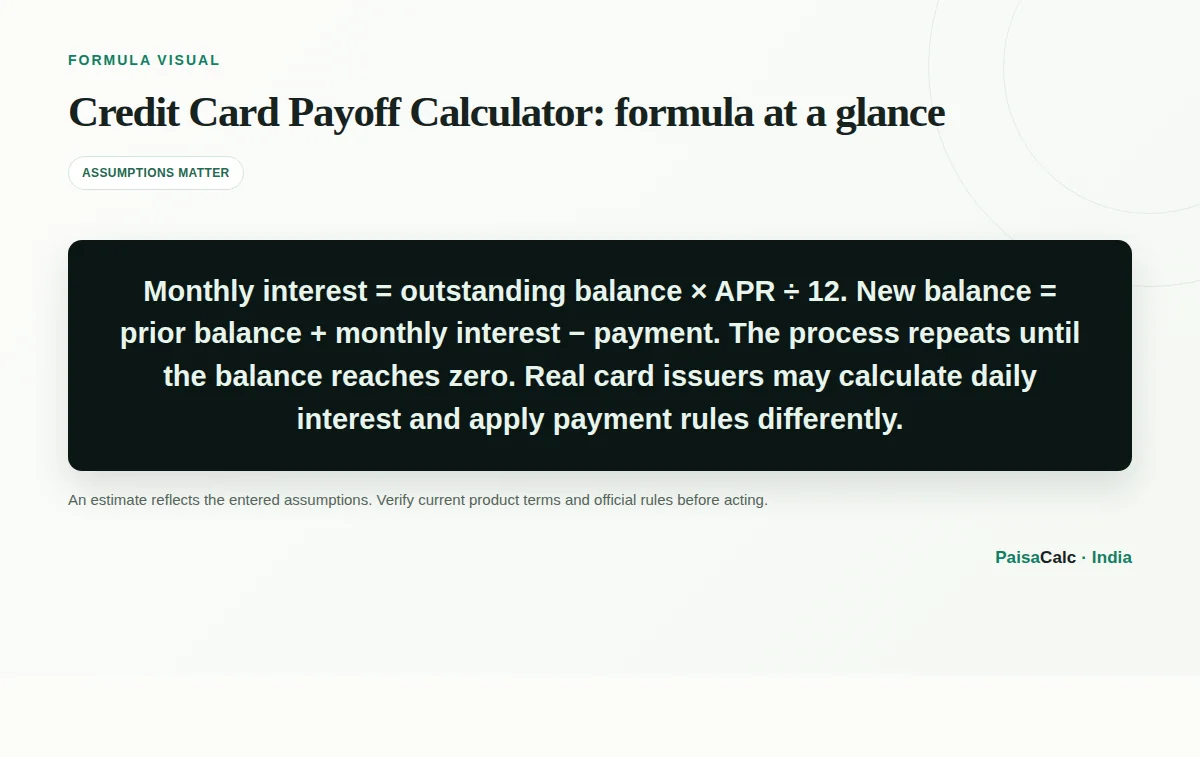
First, the calculator converts the entered annual rate to a simplified monthly rate by dividing the APR by 12 and by 100. It applies that rate to the opening balance for the month. It then subtracts your fixed payment: new balance = prior balance + monthly interest − payment. The cycle repeats until the balance reaches zero.
If the payment does not exceed the first month’s estimated interest, the model flags that it is too low to reduce principal. A payment above that amount normally produces a declining balance in this simplified schedule because interest falls as the balance falls. At 0% APR, the calculation reduces to balance divided by payment, rounded up to whole monthly payments.
Let B be the opening balance, R the annual APR as a percentage, and P the monthly payment. The modelled monthly rate is r = R ÷ 12 ÷ 100. For each month, interest is B × r, and the closing balance is B + (B × r) − P. The next month uses that closing balance as its opening balance.
For a positive repayment path, P must be greater than the first month’s interest, B × r. A rough planning estimate for the number of payments is −ln(1 − rB ÷ P) ÷ ln(1 + r), but the calculator simulates month by month and caps the final payment at the remaining balance plus that month’s interest. Total modelled interest equals total payments minus the starting balance.
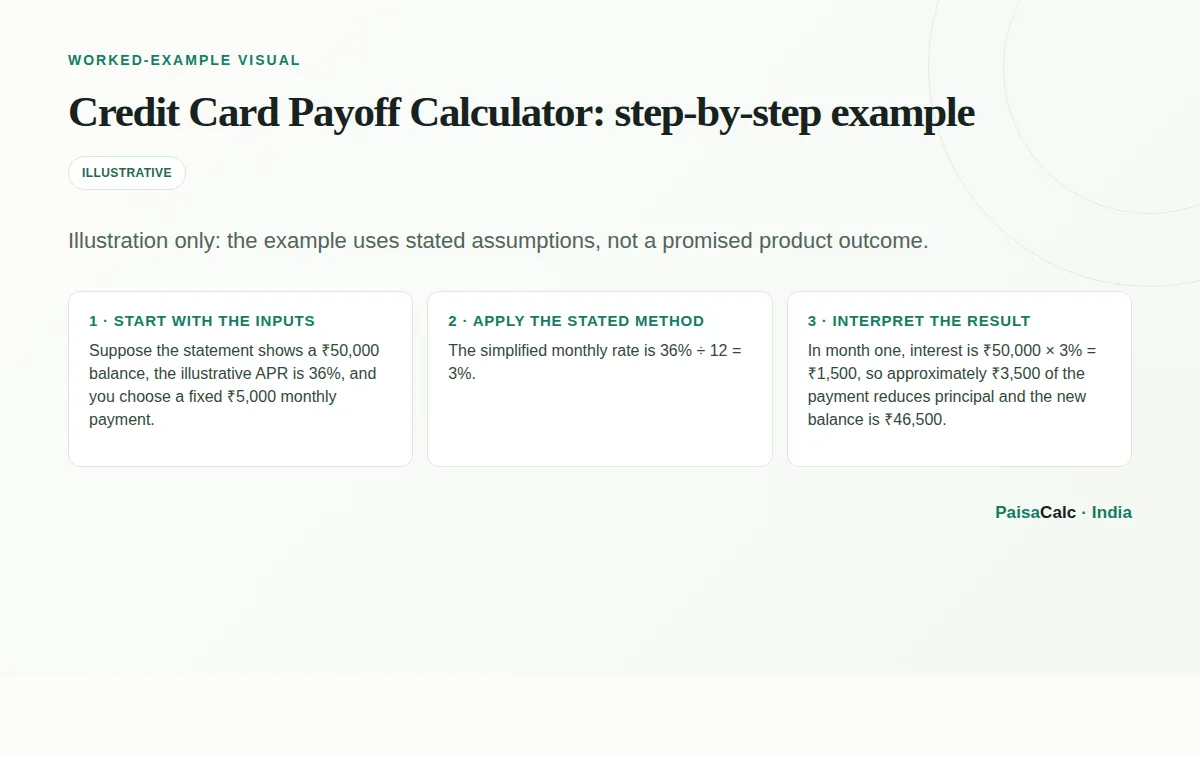
Suppose the statement shows a ₹50,000 balance, the illustrative APR is 36%, and you choose a fixed ₹5,000 monthly payment. The simplified monthly rate is 36% ÷ 12 = 3%. In month one, interest is ₹50,000 × 3% = ₹1,500, so approximately ₹3,500 of the payment reduces principal and the new balance is ₹46,500.
In month two, interest is about ₹1,395 (₹46,500 × 3%), leaving around ₹3,605 of the payment for principal. Repeating the process gives approximately 13 payments, with a final payment smaller than ₹5,000; total modelled payments are about ₹60,338 and interest about ₹10,338. Rounding and the final payment can cause small display differences.
If you instead pay ₹7,500, the balance should fall faster and the interest total should be lower, provided you do not add purchases. Run both amounts, compare the saving, and retain enough cash for rent, food, utilities and an emergency buffer.
A salaried employee in Bengaluru may use the calculator after an unexpected medical bill to compare a ₹4,000 payment with a ₹8,000 payment. A self-employed person in Jaipur can test a conservative payment for a low-income month, then revisit the plan when a client invoice is received. The figures help frame a conversation; they do not replace the card statement.
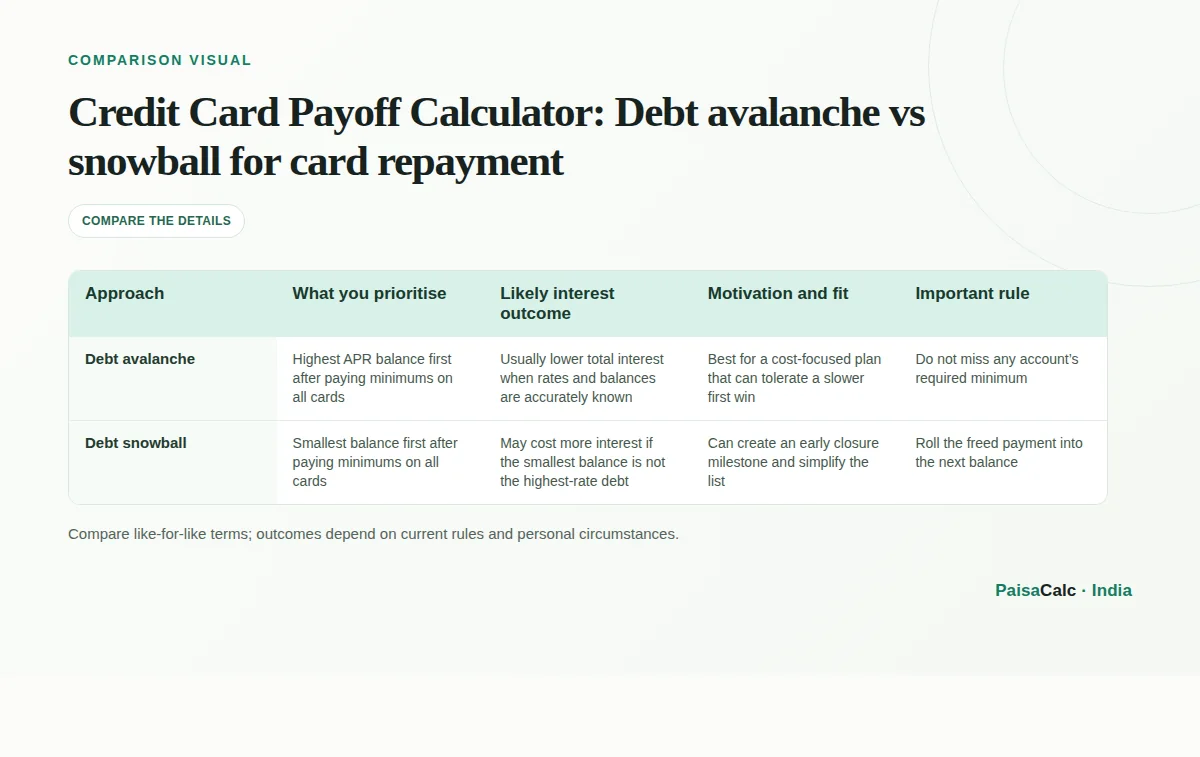
For several cards, calculate each balance separately and list APR, minimum due and due date. You might direct extra cash to the costliest balance first (avalanche) or clear the smallest balance first (snowball), while paying every required minimum. Keep new spending out of the payoff plan unless it is tracked as a separate balance.
The main benefit is visibility: one screen connects balance, APR and payment to an approximate finish point. Testing a higher payment shows the possible reduction in interest without requiring a complicated spreadsheet. That can turn a vague goal such as “pay it off soon” into a monthly amount you can review.
It supports safer comparisons. You can hold the balance and APR constant, then change only the payment; or hold payment constant and compare two disclosed APRs. The output encourages a realistic plan because it displays when a payment is too low to reduce principal under the assumed rate.
Do not enter the minimum amount due as though it were a permanent fixed payment. Minimums can change with the statement balance and may include interest, fees, taxes or a percentage of principal. Enter the amount you genuinely intend to pay every month, and separately ensure it meets the issuer’s required minimum by the due date.
Do not confuse an annual APR with a monthly rate. Enter 36 for 36% per year; do not enter 3 unless the field specifically asks for a monthly percentage. Also avoid assuming that APR ÷ 12 reproduces daily-balance interest. It is a planning assumption used by this calculator.
Finally, do not keep spending on the card without adding those transactions to your plan. Missing a due date, paying after the cut-off, transferring a balance, or leaving annual fees and GST unaccounted for can make the estimate optimistic. Recheck the statement whenever terms or spending change.
Start with the statement: note the total outstanding, payment due date, minimum due, APR or finance-charge rate, fees and any cash-advance balance. Set a standing reminder a few days before the due date and pay at least the required amount on time. A fixed extra payment is useful only after essentials and near-term obligations are covered.
If you have multiple debts, compare their rates and balances. The avalanche method usually targets the highest-rate balance first, while the snowball method targets the smallest balance for faster psychological wins. Both require minimums on every account. A budget review can reveal whether a temporary spending cut or additional income can support the chosen payment.
Keep a small liquidity buffer so one repair or medical bill does not send the balance higher. If payments are becoming unmanageable, contact the issuer early, ask for written options, and consider qualified debt counselling. Do not stop paying or rely on an unconfirmed settlement promise.
Payment sensitivity is not linear. An extra ₹1,000 paid early reduces future interest as well as principal, so the same extra amount can save more than if it is delayed. Run a few payment scenarios and compare interest saved per additional rupee, but choose a payment you can sustain rather than an aggressive number that causes fresh borrowing.
The first-month interest test is a useful warning signal. At ₹50,000 and 36% APR it is ₹1,500 under the model; a ₹1,200 payment would not reduce principal in month one. If the issuer adds fees or uses a different balance, the practical threshold can be higher. Treat a “payment too low” result as a reason to review the account, not as an issuer calculation.
| Approach | What you prioritise | Likely interest outcome | Motivation and fit | Important rule |
|---|---|---|---|---|
| Debt avalanche | Highest APR balance first after paying minimums on all cards | Usually lower total interest when rates and balances are accurately known | Best for a cost-focused plan that can tolerate a slower first win | Do not miss any account’s required minimum |
| Debt snowball | Smallest balance first after paying minimums on all cards | May cost more interest if the smallest balance is not the highest-rate debt | Can create an early closure milestone and simplify the list | Roll the freed payment into the next balance |
The payment does not exceed modelled first-month interest, so the balance will not fall under this schedule. Fees and issuer methods can change the actual amount; check your statement.
No. Enter a fixed monthly payment. The issuer calculates the minimum under its terms, and it can change each statement.
No. It excludes taxes, late fees, annual fees, new purchases and other charges. Review every statement line before deciding what to pay.
It uses a simplified monthly rate: annual APR divided by 12 and 100. An issuer may calculate daily interest, so this is only an estimate.
Avoid new purchases to keep the estimate meaningful. If you use the card, track each transaction and its payment timing separately.
Yes. An extra payment generally reduces simulated balance and later interest if affordable. Re-run the estimate when payment changes.
Not directly. It excludes transfer fees, promotional periods and post-promotion rates. Compare complete written terms and all known costs.
Run balances separately, pay every required minimum, and direct extra money using an avalanche or snowball order. One APR cannot represent all cards.
The model treats it as interest-free and rounds balance divided by payment up to whole payments. Confirm the promotion period and any fees.
No. It is modelled assuming constant payment and APR, no new spending and no fees. Verify the payoff amount with the issuer.
Use primary and provider references to verify current rules, rates, and product terms.
Card issuers must disclose APRs and explain finance-charge methodology with examples; minimum-payment warnings and the treatment of unpaid charges are described in the direction and FAQ.
Primary regulatory reference for current credit-card conduct and disclosure requirements; used here to distinguish this simplified estimate from issuer-specific billing.
TAKE A 30-SECOND BREAK
Three questions to help the key ideas stick.