Test principal 20% higher
Principal amount (₹): ₹1,00,000 → ₹1,20,000
Simple interest₹24,000₹28,800
INVESTING · FREE TOOL
Calculate interest that is based only on original principal. Adjust the assumptions and see how the result changes.
Interactive tool
Change the inputs to compare scenarios. Your values stay in this browser.
QUICK TAKEAWAY
This is a result from the assumptions currently entered. Compare a few alternatives below before drawing conclusions.
BASED ON YOUR INPUTS
With these inputs, simple interest is ₹24,000.
For context, total amount is ₹1,24,000.
Test principal 20% higher changes simple interest from ₹24,000 to ₹28,800 in this model.
TRY A DIFFERENT ASSUMPTION
Each card recalculates from the inputs above.
Principal amount (₹): ₹1,00,000 → ₹1,20,000
Time (years): 3 → 4
A MINI CHALLENGE
Test a value here first. Your calculator changes only if you apply it.
Keep experimenting to test undefined.
Calculations run locally. Browser activity remembers calculator visits and quiz scores only—not financial inputs or results. Share links include values only when you choose to share them.
PaisaCalc guide · India

This simple interest calculator estimates interest on one original principal for a stated annual percentage rate and duration. Enter the amount in Indian rupees, such as ₹1,00,000, the annual rate as a percentage, and time in years. It reports the interest separately from the total amount, so you can see exactly what the formula adds to the principal. The model keeps the principal unchanged throughout the term. That makes it useful for a classroom exercise, a contract that explicitly defines simple interest, or a quick first estimate. It is not a quote for a bank deposit or loan: Indian products may compound, accrue daily, use a reducing balance, include instalments, or apply fees and tax.
A percentage can look small until it is applied to a large rupee amount or a long period. A simple interest calculation turns an annual rate into a transparent number: at the same rate and principal, two years produces twice the interest of one year. This helps a beginner check whether a quoted total is arithmetically plausible before signing or comparing terms. For an Indian saver or borrower, separating principal from interest also improves conversations with a bank, lender, employer, or family business. Compare the calculator's pre-tax, pre-fee estimate with the actual agreement. RBI guidance has emphasised publishing rates, fees, and charges so customers can compare offers; the contract remains the controlling document.
The calculator multiplies three inputs: original principal, annual rate, and time in years. Because the rate is entered as a percentage, it divides the product by 100. It then adds the resulting interest to principal to produce the total amount. For example, six months is entered as 0.5 years, while 18 months is 1.5 years. The result grows linearly. Keeping ₹80,000 and 7% unchanged while moving from two to three years increases the interest by exactly one extra year's interest. The calculator assumes one stated annual rate and one unchanged principal. It does not simulate monthly deposits, repayments, compounding, delayed payments, or a rate that changes during the period.
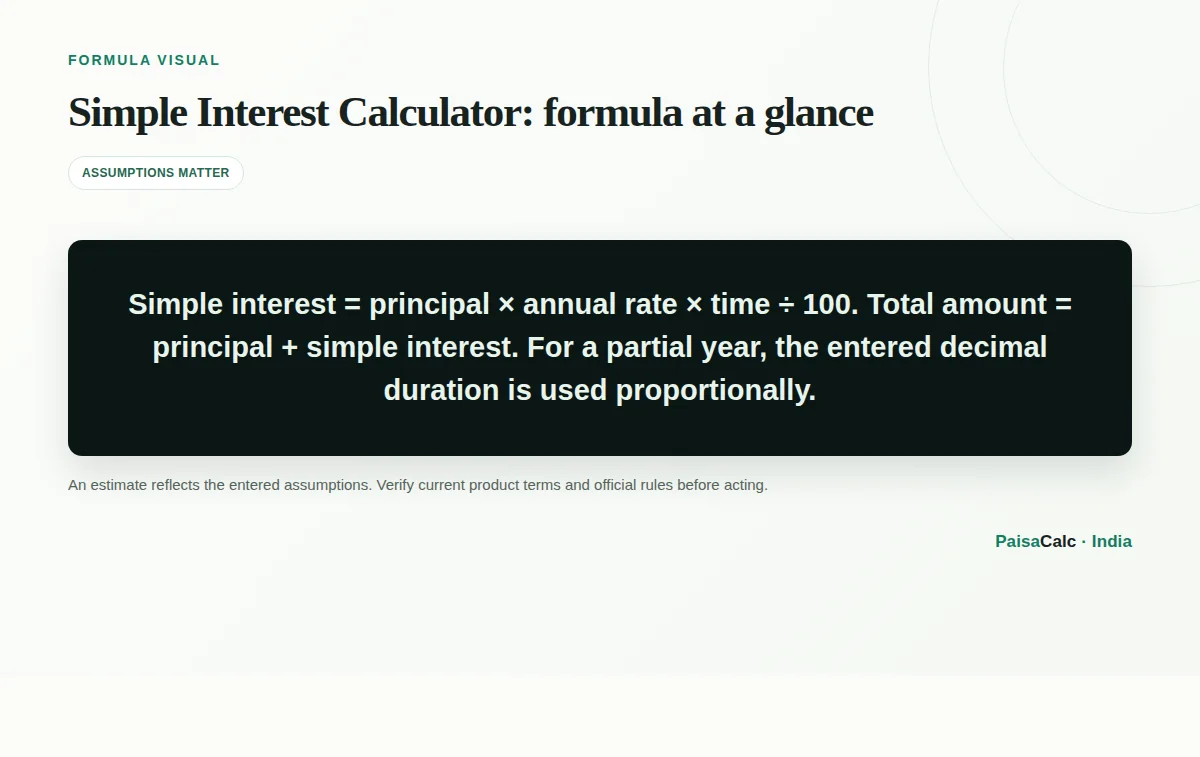
Simple interest = principal × annual rate × time ÷ 100. Total amount = principal + simple interest. In symbols, SI = P × R × T ÷ 100 and A = P + SI, where P is rupees, R is the annual percentage rate, T is time in years, and A is the final amount before adjustments. If the duration is a fraction of a year, use the decimal proportion required by the brief: three months is 0.25, nine months is 0.75, and 2 years 6 months is 2.5. Do not treat 6 months as “6 years” or enter 6 when the field expects years. Rounding shown on screen may be to the nearest rupee; an agreement can use paise or a particular day-count convention.
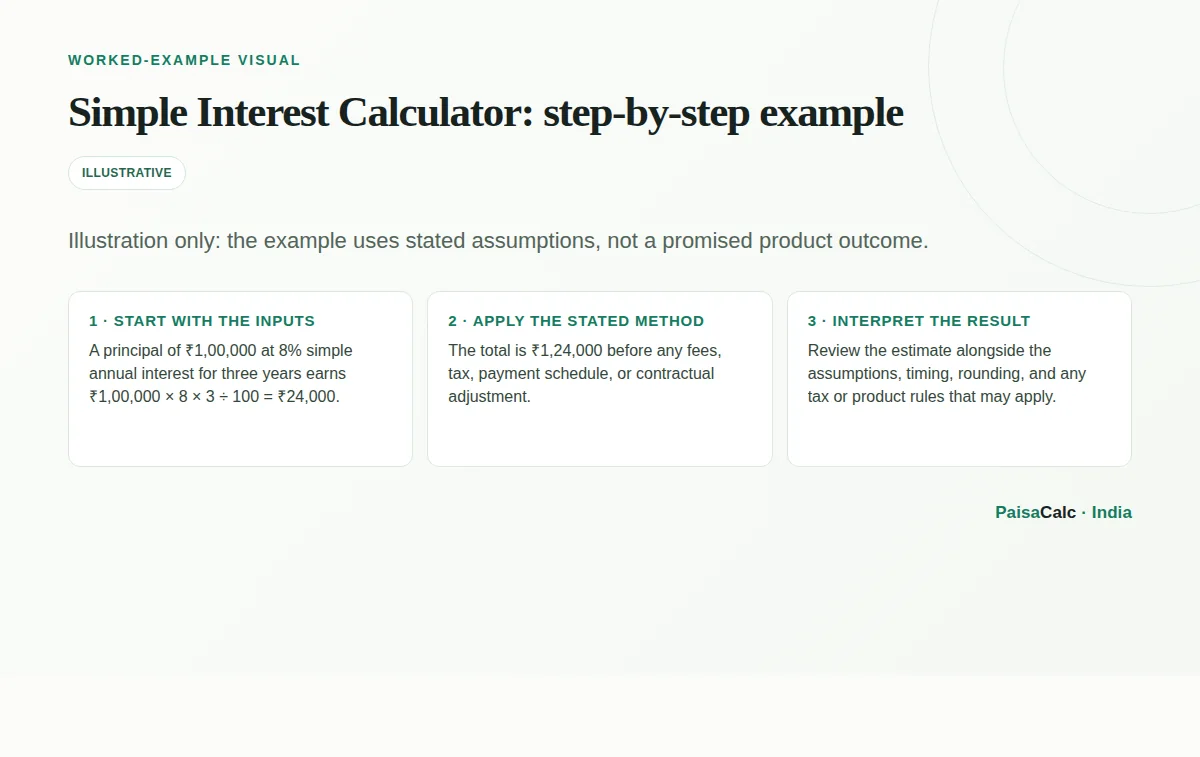
Suppose a person sets aside ₹1,00,000 at 8% simple annual interest for three years. First, identify P = ₹1,00,000, R = 8, and T = 3. Next, apply SI = 1,00,000 × 8 × 3 ÷ 100 = ₹24,000. Finally, add principal and interest: A = ₹1,00,000 + ₹24,000 = ₹1,24,000. For a shorter example, ₹50,000 at 7.2% for six months uses T = 0.5. SI = 50,000 × 7.2 × 0.5 ÷ 100 = ₹1,800, so the formula total is ₹51,800. These are before tax, fees, penalties, withholding, or a provider's rounding. If a statement differs, check compounding frequency, start and end dates, and whether the quoted rate is effective or nominal.
A student can use the calculator to verify an assignment or understand why a fixed principal and rate produce a straight-line result. A small Indian business can make a preliminary estimate for a delayed invoice when its written terms expressly specify simple annual interest. A family comparing two informal proposals can put both on the same principal-and-years basis before seeking professional or contractual confirmation. It can also provide a quick sanity check for a one-time advance or a short, fixed-period arrangement. However, do not assume that a fixed deposit, recurring deposit, personal loan, vehicle loan, or credit card uses this convention. Deposits may compound, and loan instalments normally reduce outstanding principal. Use the provider's schedule and a more suitable calculator for those products.
The main benefit is auditability. You can reproduce the answer with one multiplication and one addition, see the separate interest amount, and explain each input in rupees, percentage points, and years. This makes the calculator useful for budgeting a known one-time receipt or cost and for checking a manual calculation. It is also easy to test scenarios: change only the rate to see rate sensitivity, only the principal to see scale, or only the duration to see the linear effect. The output is an estimate rather than a promised return. Its clarity is a strength only when the underlying arrangement really uses simple interest and the principal does not change.
The most common error is using the simple formula for a compounding product. Other errors include entering 8 instead of 0.08 in a calculator that expects a percentage, treating months as years, or adding interest to principal repeatedly when the model says not to. Keep the units consistent: rupees, annual percentage, and years. Also check whether a loan has EMIs, a reducing balance, processing fees, late charges, or a floating rate. Check whether a deposit credits interest periodically and whether the quoted figure is annual, nominal, or effective. Tax can affect the amount you keep, but this calculator does not determine tax liability. A bank statement or signed agreement should override a generic estimate.
Start with the exact principal, rate, and dates in the agreement, then record the calculator result as a pre-tax and pre-fee baseline. Compare offers using the same principal and time horizon, but read the all-in cost or maturity schedule rather than comparing a headline percentage alone. Keep an emergency cash buffer separate from money committed for a fixed term. For a deposit or investment, consider purchasing-power changes and the tax treatment applicable to your situation before calling the result a return. For borrowing, include processing charges and the repayment schedule. If the balance changes through instalments or withdrawals, switch to an amortisation, recurring-deposit, or other cash-flow model; do not force those facts into a single-principal formula.
Because SI is proportional to each input, a 10% increase in principal, rate, or time produces a 10% increase in simple interest when the other two inputs are fixed. You can reverse the formula too: required rate = SI × 100 ÷ (P × T), and required time = SI × 100 ÷ (P × R). These rearrangements help audit a quoted interest amount, but they still inherit the model's assumptions. The biggest analytical limitation is the absence of compounding and cash-flow timing. A simple-interest result can therefore diverge materially from a product whose interest is credited and reinvested, or from a loan whose principal falls after every payment. Use this page to frame questions, then compare the provider's effective rate, day-count basis, balance method, fees, and tax position. Results remain estimates, not rate quotes or guaranteed outcomes.
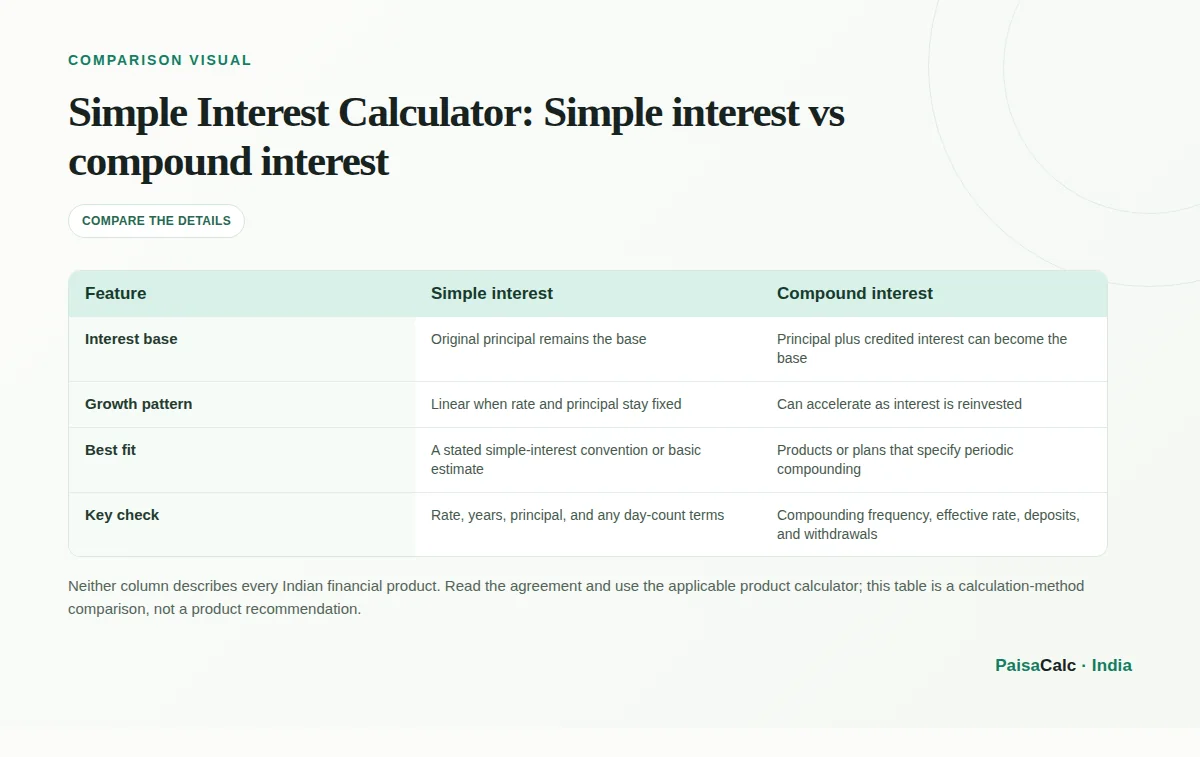
| Feature | Simple interest | Compound interest |
|---|---|---|
| Interest base | Original principal remains the base | Principal plus credited interest can become the base |
| Growth pattern | Linear when rate and principal stay fixed | Can accelerate as interest is reinvested |
| Best fit | A stated simple-interest convention or basic estimate | Products or plans that specify periodic compounding |
| Key check | Rate, years, principal, and any day-count terms | Compounding frequency, effective rate, deposits, and withdrawals |
Neither column describes every Indian financial product. Read the agreement and use the applicable product calculator; this table is a calculation-method comparison, not a product recommendation.
Simple interest equals principal × annual rate × time ÷ 100 when the rate is entered as a percentage. Total amount is principal plus that interest.
No. This model calculates every period's interest on the original principal, so previously calculated interest is not added to the base.
Convert months to years first. For example, six months is 0.5 years and three months is 0.25 years; the calculator applies the annual rate proportionally.
Usually not. An EMI loan generally has a changing outstanding balance and a repayment schedule. Use an amortisation or loan calculator for instalments and total interest.
No. It is a before-tax, before-fee formula result and does not include penalties, withholding, provider charges, or contractual adjustments.
It needs the original principal in rupees, the annual interest rate as a percentage, and the duration in years, including a decimal for a partial year.
With principal and annual rate unchanged, the simple-interest amount doubles because the model increases linearly with time. The total also rises by that additional interest.
Only as a generic estimate if the product's terms explicitly use simple interest. Check the bank's maturity calculation, compounding frequency, dates, and tax information first.
Simple interest uses the original principal throughout. Compound interest adds earned interest to the base at defined intervals, so later interest can be calculated on a larger balance.
The agreement may use daily accrual, a different day-count convention, compounding, a reducing balance, instalments, fees, tax, or different start and end dates.
Use primary and provider references to verify current rules, rates, and product terms.
The guidance to compare disclosed rates and charges and to treat the agreement as controlling product information.
The caution that tax treatment is separate from the pre-tax interest estimate and depends on the user's applicable rules.
TAKE A 30-SECOND BREAK
Three questions to help the key ideas stick.