Test principal 20% higher
Initial amount (₹): ₹1,00,000 → ₹1,20,000
Future value₹2,21,964₹2,66,357
INVESTING · FREE TOOL
Project growth when earned interest is reinvested. Adjust the assumptions and see how the result changes.
Interactive tool
Change the inputs to compare scenarios. Your values stay in this browser.
QUICK TAKEAWAY
This is a result from the assumptions currently entered. Compare a few alternatives below before drawing conclusions.
BASED ON YOUR INPUTS
With these inputs, future value is ₹2,21,964.
For context, compound interest is ₹1,21,964.
Test principal 20% higher changes future value from ₹2,21,964 to ₹2,66,357 in this model.
TRY A DIFFERENT ASSUMPTION
Each card recalculates from the inputs above.
Initial amount (₹): ₹1,00,000 → ₹1,20,000
Investment period (years): 10 → 15
A MINI CHALLENGE
Test a value here first. Your calculator changes only if you apply it.
Challenge reached: undefined.
Calculations run locally. Browser activity remembers calculator visits and quiz scores only—not financial inputs or results. Share links include values only when you choose to share them.
PaisaCalc guide · India

This calculator estimates the future value of one starting amount when interest is added back to the balance. Enter a principal in Indian rupees, an annual nominal rate, the term in years and compounding periods per year. It shows the original principal and estimated compound interest. For example, model ₹1,00,000 for 10 years at an assumed 8% compounded monthly. This is a mathematical scenario, not a quote or promise from a bank, mutual fund or other provider. It excludes regular deposits, withdrawals, fees and tax. Use it to compare 5, 10 and 15 years or quarterly and monthly compounding. Keep the result labelled an estimate, especially for market-linked investments.
Compounding makes time a practical planning variable. When earned interest stays invested, the next period begins with a larger balance. A household in Bengaluru saving for education or a salaried family in Pune can see why an early start may matter. The calculator turns an annual percentage into a comparable rupee scenario. Comparing the projected difference between 8% and 9% over a decade can be more useful than looking at the percentages alone, but it is not a forecast of a fixed market return. Inflation is a second lens in India. A larger nominal balance may buy less later, so compare this result with inflation and an after-tax estimate rather than treating it as guaranteed real wealth.
The calculator starts with the full principal, such as ₹1,00,000, and divides the annual nominal rate by the chosen frequency. At 8% with monthly compounding, the periodic rate is 8% ÷ 12. The balance updates once per period; 12 periods for 10 years means 120 updates. A frequency of 1 means annual, 4 quarterly, 12 monthly and 365 daily in a mathematical scenario. Use the convention in a product document; payment frequency is not necessarily compounding frequency. The model assumes one unchanged rate, full reinvestment and no withdrawals. Real products can use day counts, crediting dates, renewal terms or broken-period rules.
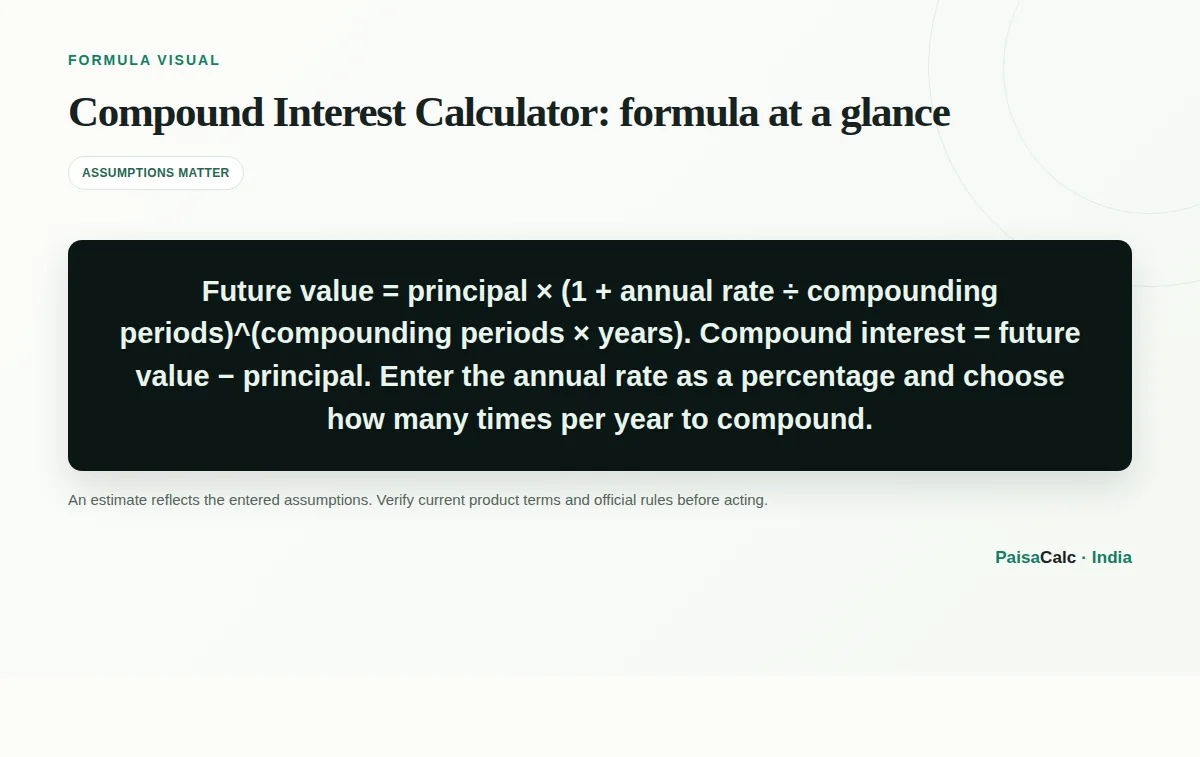
The formula is: Future value = P × (1 + r ÷ n)^(n × t). P is the initial rupee principal, r is the annual rate as a decimal, n is compounding periods per year and t is years. For an 8% input, r is 0.08, not 8. Compound interest = Future value − P. With ₹1,00,000, 8%, 12 periods and 10 years, future value is approximately ₹2,21,964 and estimated interest about ₹1,21,964, before fees and tax. Rounding may cause small differences. This is a nominal-rate calculation, not an effective annual rate or a return calculation for deposits made on different dates. Inflation, charges and tax are outside this formula.
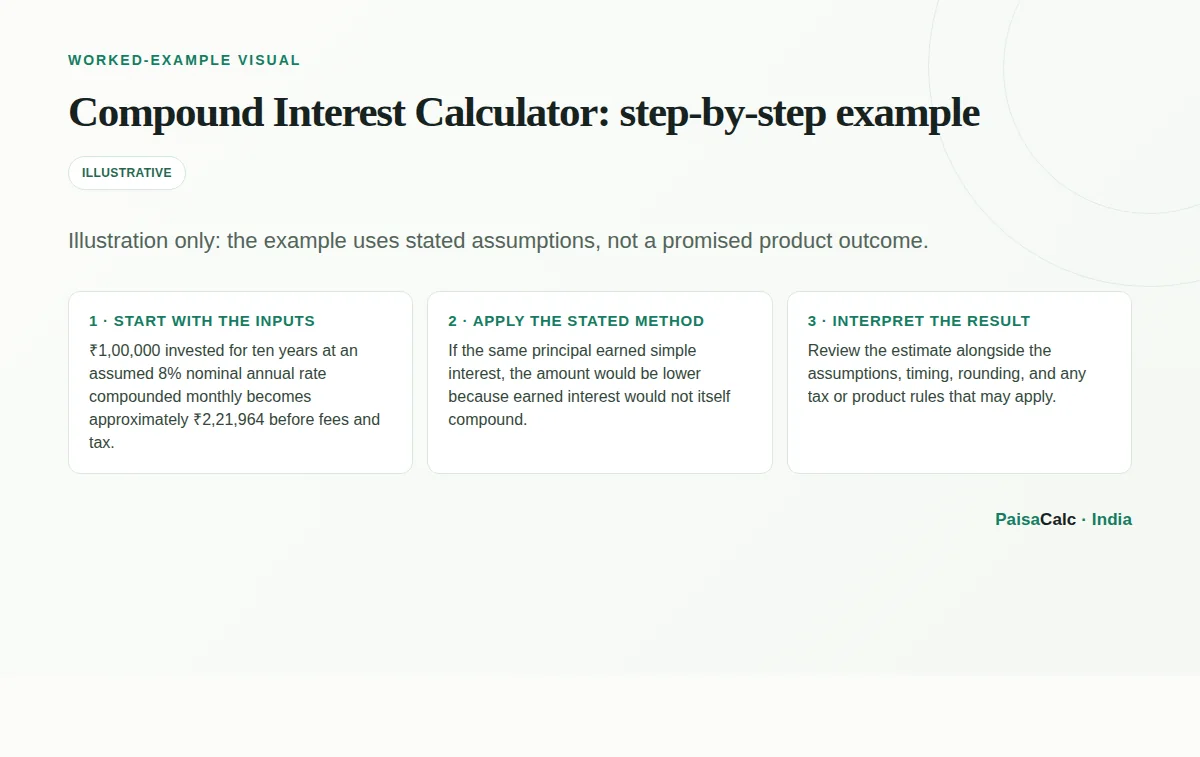
Suppose a saver has ₹1,00,000 for a long-term goal. Enter 100000 as principal, 8 as annual nominal rate, 10 as years and 12 as compounding per year. The inputs mean one lakh rupees, 8% per year, 10 years and monthly compounding. The model applies 0.08 ÷ 12, about 0.6667% per period, for 120 periods. Future value is approximately ₹2,21,964; less the original principal, estimated interest is about ₹1,21,964. The smooth curve reflects the unchanged-rate assumption. Repeat it with annual compounding, then 7% and 9%, and compare simple interest. These scenarios explain sensitivity; they do not justify choosing a product solely for a higher illustration.
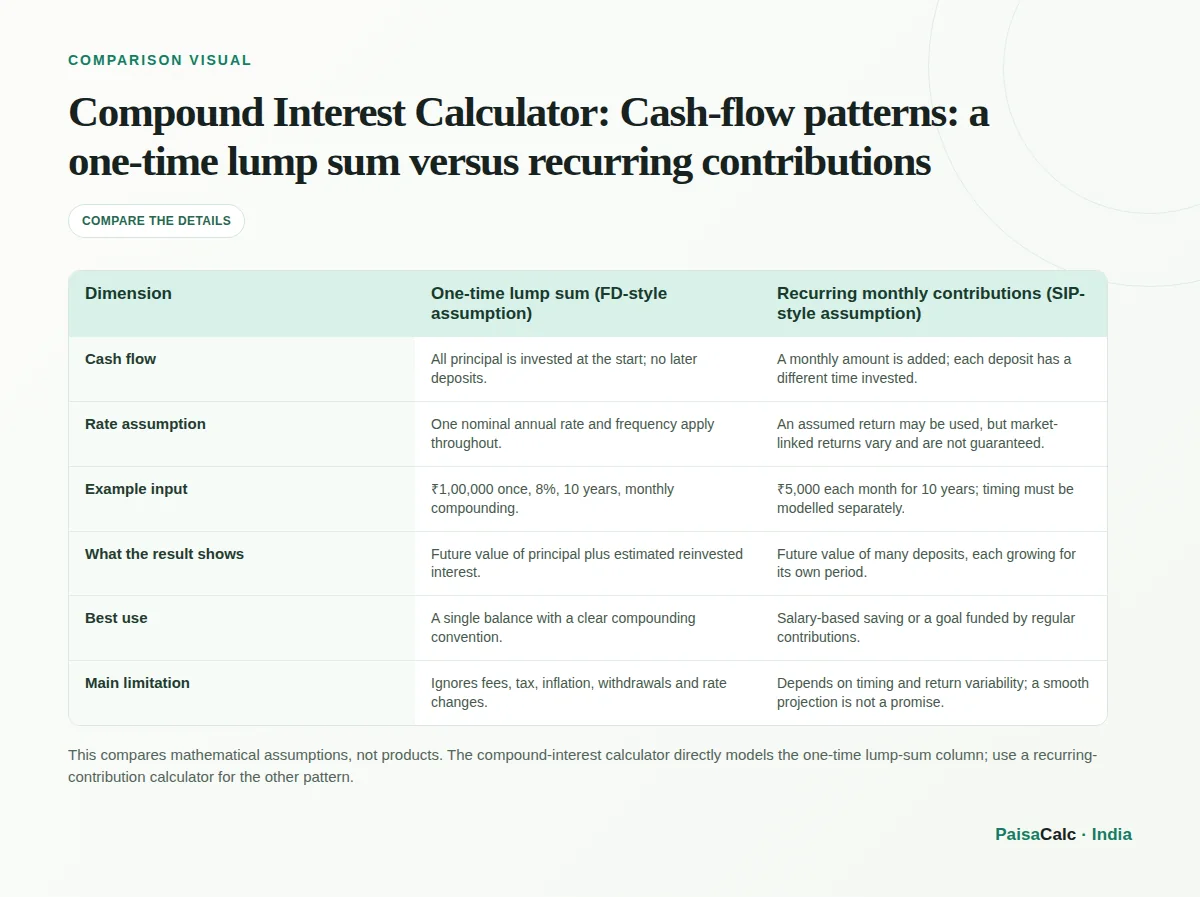
A family can use a conservative rate range to discuss a lump sum for a child’s higher-education goal in India. If it will add money each month, use an education-goal or recurring-contribution model instead. An investor reviewing a fixed-deposit-style lump sum can enter the stated rate and compounding convention for one, five or ten years. Check the institution’s product document for payout option, premature-closure terms, fees and tax treatment. A learner can contrast this one-time amount with a SIP-style pattern. Contributions arrive on different dates and market returns vary, so a recurring-investment calculator is the better model for that cash flow.
The main benefit is visibility. A beginner can see the original principal, estimated interest and ending value in rupees rather than hearing only that “interest earns interest.” Scenario testing is another benefit. Try a lower rate, shorter term and annual rather than monthly compounding. If a goal works only under an optimistic assumption, you can consider more saving, more time, a smaller target or a different risk level. It also prevents a common comparison error: a lump sum and monthly contributions are not equivalent inputs. Matching the tool to the cash flow makes the result more useful.
Do not type 8 when a form expects a decimal 0.08; this calculator expects a percentage. Do not enter 12 for years when you mean 12 months, and do not select monthly frequency merely because a product pays monthly. Do not treat a fixed-rate illustration as a decades-long promise. Check whether the figure is nominal or effective, whether interest is reinvested and whether the institution uses a particular day-count or crediting convention. Market-linked returns can fall. Remember cash flows. Adding ₹5,000 monthly, withdrawing for an emergency or paying a fee changes the balance path. Tax is also excluded, so use a cash-flow or tax-aware method where needed.
Start with a range rather than one attractive rate. Run conservative, middle and optimistic scenarios and record the principal, date and assumptions. Revisit a ten-year estimate as income, goals and available products change. Ask what the future value may buy after inflation and what may remain after fees and tax. An inflation calculator can provide a separate purchasing-power view; keep its assumptions clearly labelled. Match the tool to the cash flow: this one is for a starting amount, an RD or recurring model is for regular deposits, and a withdrawal model is for income from a corpus. Liquidity and risk capacity matter too.
For the same nominal rate, more frequent compounding raises the mathematical effective rate, but the difference is usually less important than starting earlier, investing longer, investing more or actually reinvesting returns. Change one input at a time to see its effect. The curve becomes steeper because each period applies the rate to a larger balance. A real market-linked asset may have negative periods, and a deposit may renew at a different rate, so the graph is a formula illustration rather than a forecast. For advanced planning, create separate after-tax and inflation-adjusted scenarios using dated, product-relevant assumptions. Do not guess a statutory rate. Keep the nominal output as the direct answer to this calculator’s formula.
| Dimension | One-time lump sum (FD-style assumption) | Recurring monthly contributions (SIP-style assumption) |
|---|---|---|
| Cash flow | All principal is invested at the start; no later deposits. | A monthly amount is added; each deposit has a different time invested. |
| Rate assumption | One nominal annual rate and frequency apply throughout. | An assumed return may be used, but market-linked returns vary and are not guaranteed. |
| Example input | ₹1,00,000 once, 8%, 10 years, monthly compounding. | ₹5,000 each month for 10 years; timing must be modelled separately. |
| What the result shows | Future value of principal plus estimated reinvested interest. | Future value of many deposits, each growing for its own period. |
| Best use | A single balance with a clear compounding convention. | Salary-based saving or a goal funded by regular contributions. |
| Main limitation | Ignores fees, tax, inflation, withdrawals and rate changes. | Depends on timing and return variability; a smooth projection is not a promise. |
This compares mathematical assumptions, not products. The compound-interest calculator directly models the one-time lump-sum column; use a recurring-contribution calculator for the other pattern.
Compound interest adds earned interest to the balance, so later periods can earn interest on prior interest. Simple interest applies the rate only to the original principal.
It is the number of compounding periods in one year: 1 annual, 4 quarterly or 12 monthly, for example. Follow the scenario or product convention.
No. It models one lump sum with no later contributions. Use a recurring-investment or goal calculator for regular deposits.
No. The result is before tax and fees. Treatment depends on investment type, holding period, income and rules for the relevant assessment period.
For the same nominal rate, more frequent compounding modestly increases the mathematical effective rate. Fees and changing returns can matter more.
Under these assumptions, it becomes approximately ₹2,21,964 before fees and tax. This is an illustration, not a guaranteed outcome.
You can model a fixed-deposit-style lump sum using its stated rate and frequency, but verify the institution’s terms, payout option and renewal conditions.
The product may use a different effective rate, day-count, crediting date, payout option, fee, tax treatment or rounding rule. Compare assumptions.
Not in this model. Withdrawals and later deposits change the balance path, so use a cash-flow-specific calculator.
Yes. A nominal future value does not show purchasing power. Run a separate inflation scenario and label its assumptions.
Use primary and provider references to verify current rules, rates, and product terms.
The future-value calculation applies a periodic rate over repeated compounding periods; the calculator’s formula explanation and example are based on this standard model.
India-focused guidance to consider product terms and financial-planning context rather than treating a generic illustration as a product promise.
The cautions that market-linked returns can vary and that investors should review relevant disclosures and risks.
TAKE A 30-SECOND BREAK
Three questions to help the key ideas stick.