Test current savings 20% higher
Current goal savings (₹): ₹1,00,000 → ₹1,20,000
Future education cost₹37,77,255₹37,77,255
PLANNING · FREE TOOL
Project future education costs and monthly savings needed. Adjust the assumptions and see how the result changes.
Interactive tool
Change the inputs to compare scenarios. Your values stay in this browser.
QUICK TAKEAWAY
This is a result from the assumptions currently entered. Compare a few alternatives below before drawing conclusions.
BASED ON YOUR INPUTS
With these inputs, future education cost is ₹37,77,255.
Unfunded goal shows a modeled surplus of ₹34,83,971.
Test current savings 20% higher changes future education cost from ₹37,77,255 to ₹37,77,255 in this model.
TRY A DIFFERENT ASSUMPTION
Each card recalculates from the inputs above.
Current goal savings (₹): ₹1,00,000 → ₹1,20,000
Years until goal: 12 → 13
A MINI CHALLENGE
Test a value here first. Your calculator changes only if you apply it.
Keep experimenting to test no unfunded amount.
Calculations run locally. Browser activity remembers calculator visits and quiz scores only—not financial inputs or results. Share links include values only when you choose to share them.
PaisaCalc guide · India

The Education Goal Calculator turns a fee quoted in today's rupees into an estimated target for a future admission date. Enter the current education cost, years until the goal, an education-inflation assumption, current earmarked savings and an assumed annual investment return. It then shows the future nominal cost, the projected value of those savings, the remaining amount to fund and an indicative monthly contribution.
This is a planning estimate, not a fee quotation or a promise about investment performance. The model is useful for an Indian school, undergraduate, postgraduate or professional-course goal when the time horizon is known. Education costs differ by institution, city, stream and academic year, so replace the starting cost with a realistic quote and include costs beyond tuition where they matter.
A fee that feels manageable today can be materially larger when admission is several years away. Compounding it by an education-inflation assumption makes timing risk visible. Starting early gives existing savings and monthly contributions more time to compound.
Families in India may need tuition, hostel or rent, books, devices, transport, examinations, insurance and travel. Public, private and overseas programmes have different cost drivers. A written target supports a higher fee-inflation case, a fixed-versus-step-up comparison and reviews after new fee schedules.
First, the calculator compounds the present cost for the entered number of years. Second, it compounds current goal savings at the assumed annual investment return. Third, it subtracts projected current savings from the future cost. Finally, it calculates the equal month-end contribution that would accumulate to the remaining amount over years × 12 months, using monthly compounding at the assumed return.
With ₹15,00,000 today, 12 years, 8% education inflation, ₹1,00,000 saved and a 9% return assumption, the target is about ₹37.77 lakh. Savings may grow to ₹2.81 lakh, leaving ₹34.96 lakh. The indicative contribution is about ₹13,566 monthly; actual results vary.
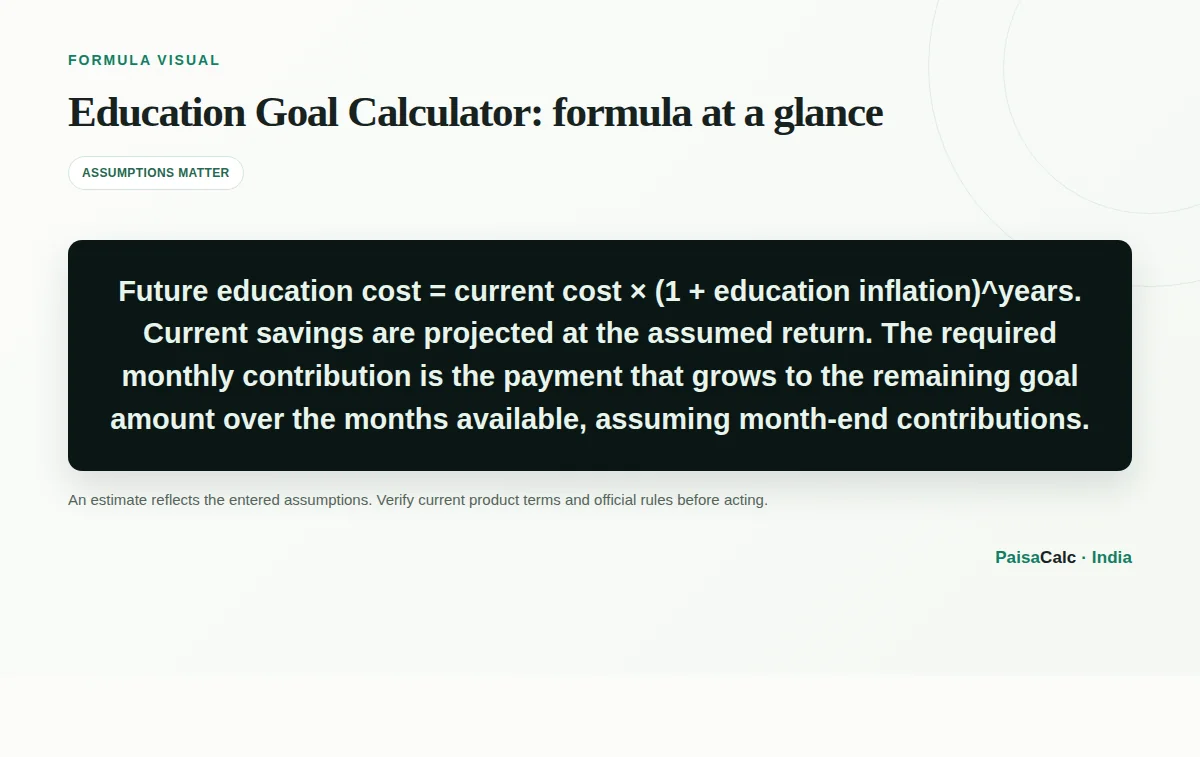
Let C be today's cost, i the education-inflation rate as a decimal, and y the years until admission. The future education cost is C × (1 + i)^y. If S is current goal savings and r is the assumed annual return as a decimal, projected current savings are S × (1 + r)^y. The remaining goal is the future cost minus projected current savings, floored at zero for a contribution display.
For n = 12y months and a monthly rate m = r/12, the month-end contribution P is remaining goal × m ÷ ((1 + m)^n − 1). If the assumed return is 0%, the equivalent is remaining goal ÷ n. This convention assumes regular deposits at month-end, a constant rate, no withdrawals, no fees, no taxes and no missed deposits. It is deliberately simple: use scenario testing rather than treating one rate as a forecast.
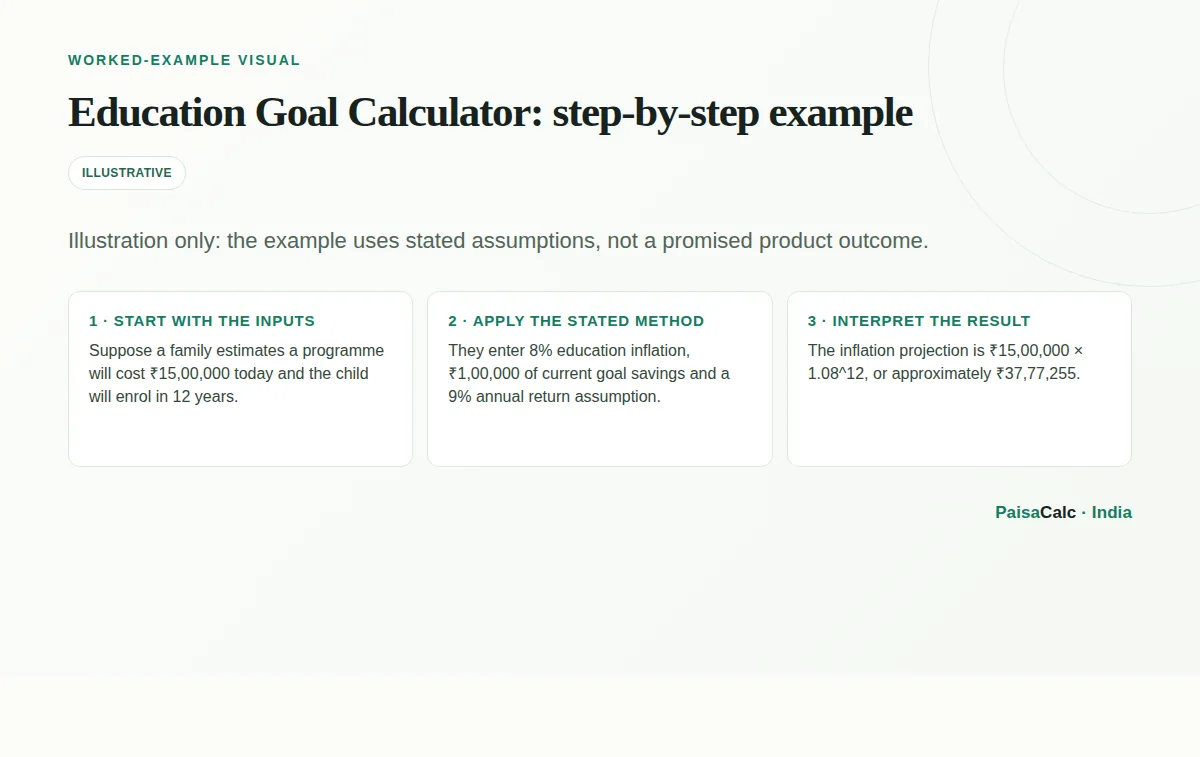
Suppose a family estimates a programme will cost ₹15,00,000 today and the child will enrol in 12 years. They enter 8% education inflation, ₹1,00,000 of current goal savings and a 9% annual return assumption. The inflation projection is ₹15,00,000 × 1.08^12, or approximately ₹37,77,255. This is a nominal future amount, not the purchasing power of today's rupees.
The earmarked ₹1,00,000 becomes approximately ₹2,81,266 at 9% compounded annually. The remaining projected goal is therefore approximately ₹34,95,989. With 144 month-end deposits and a monthly rate of 9% ÷ 12, the indicative contribution is around ₹13,566 per month. A prudent next step is to test 10% education inflation and 7% return: that combination raises the monthly requirement to roughly ₹19,949, demonstrating why a range is more useful than false precision.
For an Indian undergraduate course eight years away, use the latest fee schedule and add hostel, laptop and travel. For a professional qualification, separate course fees from coaching and exam attempts. With more than one child, run a scenario for each admission year.
Overseas study needs extra care. Convert tuition and living costs from the relevant foreign currency using a planning exchange-rate scenario, then consider visa, travel, health cover and currency buffers separately; this calculator does not model exchange-rate movement. A family expecting scholarships can run a conservative case without the scholarship and a second case with a documented award, rather than assuming uncertain aid will arrive.
The main benefit is translation: a distant obligation becomes a rupee target, date and monthly action. It reveals whether an existing ₹1 lakh or ₹5 lakh earmarking is meaningful and whether the saving fits the household budget. It encourages starting before the final school years, when cash-flow choices are narrower.
The calculator supports comparison without endorsing a product. Compare a level contribution with an annual step-up, test a lower return or move the goal date. Keep inputs and run date as a review record; actual fees, returns and expenses can differ.
A common error is using general consumer inflation as a proxy for a specialist course without checking actual fee history. Another is entering tuition only while forgetting accommodation, food, devices, books, examination charges, deposits, travel or currency exposure. Do not mix a present-day overseas fee in foreign currency with a rupee inflation rate; first make the units and scenario explicit.
Do not choose a high return simply to make the required monthly amount comfortable. Market returns are not guaranteed and may be uneven, especially near the withdrawal date. Avoid counting emergency cash, retirement money or a sibling's separate goal savings twice. Finally, do not assume a monthly deposit is made at the beginning when the output assumes month-end contributions; timing changes the result.
Begin with a cost sheet and target admission month. Run a base case, higher education inflation and lower return. Review after a new fee schedule, a date change or a missed contribution. If the amount is unaffordable, more time, a documented lump sum or a lower-cost path are transparent levers; do not hide the gap with an aggressive assumption.
Match liquidity to the payment calendar and reduce reliance on a last-minute market recovery. Keep an emergency reserve separate. For a step-up plan, set an annual increase that follows income changes; a sustainable lower contribution is better than an unaffordable promise.
The gap between education inflation and return is a key sensitivity. In the example, raising inflation from 8% to 10% increases the target from about ₹37.77 lakh to ₹47.08 lakh. Lowering return from 9% to 7% also reduces growth. Test inputs together because high costs and weak returns can coincide.
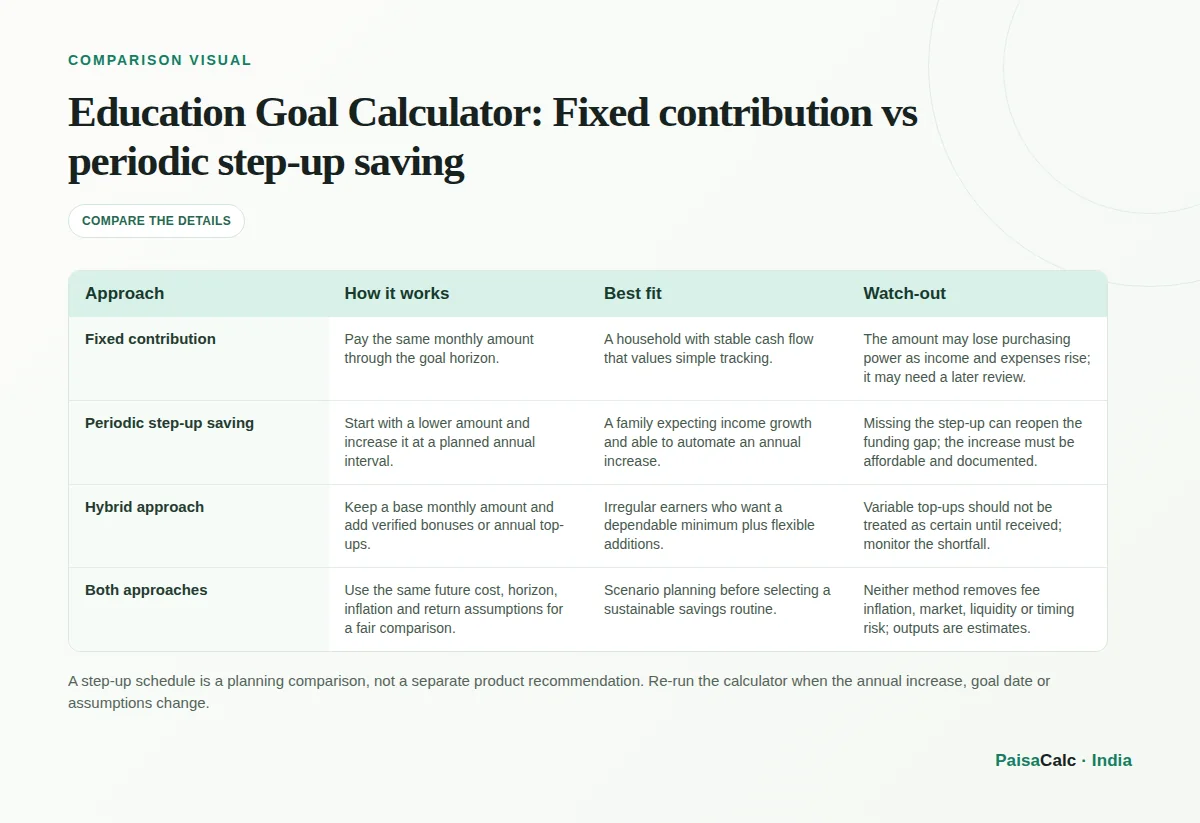
A fixed contribution is easy to monitor but may lose purchasing power as income changes. A step-up can begin lower and rise annually, but needs an income rule. For multiple goals, rank them by date and model each separately. Use the output as a range, not a guarantee.
| Approach | How it works | Best fit | Watch-out |
|---|---|---|---|
| Fixed contribution | Pay the same monthly amount through the goal horizon. | A household with stable cash flow that values simple tracking. | The amount may lose purchasing power as income and expenses rise; it may need a later review. |
| Periodic step-up saving | Start with a lower amount and increase it at a planned annual interval. | A family expecting income growth and able to automate an annual increase. | Missing the step-up can reopen the funding gap; the increase must be affordable and documented. |
| Hybrid approach | Keep a base monthly amount and add verified bonuses or annual top-ups. | Irregular earners who want a dependable minimum plus flexible additions. | Variable top-ups should not be treated as certain until received; monitor the shortfall. |
| Both approaches | Use the same future cost, horizon, inflation and return assumptions for a fair comparison. | Scenario planning before selecting a sustainable savings routine. | Neither method removes fee inflation, market, liquidity or timing risk; outputs are estimates. |
A step-up schedule is a planning comparison, not a separate product recommendation. Re-run the calculator when the annual increase, goal date or assumptions change.
Use an assumption informed by the course, institution and location. Compare published fee changes where available and run a higher case for a specialised or international programme; a headline rate may not match.
No. For overseas education, estimate tuition and living costs in the relevant foreign currency, then run exchange-rate scenarios and add travel, visa, insurance and other one-off costs separately.
No. The return is only an input assumption. Actual outcomes can be higher or lower and may be volatile, so use conservative cases and avoid relying on a favourable return close to the payment date.
Consider hostel or rent, food, transport, books, equipment, exam fees, deposits, insurance, travel and currency costs. Separate expenses paid before the course begins.
The formula assumes regular month-end contributions. Beginning-of-month investing has a slightly different compounding period, so keep the timing consistent when comparing the result with a bank standing instruction.
The remaining amount is treated as zero for the indicative contribution. Keep checking assumptions and payment dates; a surplus in one scenario does not remove fees or market risk the model omits.
Yes, provided the present cost, years and included expenses describe the school or course goal. For recurring annual school fees, consider separate admission years or a cash-flow plan because this calculator represents one target date.
Use a conservative case that does not depend on an uncertain scholarship, then run a second case for a documented award with its conditions and duration. Do not subtract a verbal or competitive possibility as though it were guaranteed.
Review annually and after a fee-schedule or date change, material income change or missed contribution. Record the date and assumptions to compare runs.
No. It only models a target, assumed return and regular contributions. Product selection should consider risk, liquidity, costs, tax treatment and suitability, and the result should not be read as a recommendation or a guaranteed corpus.
Use primary and provider references to verify current rules, rates, and product terms.
Supports explaining inflation as a change in prices and the need to distinguish a planning inflation assumption from a guaranteed future fee.
Supports the caution that investment outcomes are not guaranteed and that a calculator output is not a product recommendation.
Supports the India-focused context that higher-education institutions and streams differ; the calculator still requires a course-specific fee estimate.
TAKE A 30-SECOND BREAK
Three questions to help the key ideas stick.