Add five contribution years
Years remaining: 20 → 25
Projected EPF-style balance₹48,44,347₹77,71,065
RETIREMENT · FREE TOOL
Project EPF savings from monthly contributions and interest. Adjust the assumptions and see how the result changes.
Interactive tool
Change the inputs to compare scenarios. Your values stay in this browser.
Simplified EPF projection; employer EPS split, wage ceilings, interruptions and future interest declarations are not modelled.
QUICK TAKEAWAY
This is a result from the assumptions currently entered. Compare a few alternatives below before drawing conclusions.
BASED ON YOUR INPUTS
With these inputs, projected epf-style balance is ₹48,44,347.
The projected amount is ₹33,40,027 above modeled contributions or deposits; this is not a guaranteed return.
Add five contribution years changes projected epf-style balance from ₹48,44,347 to ₹77,71,065 in this model.
Model note: Simplified EPF projection; employer EPS split, wage ceilings, interruptions and future interest declarations are not modelled.
TRY A DIFFERENT ASSUMPTION
Each card recalculates from the inputs above.
Years remaining: 20 → 25
Employee EPF contribution (%): 12% → 13%
A MINI CHALLENGE
Test a value here first. Your calculator changes only if you apply it.
Keep experimenting to test ₹1 crore.
Calculations run locally. Browser activity remembers calculator visits and quiz scores only—not financial inputs or results. Share links include values only when you choose to share them.
PaisaCalc guide · India

This EPF calculator estimates how a starting Employees’ Provident Fund balance and regular monthly contributions could grow. Enter monthly basic pay plus dearness allowance, the employee EPF percentage, the employer EPF share that actually goes to EPF, your current balance, an assumed annual interest rate and years remaining. The result is an illustration, not an EPFO passbook. The model is designed for an Indian salaried employee reviewing a retirement plan. It assumes the entered wage base and contribution percentages continue each month. Use the basic-plus-DA figure from your payslip, not automatically your gross salary or cost-to-company. If payroll shows a different employer credit, enter its EPF portion separately from EPS.
EPF is often a large, automatic part of an employee’s long-term savings. A projection converts a payroll line into a retirement-corpus estimate, showing how balance, contribution rate and service interact. It can reveal whether a missing contribution or low employer EPF share changes the path. It is a planning baseline, not decades-ahead precision. For example, a 28-year-old employee can compare a conservative and optimistic interest assumption, while someone changing jobs can check whether a transfer and uninterrupted deposits are reflected in the starting balance. Actual credits depend on wages, timing, transfers, withdrawals, rules and yearly declared interest.
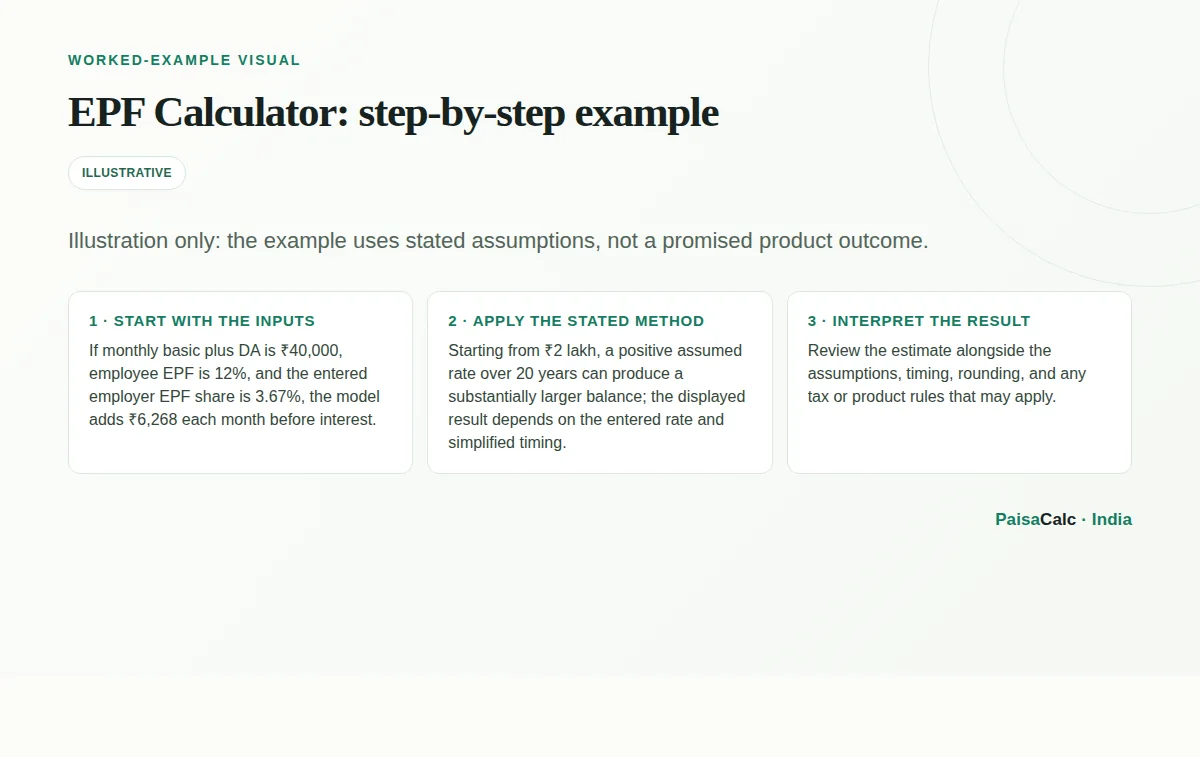
First, the calculator combines the two entered rates and applies them to monthly basic pay plus DA. With ₹40,000 as the wage base, 12% employee EPF and 3.67% employer EPF share, the monthly addition is ₹40,000 × 15.67% = ₹6,268. The employer input is deliberately separate: the full employer-side amount may not be credited to EPF because applicable rules can direct a portion to EPS or other statutory components. Next, each month’s estimated balance earns the entered annual rate divided by 12, and the month’s contribution is added under the calculator’s simplified timing convention. It repeats for the selected years, assuming steady employment, no withdrawals or breaks, no wage changes and a constant rate. Compare the result with posted passbook entries rather than treating it as a promise.
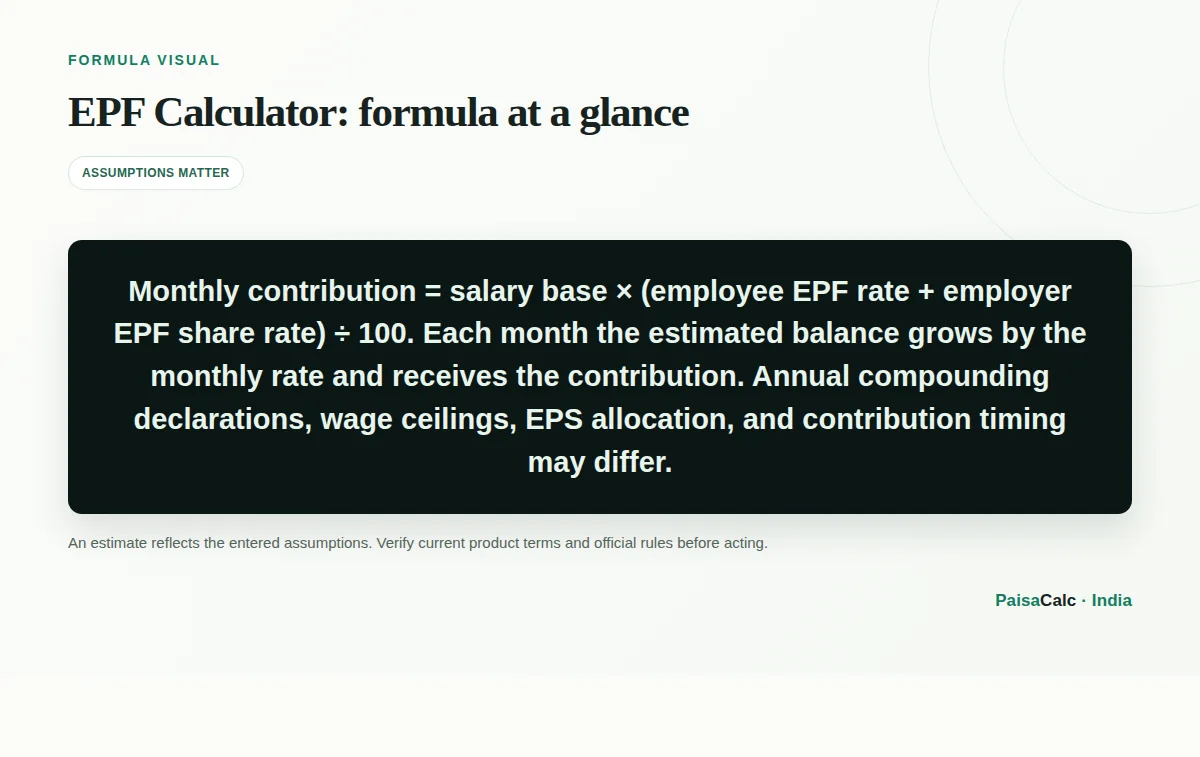
The monthly contribution formula is: monthly contribution = monthly basic plus DA × (employee EPF rate + employer EPF share rate) ÷ 100. The monthly interest assumption is annual rate ÷ 12. In a simple month-by-month projection, the balance is updated as: new balance = old balance × (1 + monthly rate) + monthly contribution. Repeating that update for 12 × years remaining gives the estimated future balance. The output separates deposits from illustrative compounding growth. First-month ordering can change the result slightly. EPFO’s actual interest is credited on a monthly running-balance basis at the statutory rate declared for each year; this calculator holds your chosen rate constant for easier scenario planning. Wage ceilings, annual declarations, EPS allocation and posting dates are not automatically modelled.
Suppose Priya enters monthly basic plus DA of ₹40,000, employee EPF of 12%, employer EPF share of 3.67%, current EPF balance of ₹2,00,000, an assumed annual rate of 8.25% and 20 years remaining. Her estimated monthly contribution is ₹40,000 × (12 + 3.67) ÷ 100, or ₹6,268. Over 240 months, the contribution-only total is ₹15,04,320; adding the opening ₹2,00,000 gives ₹17,04,320 before any estimated interest. The calculator then compounds the running balance monthly using the 8.25% assumption and reports a larger projected corpus plus an illustrative interest amount. Priya should rerun the example with a lower rate, a salary increase scenario outside this calculator, or a different employer EPF credit shown on her payslip. She should also compare the opening balance and monthly postings with her official passbook. A change in any input changes the estimate; the example is not a guaranteed maturity value.
A new employee can use the calculator to understand why basic pay—not take-home pay—matters and to set a first retirement target. An experienced employee can enter a passbook balance and test whether continuing deposits for 10, 20 or 30 years supports a broader retirement plan. Someone moving between employers can model the effect of transferring an old balance instead of starting from zero. Payroll teams and employees can use it as a reconciliation prompt: compare the entered wage base and employer EPF share with the payslip, then investigate persistent differences through the employer or EPFO channels. A person considering a withdrawal can see the opportunity cost of removing the opening balance, but must follow current EPFO procedures and tax guidance. It does not decide advance, transfer, settlement or pension eligibility.
The main benefit is visibility: balance, contributions and compounding are distinct. Testing two rates also helps prevent overconfidence in a single long-term number. The separate employer-share field encourages a more realistic reading of the payslip, particularly where EPS applies. It is also useful for conversations: take the assumptions to payroll, a financial planner or a household budget review. Its long horizon can support an emergency-fund decision before someone pauses saving. Date your assumptions and refresh them when pay, job status, balance or the declared rate changes. All results remain estimates and should not be presented as an EPFO confirmation.
The most common mistake is entering gross salary, CTC or net salary instead of the eligible basic-plus-DA wage base. Another is entering the entire employer-side percentage as EPF when payroll diverts part to EPS. Do not assume a current interest rate will remain unchanged for 20 or 30 years; test a range and label every scenario. Other errors include forgetting the opening balance, using a stale passbook figure, counting a voluntary contribution that is not actually posted, or ignoring a career break. It does not model salary revisions, ceilings, transfers, withdrawals, missing credits, exempted establishments, tax treatment or account-specific timing. Never use its output as proof that a claim is payable. Verify UAN and passbook records through official EPFO services.
Start with a clean baseline: download the latest passbook, identify the balance date, and copy the basic-plus-DA and employer EPF credit from a recent payslip. Run at least three cases—lower, central and higher assumed interest—and avoid increasing the rate merely to reach a desired corpus. Revisit the projection after a job change, pay revision, unpaid leave, transfer or withdrawal. Treat EPF as one retirement bucket, not the whole plan. Compare the estimate with expected future expenses, inflation and other permitted savings such as NPS or eligible investments; do not double-count an employer amount that goes to EPS. Maintain nominations and UAN details, and resolve discrepancies through payroll or EPFO. For tax, withdrawal or pension questions, use current official guidance because this projection does not apply those rules.
Small input changes compound over a long horizon. A ₹1,000 difference in monthly credited contribution may matter more over 25 years than a one-time adjustment, while a rate change affects both the opening balance and later deposits. To understand sensitivity, hold every input constant and change only one variable at a time. Record the result date, rate assumption and whether the employer share is EPF-only. The clean monthly model exposes assumptions. Real accounts may have changing wages, contribution ceilings, EPS diversion, delayed postings, transfers between member IDs and annual interest declarations. EPFO’s stated interest-credit method and statutory rate should therefore be checked against official updates. Use scenarios in a retirement budget, but keep the official passbook as the source of truth.
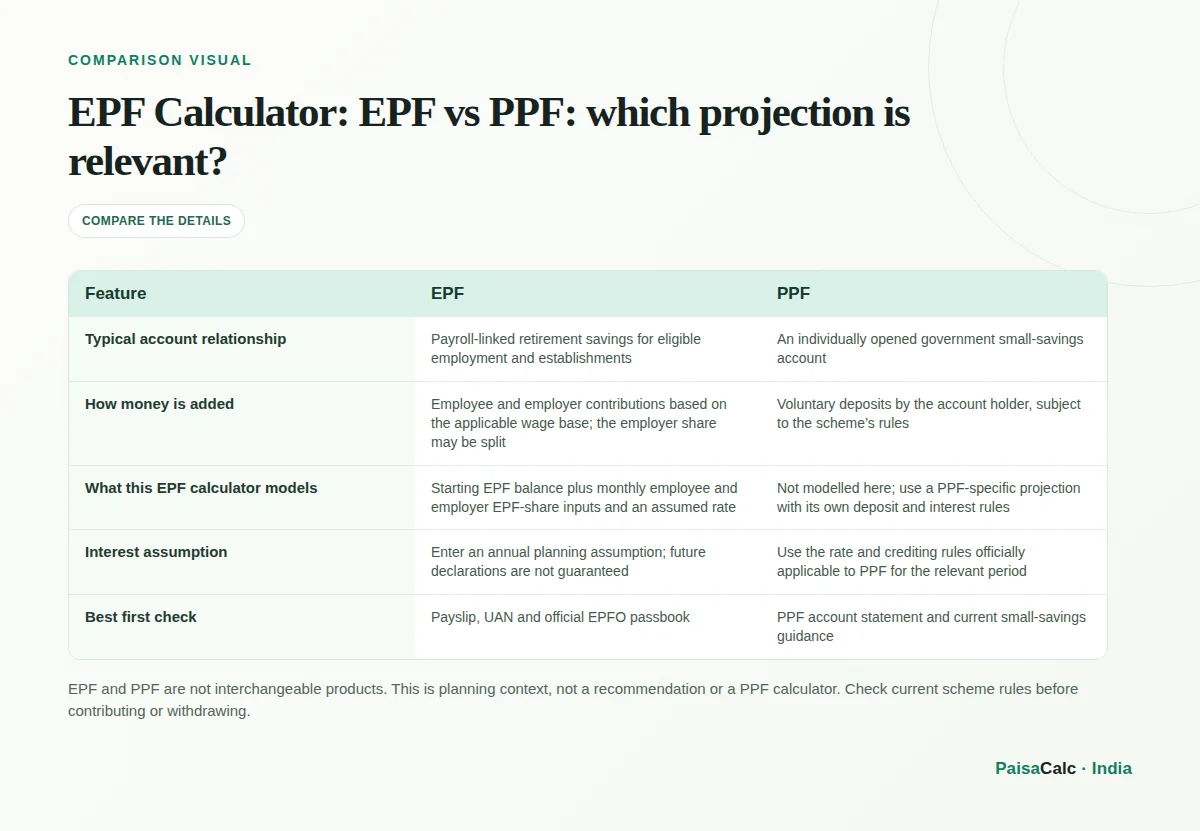
| Feature | EPF | PPF |
|---|---|---|
| Typical account relationship | Payroll-linked retirement savings for eligible employment and establishments | An individually opened government small-savings account |
| How money is added | Employee and employer contributions based on the applicable wage base; the employer share may be split | Voluntary deposits by the account holder, subject to the scheme’s rules |
| What this EPF calculator models | Starting EPF balance plus monthly employee and employer EPF-share inputs and an assumed rate | Not modelled here; use a PPF-specific projection with its own deposit and interest rules |
| Interest assumption | Enter an annual planning assumption; future declarations are not guaranteed | Use the rate and crediting rules officially applicable to PPF for the relevant period |
| Best first check | Payslip, UAN and official EPFO passbook | PPF account statement and current small-savings guidance |
EPF and PPF are not interchangeable products. This is planning context, not a recommendation or a PPF calculator. Check current scheme rules before contributing or withdrawing.
No. EPF interest is declared through the applicable process for each year and may change. This calculator keeps your entered annual rate constant only to illustrate scenarios.
Not necessarily. The employer-side contribution can be split between EPF, EPS and other statutory components under applicable rules. Enter the EPF share shown by payroll.
No. It projects an EPF-style account balance from the two entered contribution rates. EPS has separate eligibility, service and benefit rules.
Use the applicable monthly basic pay plus DA shown by your payslip or confirmed by payroll. Gross salary, allowances and statutory wage limits may not all be included.
No. The tool does not access your UAN or passbook and omits posting dates, missing credits, transfers, withdrawals and rule-specific details. Check EPFO records for the actual balance.
Enter the latest posted EPF balance from your official passbook. Exclude unposted credits and EPS amounts.
Replace the default with the EPF portion actually credited for your case, as confirmed on the payslip or by payroll. The field is an assumption, not a universal rate.
No. It only projects accumulation. Withdrawal and advance eligibility, forms, tax treatment and settlement amounts depend on current EPFO rules and account facts.
The estimate uses a constant annual rate and simplified monthly timing. Actual interest can reflect yearly declarations, running balances, posting dates, breaks, transfers and account-specific rules.
Review it after a pay or employer change, transfer, withdrawal, rate update and periodically against the passbook.
Use primary and provider references to verify current rules, rates, and product terms.
The explanation that employee and employer contributions are associated with basic wages plus DA, the employer share can be split, and official passbook records should be used for account truth.
The monthly running-balance explanation, the warning that yearly statutory rates apply, and the recommendation to check the UAN/passbook rather than treating a projection as an official balance.
The note explaining why 8.25% may be used as a scenario input while future years must not be assumed to carry the same declared rate.
PPF is a distinct government small-savings account with its own deposit terms and scheme rules; this supports the product-level comparison, not a current interest rate.
TAKE A 30-SECOND BREAK
Three questions to help the key ideas stick.