Test a 10% lower monthly withdrawal
Monthly withdrawal (₹): ₹30,000 → ₹27,000
Projected ending balance₹69,63,401₹87,30,463
INVESTING · FREE TOOL
Model periodic withdrawals from an invested corpus. Adjust the assumptions and see how the result changes.
Interactive tool
Change the inputs to compare scenarios. Your values stay in this browser.
Smooth-return scenario only. Actual market returns, taxes, fees and withdrawal timing can materially change outcomes.
QUICK TAKEAWAY
This is a result from the assumptions currently entered. Compare a few alternatives below before drawing conclusions.
BASED ON YOUR INPUTS
With these inputs, projected ending balance is ₹69,63,401.
For context, total planned withdrawals is ₹72,00,000.
Test a 10% lower monthly withdrawal changes projected ending balance from ₹69,63,401 to ₹87,30,463 in this model.
Model note: Smooth-return scenario only. Actual market returns, taxes, fees and withdrawal timing can materially change outcomes.
TRY A DIFFERENT ASSUMPTION
Each card recalculates from the inputs above.
Monthly withdrawal (₹): ₹30,000 → ₹27,000
Starting corpus (₹): ₹50,00,000 → ₹60,00,000
A MINI CHALLENGE
Test a value here first. Your calculator changes only if you apply it.
Challenge reached: a positive ending balance.
Calculations run locally. Browser activity remembers calculator visits and quiz scores only—not financial inputs or results. Share links include values only when you choose to share them.
PaisaCalc guide · India

This SWP Calculator models a systematic withdrawal plan from a starting investment corpus. Enter the corpus in Indian rupees, a fixed monthly withdrawal, an assumed annual return and the number of withdrawal months. It estimates the balance after each month and indicates whether the money lasts for the selected horizon.
An SWP is a way to redeem a specified amount at regular intervals; it is not a separate guaranteed-income product. The model is useful for an investor planning retirement cash flow, education funding or a regular family transfer. Results are estimates, not a promise from a mutual fund, platform or PaisaCalc.
A monthly withdrawal can look modest beside a large corpus, yet the total cash requirement grows quickly. ₹30,000 a month is ₹3,60,000 a year and ₹72,00,000 over 20 years before considering returns. Seeing that arithmetic alongside an assumed return helps an Indian household test whether a spending target is realistic rather than relying on a single first-year balance.
The timing of returns matters as much as the average. A portfolio that falls early while withdrawals continue may lose units at depressed prices, leaving fewer units to participate in a later recovery. A smooth projection cannot capture that sequence risk, but comparing lower-return and adverse scenarios can expose how sensitive the plan is.
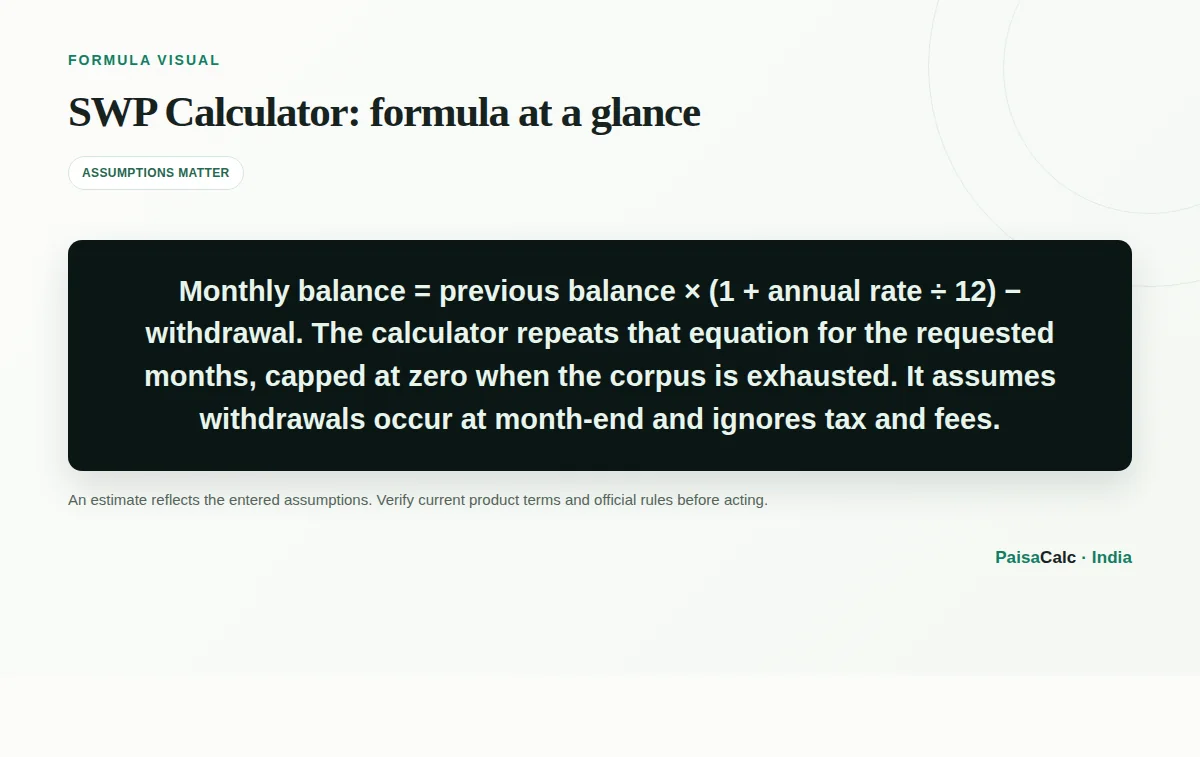
The calculator starts with the entered corpus. For every month, it first grows the previous balance by one-twelfth of the entered annual rate and then subtracts the fixed withdrawal. It repeats this sequence for the requested number of months, or stops at zero if the balance cannot fund the next withdrawal.
For example, at 8% the model uses 8% ÷ 12, or about 0.6667%, as the monthly rate. It does not convert 8% into an effective annual yield, and it does not add a different return for each market month. This is a deliberately simple scenario convention so two inputs can be compared consistently.
For month t, the core equation is: balance(t) = max(0, balance(t−1) × (1 + annual rate ÷ 12) − monthly withdrawal). The initial balance is the starting corpus, and the withdrawal is treated as a fixed rupee amount. The calculation repeats until the requested months are complete or the balance reaches zero.
With a ₹50,00,000 corpus, ₹30,000 withdrawal and 8% assumed annual return, the first month is ₹50,00,000 × (1 + 0.08 ÷ 12) − ₹30,000, or approximately ₹50,03,333. The next month applies the same monthly rate to that new balance before subtracting ₹30,000. Rounding in a displayed result can make a few paise differ from a hand calculation.
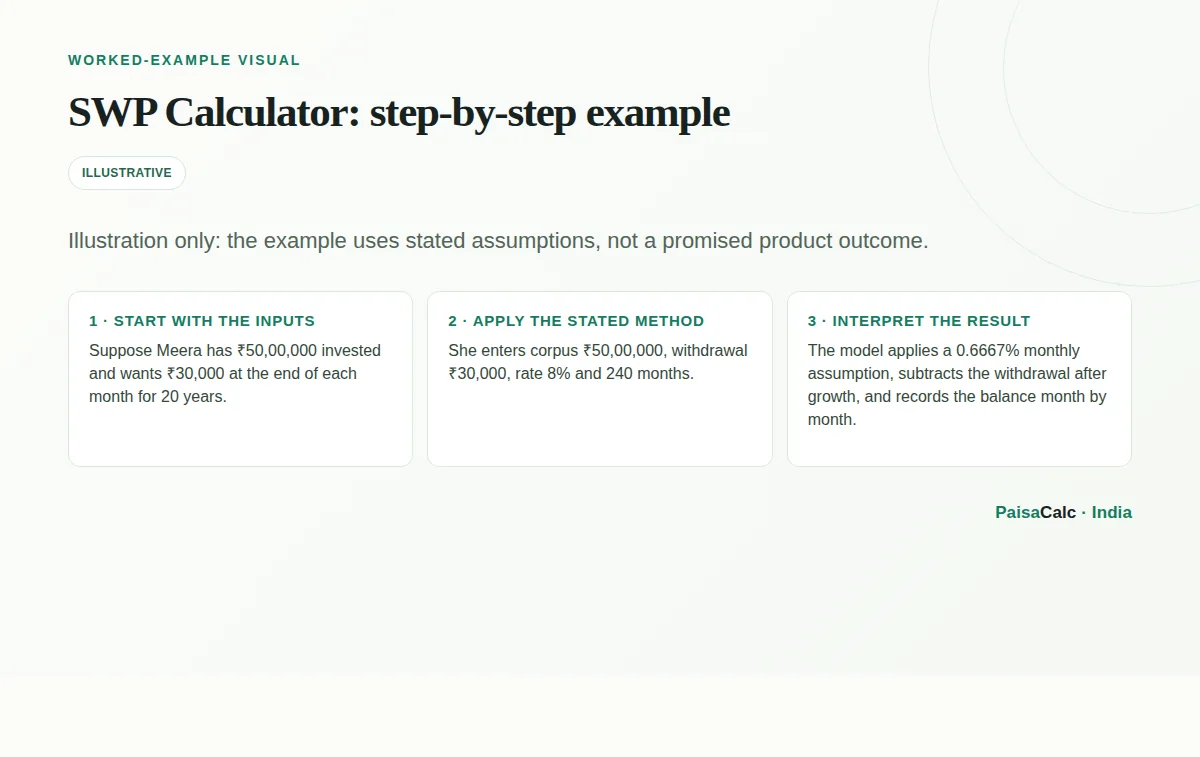
Suppose Meera has ₹50,00,000 invested and wants ₹30,000 at the end of each month for 20 years. She enters corpus ₹50,00,000, withdrawal ₹30,000, rate 8% and 240 months. The model applies a 0.6667% monthly assumption, subtracts the withdrawal after growth, and records the balance month by month.
For a stress check, Meera changes the return to 0%. Total scheduled withdrawals would be ₹30,000 × 240 = ₹72,00,000, well above the original corpus. Under the calculator's month-end convention, the balance reaches zero during month 167, so the full 20-year schedule cannot be paid. The 8% scenario may show a balance at month 240, but that number is only a smooth-return illustration.
A recently retired couple in Pune might use the model to compare a ₹40,000 monthly household draw with a ₹25,000 draw plus pension income. The calculator can show how much flexibility remains if withdrawals are reduced during a poor market period, but it cannot decide which asset allocation or fund is suitable.
Parents saving for a child’s higher education may model a temporary withdrawal window rather than a lifelong income. They can enter the expected corpus and the months between an admission date and later cash needs, then check whether a fixed redemption drains money needed for fees, rent or travel. Short horizons deserve extra caution because there is less time to recover from a fall.
The main benefit is transparency. Four inputs show the trade-off between starting corpus, monthly cash flow, assumed return and time. Changing one input at a time helps a beginner see why a higher withdrawal or longer horizon puts more pressure on the balance, while a larger corpus provides more room for uncertainty.
A month-by-month chart can also improve planning conversations. A family can discuss whether spending is essential, whether a withdrawal can be paused, and how much money should remain in liquid instruments. Running a range of assumptions is more useful than presenting one attractive end balance without context.
The most serious mistake is reading the assumed annual return as a guarantee. Mutual fund and market-linked investments can produce losses, and the same average return can have different outcomes when monthly returns arrive in a different order. Test a poor return and an early decline instead of relying only on the default rate.
Another error is leaving inflation out of the spending decision. A fixed ₹30,000 withdrawal may buy less in ten years than it does today. This calculator keeps the withdrawal fixed, so an investor whose expenses rise may need a separate inflation scenario or a planned increase that this simple model does not automatically perform.
Start with a spending budget split into essential and flexible costs. Set the proposed withdrawal against pension, rent, interest and other income, then decide which expenses can be cut if markets fall. Keeping several months of near-term expenses in an appropriate liquid reserve can reduce the need to sell volatile assets at an inconvenient time.
Run at least three cases: a cautious return, a middle scenario and a no-return or negative-return stress case. Also test a higher withdrawal and a longer life or goal horizon. The point is not to find a magical safe percentage; it is to discover how much flexibility the plan needs and when a review should happen.
A fixed-return projection can be used for sensitivity analysis, not probability. Compare the ending balance and depletion month after changing one assumption. The slope of the balance path reveals whether the plan is mainly funded by portfolio growth or by consuming principal; a plan that needs persistent growth has less tolerance for a bad sequence of returns.
Sequence risk is especially important when withdrawals begin near a market peak or before a prolonged decline. Two portfolios with the same long-run average return can produce different cash outcomes if one loses value in its first years. A useful practical test is to reserve near-term withdrawals outside higher-volatility assets and rebalance deliberately rather than selling whatever has fallen most.
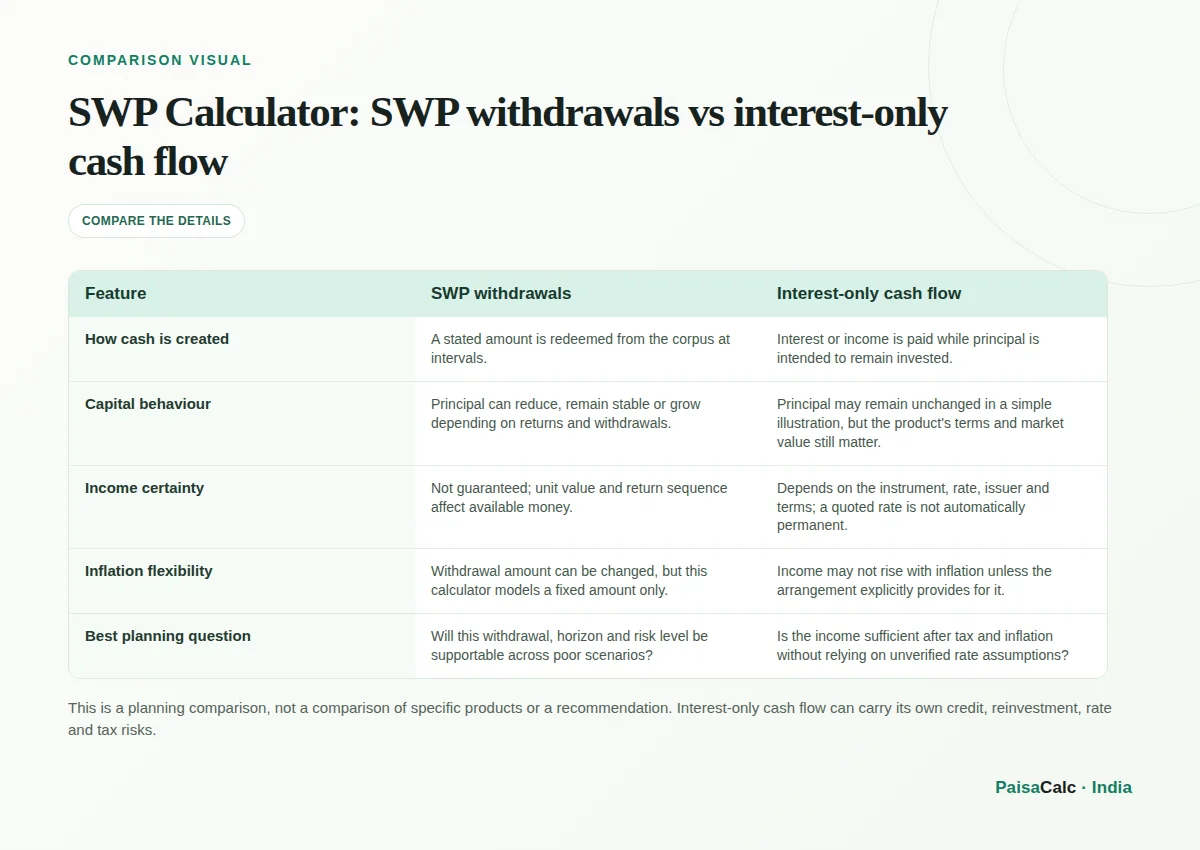
| Feature | SWP withdrawals | Interest-only cash flow |
|---|---|---|
| How cash is created | A stated amount is redeemed from the corpus at intervals. | Interest or income is paid while principal is intended to remain invested. |
| Capital behaviour | Principal can reduce, remain stable or grow depending on returns and withdrawals. | Principal may remain unchanged in a simple illustration, but the product's terms and market value still matter. |
| Income certainty | Not guaranteed; unit value and return sequence affect available money. | Depends on the instrument, rate, issuer and terms; a quoted rate is not automatically permanent. |
| Inflation flexibility | Withdrawal amount can be changed, but this calculator models a fixed amount only. | Income may not rise with inflation unless the arrangement explicitly provides for it. |
| Best planning question | Will this withdrawal, horizon and risk level be supportable across poor scenarios? | Is the income sufficient after tax and inflation without relying on unverified rate assumptions? |
This is a planning comparison, not a comparison of specific products or a recommendation. Interest-only cash flow can carry its own credit, reinvestment, rate and tax risks.
No. An SWP is a redemption instruction, not a guaranteed annuity. The available value can change with market prices, and continued withdrawals can reduce or exhaust the invested capital.
Tax treatment depends on the investment type, holding period, gains, transaction date and current law. This calculator does not estimate tax, so confirm the applicable position with official guidance or a tax professional.
No. It applies one smooth monthly rate derived from the entered annual rate. Actual returns can be uneven, and the order of gains and losses can materially change the outcome.
The simulation caps the balance at zero and reports the depletion point. It cannot fund a complete scheduled withdrawal after the available corpus has been exhausted.
Not necessarily. A sustainable withdrawal depends on horizon, inflation, fees, taxes, portfolio risk and flexibility. Comparing a withdrawal with an average return alone does not establish a safe rate.
You can use it as a generic scenario for a market-linked corpus, but it does not model a particular scheme's NAV, asset mix, charges, exit load, tax or transaction processing date.
There is no universally correct rate. Use a range rather than a promotional or guaranteed figure, include a zero or adverse case, and make the assumption clear when discussing the result with your family or adviser.
This version assumes one fixed monthly withdrawal. To explore rising expenses, run separate scenarios with higher fixed withdrawals; do not assume an inflation-linked increase is included automatically.
No. The formula ignores fees, exit loads, taxes and other transaction effects. The displayed balance is therefore a gross illustrative estimate and may differ from money actually credited.
Neither is automatically better. An SWP sells units from a market-linked corpus, while interest-only cash flow depends on the instrument and its rate. Compare cash-flow stability, capital risk, inflation, liquidity and tax rather than one headline figure.
Use primary and provider references to verify current rules, rates, and product terms.
Supports the generic explanation that mutual funds pool investor money, publish NAV information, permit redemptions and are market-linked investments; it also supports reviewing risks and scheme information rather than treating returns as guaranteed.
Supports the description of an SWP as a fixed amount withdrawn at regular intervals through partial redemption, and the caution that the remaining corpus can increase or decrease with performance and withdrawals.
Supports the caution that tax treatment of gains and redemptions depends on facts and rules in force; the calculator intentionally makes no tax estimate.
TAKE A 30-SECOND BREAK
Three questions to help the key ideas stick.