Test salary 10% higher
Eligible monthly wages (₹): ₹50,000 → ₹55,000
Illustrative gratuity₹2,88,462₹3,17,308
TAX & SALARY · FREE TOOL
Estimate gratuity from eligible monthly wages and service history. Adjust the assumptions and see how the result changes.
Interactive tool
Change the inputs to compare scenarios. Your values stay in this browser.
A simplified coverage and service prompt only; verify legal eligibility, statutory limits and tax treatment.
QUICK TAKEAWAY
This is a result from the assumptions currently entered. Compare a few alternatives below before drawing conclusions.
BASED ON YOUR INPUTS
With these inputs, illustrative gratuity is ₹2,88,462.
For context, formula amount before eligibility check is ₹2,88,462.
Test salary 10% higher changes illustrative gratuity from ₹2,88,462 to ₹3,17,308 in this model.
Model note: A simplified coverage and service prompt only; verify legal eligibility, statutory limits and tax treatment.
TRY A DIFFERENT ASSUMPTION
Each card recalculates from the inputs above.
Eligible monthly wages (₹): ₹50,000 → ₹55,000
Completed years of service: 10 → 11
Calculations run locally. Browser activity remembers calculator visits and quiz scores only—not financial inputs or results. Share links include values only when you choose to share them.
PaisaCalc guide · India

This Gratuity Calculator is a planning tool for an employee who wants an illustrative estimate of a terminal employment benefit in India. Enter an eligible monthly wage base in rupees, completed years of service, and whether the establishment is marked as covered. The output is a gross estimate, not a payroll settlement or legal decision.
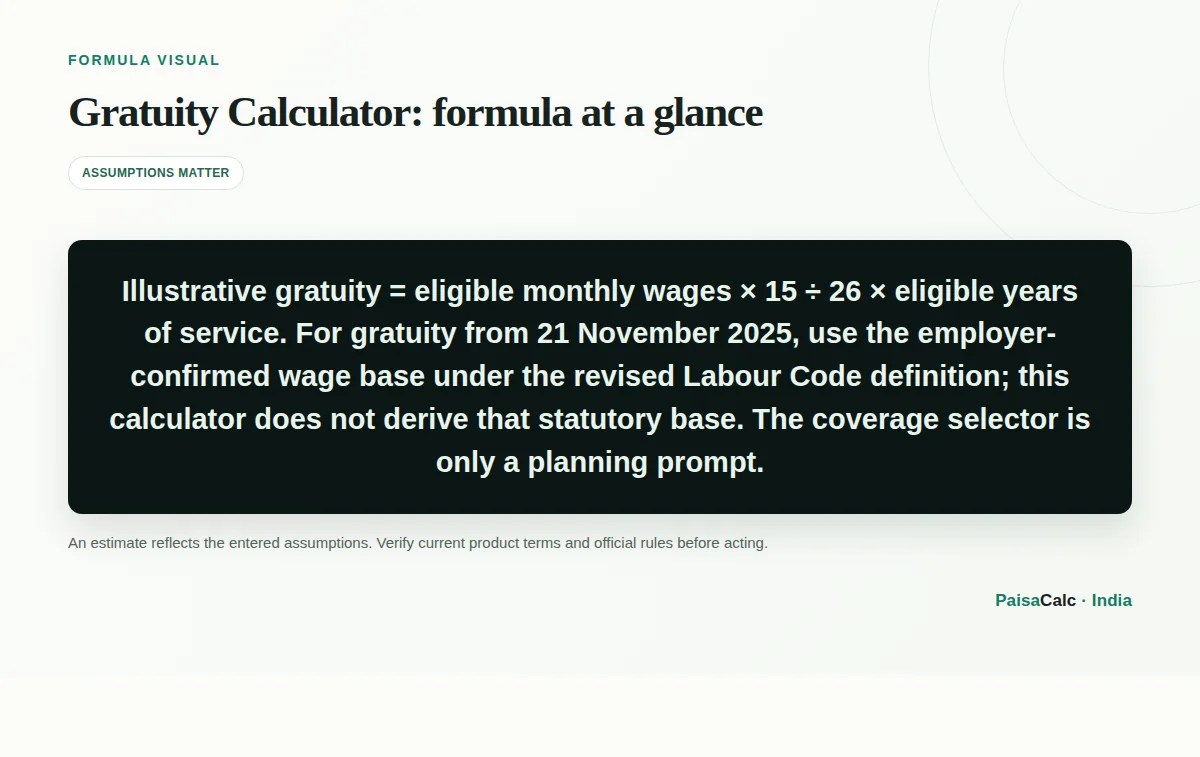
The arithmetic follows a commonly used monthly-rated formula for an eligible case: eligible monthly wages × 15 ÷ 26 × eligible years. It uses the wage base and service number you enter; it does not inspect an appointment letter, payroll record, service break, cap, forfeiture issue, tax return, or current law. For gratuity from 21 November 2025, Ministry guidance says the revised definition of wages under the Labour Codes applies; the tool does not derive that statutory wage base.
Gratuity can be a meaningful part of an Indian employee’s transition from one job to another, retirement, or another qualifying exit. A salary slip may show basic pay, DA, allowances, deductions, and CTC separately, so a quick estimate helps you understand why a gratuity figure will not usually equal one month of gross salary or the full CTC.
A transparent estimate also gives you useful questions to ask before a final settlement: which salary components were used, how service was counted, whether the establishment is covered, what rounding was applied, and whether any statutory limit or special circumstance affects the payment. It supports a conversation; it does not establish entitlement. The wage base is date-sensitive: the Ministry’s 2026 FAQ states the revised definition of wages applies from 21 November 2025.
Enter the monthly eligible wage base identified by payroll under the law applicable to the relevant exit date; do not assume that basic pay plus DA alone is always the correct current input. Enter eligible years of service as a whole-year planning input. For example, an assumed ₹50,000 monthly wage base and 10 years produce the same arithmetic whether the employee is in Mumbai, Bengaluru, or another Indian location; location alone does not change this illustrative formula.
The covered-establishment selector is a prompt to think about applicability, not an eligibility test. The estimate applies 15 days per eligible year using 26 as the monthly divisor. It does not automatically decide the treatment of a service fraction, death or disability, seasonal work, resignation, dismissal, disputed service, statutory amendments, or an employer’s more favourable policy.
For the calculator’s planning model, illustrative gratuity = (employer-confirmed monthly eligible wage base) × 15 ÷ 26 × eligible years. The 15/26 factor represents 15 days’ wages divided by the 26-day monthly convention used by this simplified model.
For gratuity from 21 November 2025, the Ministry says the revised wage definition under the Labour Codes applies. Enter a wage base confirmed for the relevant date rather than expecting the calculator to construct statutory wages from a payslip. The tool still excludes any applicable cap, tax treatment, forfeiture, special eligibility rule, or employer adjustment.
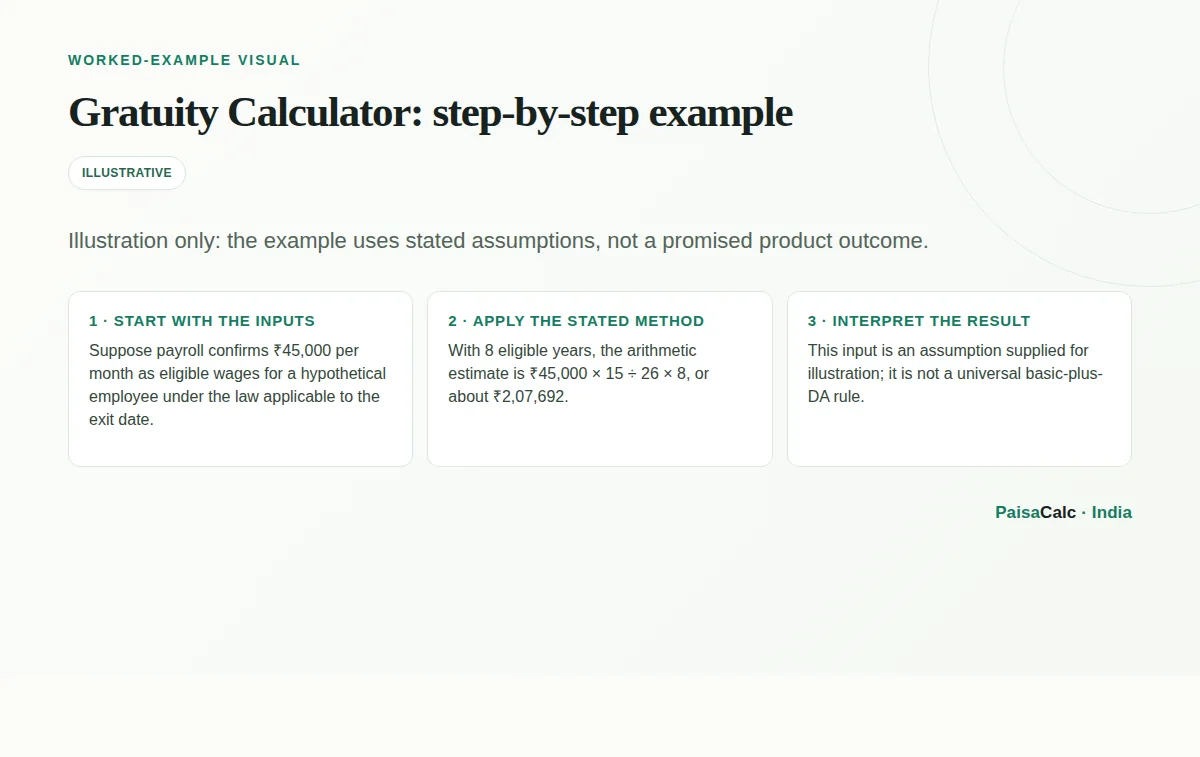
Suppose payroll confirms ₹45,000 per month as eligible wages for a hypothetical employee under the law applicable to the exit date. With 8 eligible years, the arithmetic estimate is ₹45,000 × 15 ÷ 26 × 8, or about ₹2,07,692. This input is an assumption supplied for illustration; it is not a universal basic-plus-DA rule.
Now test a change in service length. At the same ₹45,000 wage base, 10 eligible years gives about ₹2,59,615, while 8 years gives about ₹2,07,692. That difference is a planning illustration, not proof that two extra years automatically create entitlement.
Before resigning from a private-sector job in India, an employee can use the estimate to separate possible gratuity from salary arrears, leave encashment, bonus, and provident-fund balances. Comparing an offer can also show why the employer-confirmed eligible wage base, rather than headline CTC alone, matters to a future benefit.
HR or payroll teams can use the arithmetic as a sense-check when explaining a settlement, provided the official calculation is done from employment records. A disputed service period, transfer between entities, death, disability, or termination deserves case-specific review rather than a calculator-only answer.
The result makes the wage base, 15/26 factor, and service years visible, so an employee can spot a misunderstanding between eligible wages and total gross pay. For a current exit, the statutory wage definition changed from 21 November 2025; testing several assumed inputs shows how strongly the estimate depends on the base confirmed by payroll.
It is useful for scenario planning without pretending to forecast a final settlement. Save the date, salary slip, service assumption, and coverage assumption next to the result. When the employer supplies a written computation, compare the assumptions line by line.
Do not enter gross salary, take-home pay, or total CTC as the wage base. Do not assume that basic pay plus DA alone automatically defines eligible wages for an exit on or after 21 November 2025; use the revised Labour Code definition and obtain the employer’s component breakdown. Also do not assume that selecting “covered” proves statutory coverage.
Another mistake is treating a five-year service idea as an automatic answer for every employee. The Ministry’s 2026 FAQ states that a directly employed fixed-term employee is eligible after one year under the contract, while contract labour is treated separately; other exceptions and special facts can matter. Do not assume the displayed amount is tax-free, uncapped, or payable immediately. Check current official law and the employer’s written settlement.
Use gratuity as a possible future cash flow, not as an emergency fund that is already available. Keep a separate liquid reserve for job transition and near-term expenses. If you include an estimated gratuity in a retirement or debt plan, label it as uncertain and test a lower or zero receipt case until eligibility and the amount are confirmed in writing.
Maintain appointment letters, promotion letters, salary slips, transfer records, attendance or service evidence, and the relieving or retirement document. Ask payroll to identify the salary base, completed service period, rounding method, coverage, any cap, and tax handling. Tax exemption is distinct from the gross gratuity calculation, so confirm the current position with the Income Tax Department or a qualified adviser. For an exit from 21 November 2025, ask payroll which wage components and exclusions were used under the revised definition; do not carry forward an old basic-plus-DA spreadsheet without checking.
Because the model is linear, a 10% increase in the eligible salary input produces a 10% increase in the illustrative result when service years and the formula are unchanged. Similarly, one additional entered year adds one more 15/26 salary slice. Real employment records may change the eligible years, salary definition, or legal treatment at the same time.
The most important advanced distinction is gross benefit versus net cash. A gross estimate can be affected by a statutory maximum, tax exemption conditions, withholding or other adjustments, while forfeiture or special eligibility rules can affect entitlement itself. Compare eligible and non-eligible assumptions separately, record the relevant exit date, and use current government material for any time-sensitive rule rather than carrying an old spreadsheet forward. Record the exit date because the revised wage definition took effect on 21 November 2025. The Ministry FAQ also distinguishes directly employed fixed-term employees from contract labour; confirm the exact employment arrangement rather than applying the one-year rule broadly.
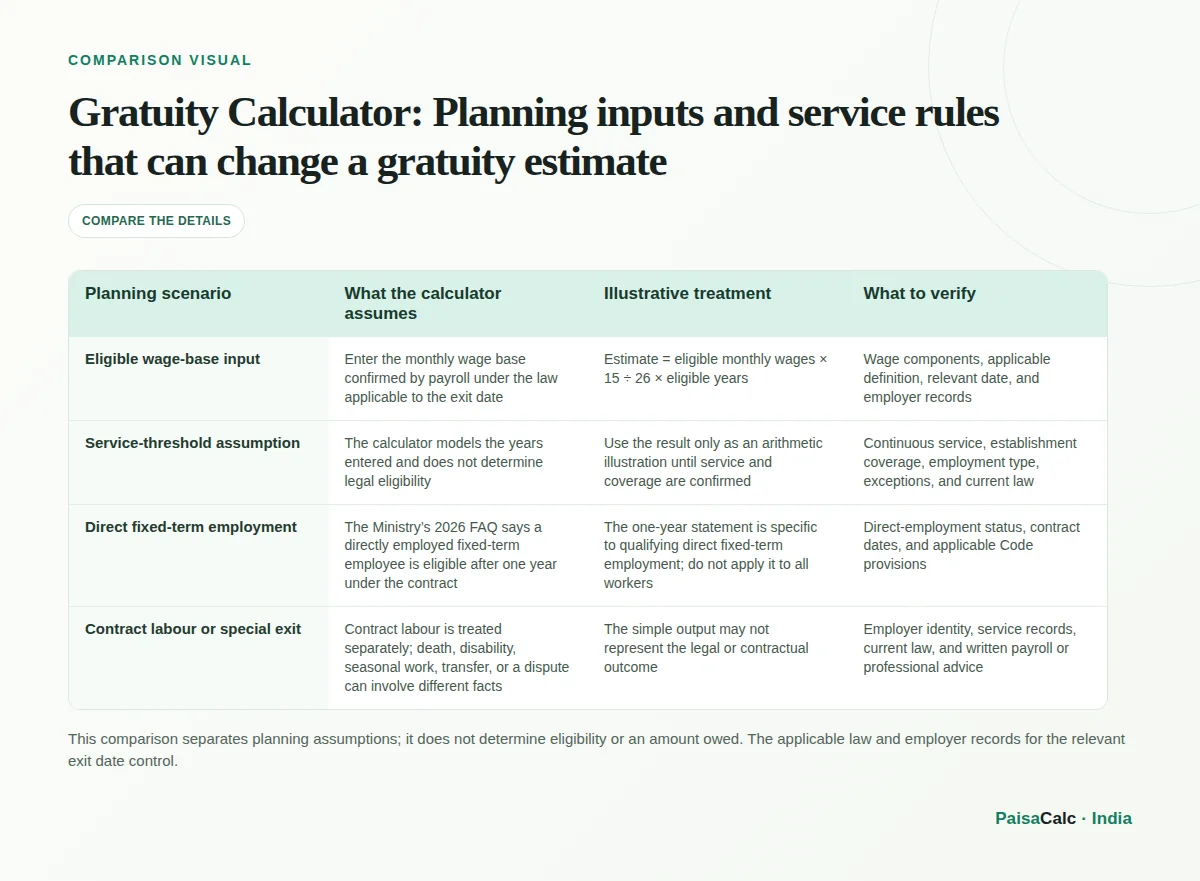
| Planning scenario | What the calculator assumes | Illustrative treatment | What to verify |
|---|---|---|---|
| Eligible wage-base input | Enter the monthly wage base confirmed by payroll under the law applicable to the exit date | Estimate = eligible monthly wages × 15 ÷ 26 × eligible years | Wage components, applicable definition, relevant date, and employer records |
| Service-threshold assumption | The calculator models the years entered and does not determine legal eligibility | Use the result only as an arithmetic illustration until service and coverage are confirmed | Continuous service, establishment coverage, employment type, exceptions, and current law |
| Direct fixed-term employment | The Ministry’s 2026 FAQ says a directly employed fixed-term employee is eligible after one year under the contract | The one-year statement is specific to qualifying direct fixed-term employment; do not apply it to all workers | Direct-employment status, contract dates, and applicable Code provisions |
| Contract labour or special exit | Contract labour is treated separately; death, disability, seasonal work, transfer, or a dispute can involve different facts | The simple output may not represent the legal or contractual outcome | Employer identity, service records, current law, and written payroll or professional advice |
This comparison separates planning assumptions; it does not determine eligibility or an amount owed. The applicable law and employer records for the relevant exit date control.
For an eligible monthly-rated case, the illustrative model is eligible monthly wages × 15/26 × eligible years. Apply the wage definition and service rule for the relevant exit date; Ministry guidance says the revised wage definition applies from 21 November 2025.
Enter the monthly eligible wage base confirmed by payroll under the law applicable to the exit date. For gratuity from 21 November 2025, Ministry guidance says the revised Labour Code definition applies; do not assume the correct input is always basic pay plus DA.
Not in every case. The Ministry’s 2026 FAQ says a directly employed fixed-term employee is eligible after one year under the contract; contract labour is treated separately, and other exceptions can apply. Confirm the employment type, service record, and applicable law.
No. It shows a gross illustrative formula result and does not apply a legal maximum. The applicable limit can depend on the relevant date, law, coverage, and facts, so confirm it with current official guidance and payroll.
Not necessarily. Tax exemption and taxable treatment depend on employee category, applicable provisions, limits, and the relevant year. The calculator estimates gross gratuity only and does not calculate tax or withholding.
Do not enter total CTC or take-home pay; use the eligible wage base identified under applicable law. From 21 November 2025, the revised Labour Code wage definition applies, so basic pay plus DA alone may not be the current statutory base.
This simple tool asks for completed years and does not adjudicate service fractions. Fractions can be treated under applicable rules and records, so use the joining and exit dates and ask payroll to explain its service-rounding convention.
Yes, as a rough planning figure. It can help you ask about service, salary base, coverage, and settlement timing, but resignation circumstances and the current law may affect eligibility, amount, tax, or forfeiture.
No. The selector is only a planning prompt. Actual coverage and eligibility depend on the establishment, employee category, service history, exit circumstances, applicable law, and employer records. Obtain a written payroll or professional review when material.
Differences may come from the employer-confirmed wage base, the exit date and wage definition, service dates or fractions, coverage, a statutory limit, rounding, forfeiture, special circumstances, or a more favourable company policy. Request a written breakdown and compare each assumption.
Use primary and provider references to verify current rules, rates, and product terms.
The 1972 Act provides historical statutory context for relevant earlier exits; do not rely on it alone for gratuity from 21 November 2025, when the Labour Code wage definition applies.
The Central Rules provide procedural context where applicable; verify the rules, notifications, and Code provisions governing the relevant exit date.
The Ministry states that the revised wage definition applies from 21 November 2025, explains one-year gratuity eligibility for qualifying directly employed fixed-term employees, and distinguishes contract labour; check the exact employment and exit facts.
Tax exemption treatment for retirement benefits, including gratuity, is separate from a gross gratuity estimate and depends on the applicable employee category, conditions and assessment-year rules.
TAKE A 30-SECOND BREAK
Three questions to help the key ideas stick.